


AleaSoft Energy Forecasting, November 11, 2026. COP31 places electrification and green industrialisation among its priorities. The abundant solar resource in southern Spain offers an opportunity to attract industrial investment and data centers. Seizing it requires competitive electricity 24 hours a day, grids, storage, hybridisation, PPAs tailored to consumption and long-term price forecasts.
Energy, a historical factor in industrial location
During the 19th century, the availability and cost of energy shaped Spain’s industrial development. Málaga, with the La Concepción blast furnaces in Marbella and the La Constancia factory, came to lead the Spanish iron and steel industry until the 1860s, but the cost of fuel eroded its competitiveness. Activity ended up concentrated in Asturias, with major coal deposits, and in the Basque Country, which combined iron ore, port infrastructure and access to British coal thanks to the return freights of the ships that exported ore. Although other economic and social factors also played a role, energy helped to shape an industrial map whose territorial differences still persist.
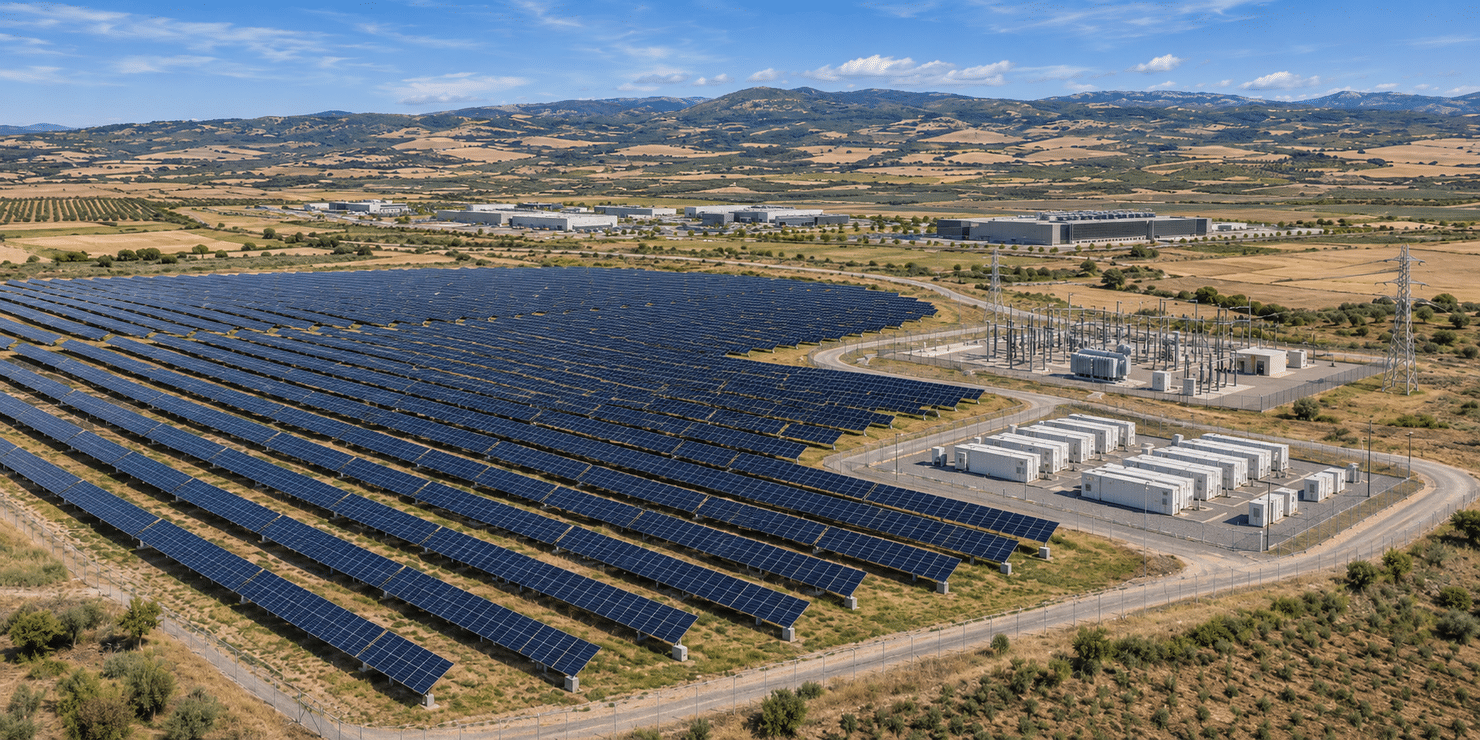
The development of renewable energy now opens up the possibility of changing that map. Andalusia, Extremadura, Castilla-La Mancha and the Region of Murcia have an exceptional solar resource in the European context. This advantage can favour the establishment of electro-intensive industry, data centers and renewable hydrogen projects, with new opportunities for investment, employment and economic development in these regions.
Solar energy can help to create new industrial hubs and reduce historical territorial imbalances, but this outcome will not be automatic. Producing low-cost renewable electricity is the starting point. The challenge is to turn it into a competitive and stable supply for industry, and to achieve this Spain needs to combine its natural resources with grids, storage, planning and a long-term vision.
Electrification, a priority of COP31
COP31, which is being held in Antalya, Türkiye, from November 9 to 20, includes clean energy, electrification and green industrialisation among the pillars of its action agenda. The conference presidency is promoting a voluntary commitment for electricity to reach 35% of global final energy consumption by 2035. The target reflects the growing weight of electricity in decarbonisation and in the competitiveness of industry.
From solar resource to competitive supply 24 hours a day
Having abundant solar energy does not guarantee a competitive electricity supply throughout the day. Photovoltaic production is concentrated in daylight hours and depends on the weather, while industrial facilities with continuous processes and data centers need a stable and predictable supply. Low prices in the hours of highest solar energy production do not ensure low costs at night or in periods of lower renewable generation.
For this reason, it is necessary to develop battery energy storage and to advance the hybridisation of renewable technologies. The combination of photovoltaics, wind and storage makes it possible to adapt generation to the consumption profile and reduce exposure to price volatility. PPA contracts will also need to evolve towards more stable supply profiles, complemented by market purchases when necessary.
Grids and access, a condition for investments to materialise
Connection capacity is another decisive factor. According to the demand access capacity map published by Red Eléctrica, data processing centres hold 6329 MW of access capacity granted on the transmission grid, 34% of the total granted to demand, although none of these facilities has yet entered into service. The planning of electricity grids and the execution of the projects will determine to what extent these investments materialise and where they are located.
Long-term forecasts to turn the solar resource into an industrial advantage
Industrial location decisions commit investments for decades, so long-term electricity market price forecasts are essential. Their hourly analysis makes it possible to assess future supply costs, design PPAs, estimate the revenues of renewable and storage facilities and compare configurations of hybrid projects. AleaGreen, the AleaSoft Energy Forecasting division specialising in long-term forecasts, provides hourly price curves with confidence bands for renewable project financing, asset valuation and PPA negotiation. Meanwhile, AleaStorage, which specialises in the optimisation of energy storage, analyses the revenues and risks of batteries and hybrid projects over their entire useful life.
Source: AleaSoft Energy Forecasting