


AleaSoft Energy Forecasting, November 18, 2026. Energy arbitrage is emerging as the main source of battery revenues in the long term, while balancing services will lose appeal as installed capacity increases. AleaSoft and AEPIBAL share this view and highlight the opportunities of photovoltaic hybridisation, even without charging from the grid, and the importance of contracted revenues for financing projects.
Balancing services will be cannibalised before arbitrage
The future profitability of batteries was the focus of the 71st webinar on energy markets that AleaSoft Energy Forecasting held on November 12, 2026. Oriol Saltó i Bauzà, Associate Partner at AleaSoft, analysed the revenue sources of energy storage together with Luis Marquina de Soto, president of the Spanish Business Association of Batteries and Energy Storage, AEPIBAL, who took part in the Spanish session.
Price volatility in electricity markets currently offers great opportunities for batteries. According to AleaSoft, the average intraday spread in the Spanish market remained at around €200/MWh in October. With one cycle per day, arbitrage opportunities over the last twelve months amount to around €88 000/MW for a two-hour battery and more than €162 000/MW for a four-hour battery. Balancing services, especially secondary band, also register attractive prices and, according to AEPIBAL, are currently the main source of revenue for storage.
However, they are small markets. Secondary band requirements are around 1.5 GW, while Spain has some 300 MW of batteries in service and more than 35 GW with access granted. AEPIBAL works with a central scenario of between 6 and 8 GW installed by 2030. As has already happened in the United Kingdom and Germany, these services will start to be cannibalised when battery capacity approaches that level, and Marquina explained that this process will be faster than the reduction in arbitrage revenues.
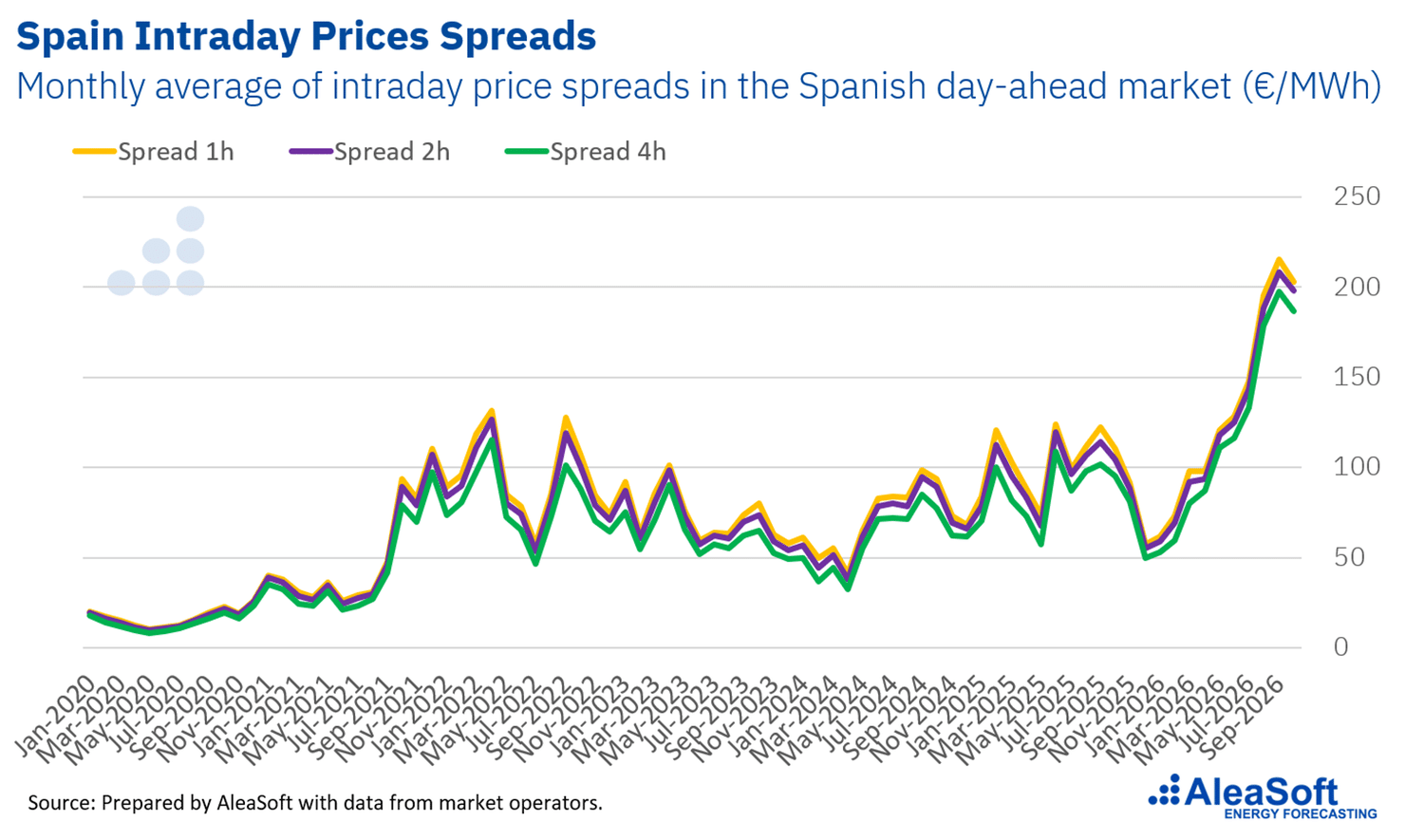
AleaSoft’s simulations point to arbitrage in the day-ahead market and the intraday market as the basis of battery revenues in the long term. Storage will also reduce spreads, but much more capacity will be needed for this effect to be noticeable in the day-ahead market, even more so if electricity demand grows at the same pace. AEPIBAL, for its part, projects that the spread will keep revenues above €80/MWh for at least ten years.
Photovoltaic hybridisation offers opportunities even without charging from the grid
Adding batteries to a photovoltaic plant makes it possible to shift part of the production from the lowest-price hours to the highest-value hours, which improves captured prices and reduces solar cannibalisation. Marquina highlighted that hybridisation is attractive even when the battery cannot be charged from the grid and depends only on the plant. These facilities take part in fewer balancing service opportunities than a stand‑alone battery, but the difference will not be substantial, while they can capture the spread. In addition, doing without grid charging simplifies the procedures and speeds up project development.
According to AEPIBAL’s figures, a photovoltaic plant without storage currently obtains a return of around 3.5%, which rises to 5.5%‑6.0% with a battery without grid charging and to 8.0%‑8.5% with grid charging, and can reach 10%‑11% with leverage. In any case, the design, battery duration, charging type and location will define the economic model of each plant.
Contracted revenues will facilitate battery financing
The future capacity market and tolling contracts can bring stability to revenues by reducing exposure to volatility and improving the visibility of cash flows. According to AEPIBAL, these long-term secured revenues will set the volume of debt of the projects. A tolling contract allows high levels of leverage, while greater merchant exposure reduces them. AleaSoft considers that the capacity market, as contracted revenue, will help the bankability of projects, although it will hardly be what makes an unprofitable project profitable.
Simulating battery operation to estimate profitability
The operation of a battery determines its revenues and its degradation, and degradation in turn conditions future operation. For this reason, its revenues cannot be estimated by multiplying the spread by the number of cycles. In the view of AleaSoft, the consistent way to estimate them is to simulate the hourly operation of the battery on long-term price forecasts.
AleaStorage, the AleaSoft Energy Forecasting division specialising in energy storage, carries out revenue analyses and financial models for stand‑alone and hybrid battery projects. In addition, during the webinar, AleaSoft presented AleaBattery, an online platform for the Spanish market that simulates 20 years of hourly operation on more than 1000 price simulations and calculates in minutes the revenues, degradation, IRR and debt coverage.
Source: AleaSoft Energy Forecasting