


AleaSoft Energy Forecasting, November 17, 2026. With a clearer regulatory framework, the difficulties facing battery storage in Spain are now concentrated in connection to distribution grids, safety-related permits and the financial sector’s understanding of the technology.
On November 12, AleaSoft Energy Forecasting held the 71st edition of its monthly webinar series, dedicated to European energy markets, batteries and hybridisation. The Spanish session featured, for the fourth time, Luis Marquina de Soto, president of the Spanish Business Association of Batteries and Energy Storage (AEPIBAL), which brings together 280 members from across the battery value chain.
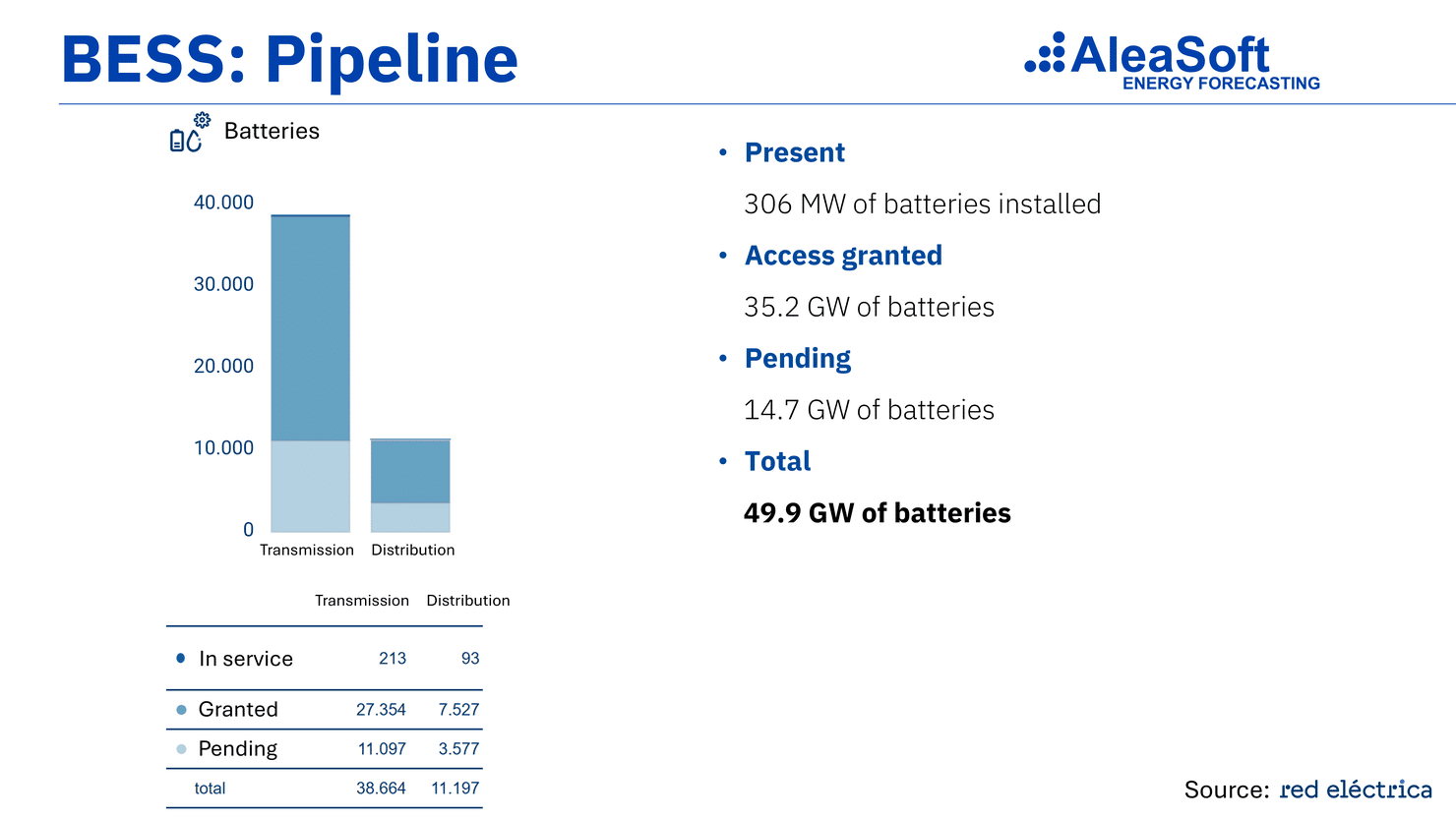
During the webinar, AleaSoft showed the gap between the interest in energy storage and the capacity currently in operation. According to the Red Eléctrica data analysed in the session, Spain has 306 MW of batteries in service, while projects with access granted total 35.2 GW and another 14.7 GW are awaiting a permit. Not all of them will end up being connected, but these figures give an idea of the development expected in the coming years.
From regulation to the construction of facilities
The president of AEPIBAL explained that the sector’s concerns have changed as the market has progressed. When there was no regulation, the focus was on obtaining it. Later, the work centred on the most uncertain aspects of the rules and on clarifying them at national, regional and municipal level and before the CNMC. Today the regulatory landscape is much clearer, and the difficulties have shifted to the construction of facilities and to the permits related to their safety.
Commissioning on distribution grids
One of the problems Marquina highlighted is commissioning. Connecting a storage plant to a distribution company’s grid is complex because there are still no protocols developed for this process. Added to this is the economic pressure, since every day without connection means revenue the project fails to obtain. AEPIBAL is working with representatives of the distribution companies and with Red Eléctrica to simplify these procedures and make them as fast as possible.
Common technical criteria for battery safety
Facility safety is the association’s other area of work. Part of the permitting process is being delayed in Civil Protection and environmental procedures because of aspects related to battery safety. In addition, during construction, developers need clear criteria on what they have been authorised to do. To meet both needs, AEPIBAL leads a UNE working group that is drafting a technical standard on how an energy storage facility should be designed, how it should define its risk map and how it should manage those risks. Standardising these requirements can facilitate permitting and give developers more certainty.
Understanding the risks to finance the projects
Marquina also referred to the training programmes that AEPIBAL has developed with financial institutions. Batteries are a complex technology, although fundamentally very standard, which needs its own maturing process, and their revenue models are more complex than those the financial sector has analysed so far. For this reason, lenders need in-house teams capable of understanding market risks, assessing them, mitigating them and, finally, deciding how to finance the projects.
For the president of AEPIBAL, batteries are now a necessary element of the market, although generation and electricity demand remain the factors that drive the system. Faster connection, consistent safety requirements and a better understanding of risks among lenders will be decisive for more projects in the permitting pipeline to enter operation.
Assessing revenues and risks: the role of AleaStorage
As explained in the webinar, the revenues of a battery cannot be estimated by multiplying the spread by the number of cycles. The cycles depend on the characteristics of the asset, its operating strategy and hourly price profiles. Operation in turn conditions degradation. For this reason, the only way to estimate revenues is to simulate the operation of the battery on hourly price simulations over its entire useful life.
AleaStorage, the AleaSoft Energy Forecasting division specialising in energy storage, provides revenue estimates for stand-alone batteries and for hybridisation projects with photovoltaics and wind in energy markets, balancing services and the capacity market. In addition, the platform AleaBattery, presented at the webinar, calculates in minutes the revenues, IRR, payback and debt coverage of a project from more than 1000 long-term hourly price simulations by AleaSoft and 20 years of simulated operation.
Source: AleaSoft Energy Forecasting