


AleaSoft Energy Forecasting, February 27, 2026. The beginning of 2026 has brought a decline in production from gas‑fired power plants compared to the same period last year, particularly during February. This article analyses the causes and immediate consequences of this evolution, as well as the signals it sends regarding the direction to be taken for long‑term decision‑making.
The decline in gas production in Spain
In the first weeks of 2026, generation from gas‑fired power plants in Spain has fallen by 2.4% compared to the same period last year, an average of 523 MWh per day less than in 2025. By contrast, at this time in 2025 the trend showed an 11% increase compared to 2024.
Renewable energy generation vs gas dependency
What causes gas‑fired generation to rise or fall? This is where the concept of the thermal gap comes into play. The thermal gap is defined as the difference between electricity demand and generation from renewable sources and nuclear power plants. In other words, it is the energy required by the grid that non‑CO₂‑emitting sources are unable to supply.
The thermal gap is covered by fossil fuels. In Spain, coal and other more polluting technologies have gradually been phased out and, in practical terms, only gas is now used.
For this reason, electricity generation through gas‑fired combined cycle plants is in constant competition with renewable sources. The principle is straightforward: the more energy a region or country can generate from renewable sources, the less it will depend on fossil fuels.
Renewable energy in Spain in 2026
Partly due to the significant storms at the start of the year (10 high‑impact storms according to AEMET), renewable energy generation has seen a notable increase. Wind energy production in particular has risen by 65% compared to 2025 and hydroelectric energy production has also increased by 7.5%, based on production data between January 1 and February 24.
It is true that weather conditions have driven this increase in renewable energy. Even so, the key long‑term factor is the capacity to make the most of both exceptional weather events, such as those experienced at the start of this year, and the day‑to‑day conditions of less unusual periods.
The current impact
One of the main consequences of the growth in renewable energy generation is a reduction in production from combined cycle gas turbines. This not only leads to lower CO₂ emissions but also directly affects electricity market prices.
Reducing dependence on gas also helps to lower prices. This fuel must be imported and, in the long term, reducing reliance on it can decouple electricity market prices from gas prices.
Long‑term objectives
One lesson to be drawn from the start of 2026 is that, although there is still ground to cover, progress is being made towards decarbonisation. Achieving lower prices, independence from fossil fuels and net‑zero emissions necessarily requires the promotion of renewable energy sources.
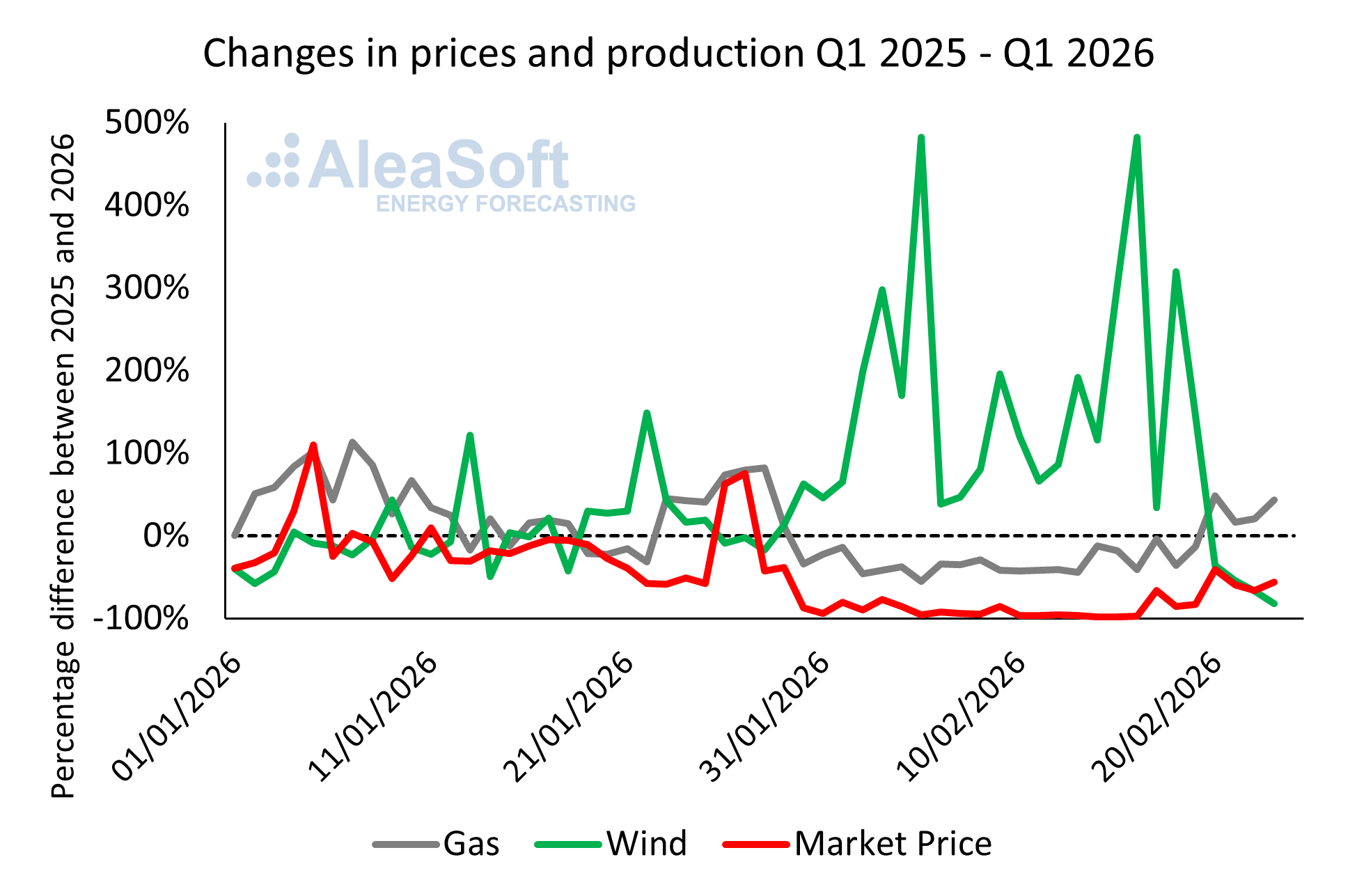 Source: Prepared by AleaSoft using data from ENTSO-e, Red Eléctrica and OMIE.
AleaSoft Energy Forecasting’s analysis and forecasts for renewable energy and storage projects
Through its AleaGreen division, AleaSoft Energy Forecasting provides long‑term forecasts, essential for the financing of renewable energy projects and the negotiation of PPA, asset valuation and the development of hedging strategies. Among the services offered by AleaGreen are production forecasts for different types of renewable energy plants, accompanied by the corresponding price forecasts, as well as forecasts of guarantees of origin.
In addition, the AleaWhite division provides up‑to‑date information on the energy sector through the Alea Energy DataBase platform. Alongside the latest figures, the platform offers data analysis and visualisation tools.
Source: AleaSoft Energy Forecasting.