


AleaSoft Energy Forecasting, August 11, 2026. The total solar eclipse of August 12 will cause a rapid and synchronised fall in photovoltaic production in Spain and other European countries. Beyond its exceptional nature, the phenomenon shows on a large scale an everyday challenge of solar generation. Market participants must anticipate sharp changes in production and manage their effects with accurate forecasts and flexible resources such as batteries.
An exceptional phenomenon that amplifies a well known challenge
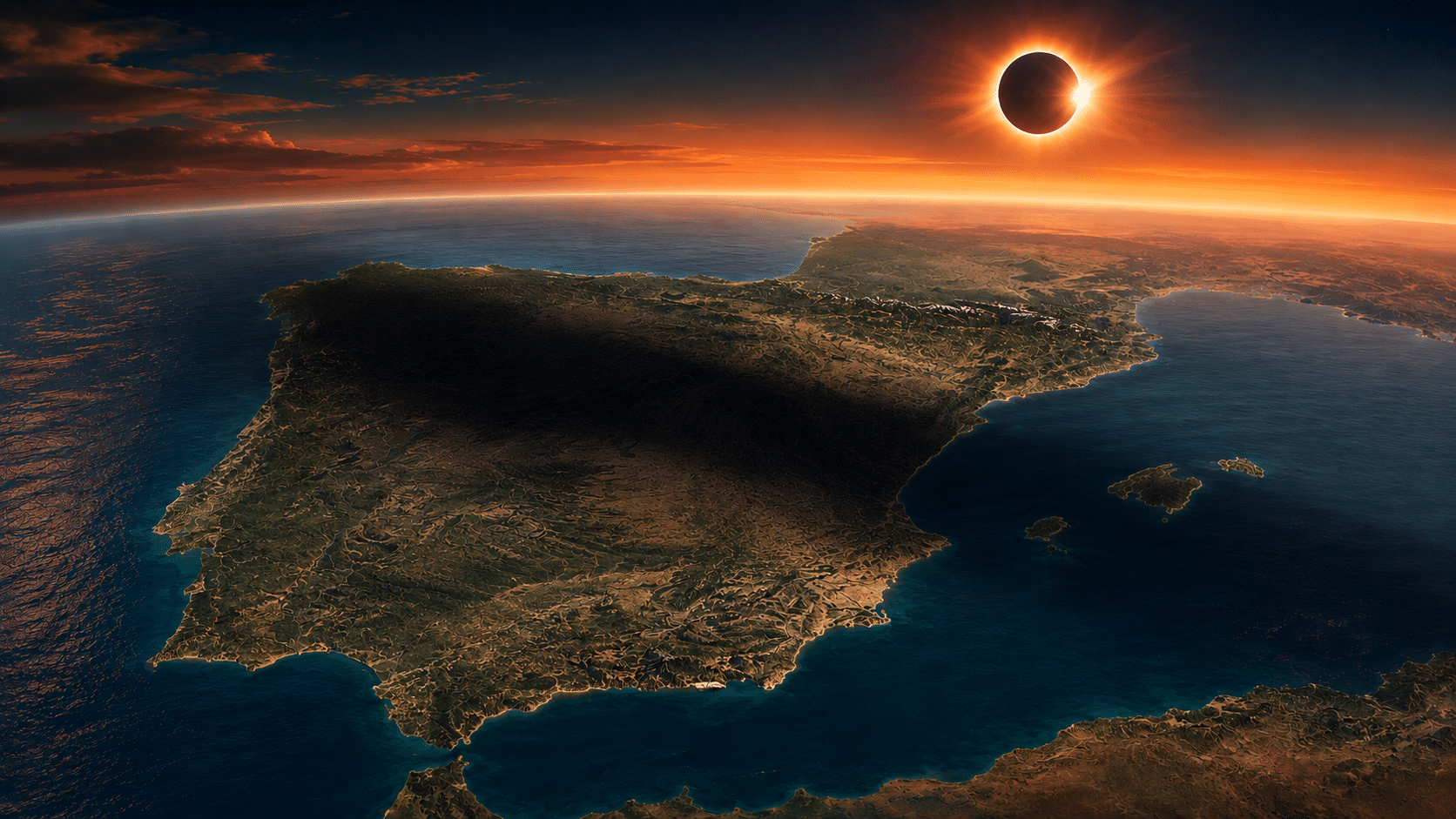
According to Red Eléctrica, the eclipse of August 12 may reduce photovoltaic production by up to 5 GW in Spain and by close to 9.7 GW in Europe. Spain currently has more than 30 GW of installed photovoltaic capacity, so the phenomenon will test the system’s ability to manage a rapid and widely synchronised production ramp.
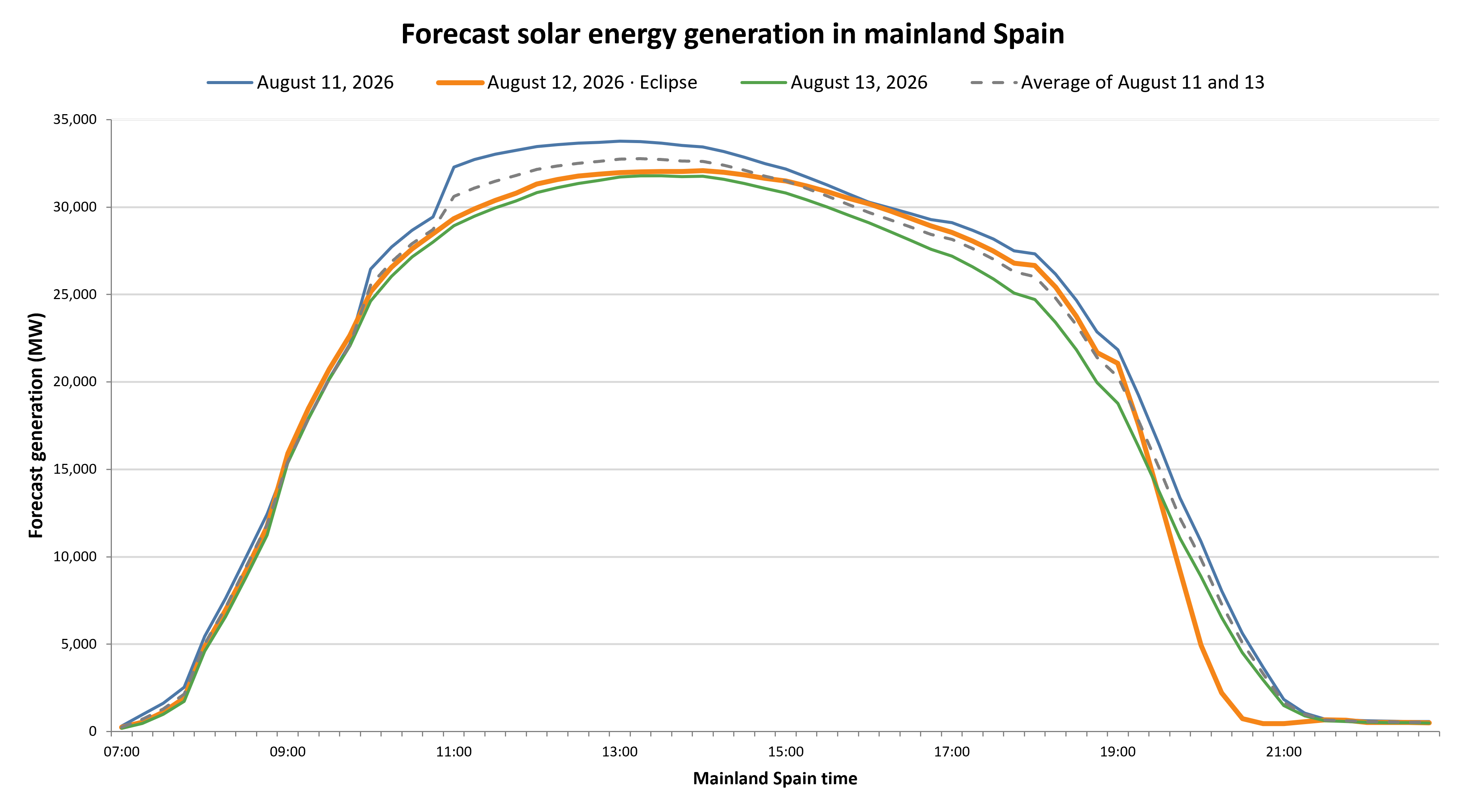 Source: Prepared by AleaSoft Energy Forecasting using data from E.SIOS.
The singularity of the eclipse lies not only in the magnitude of the fall, but also in the fact that it will affect a wide geographical area simultaneously. A cloud front can cause similar variations at local or regional level, although in a less synchronised way and, in many cases, harder to anticipate.
In both cases, the challenge is to correctly forecast how production will evolve. A fall in generation that market participants anticipate and incorporate into their scheduling does not have to turn into a deviation. The problem appears when actual production departs from the forecast production and forces them to correct positions or turn to the balancing services.
The eclipse offers an advantage over cloud cover. Market participants know its path and duration in advance. However, final photovoltaic production will also depend on the weather conditions at each moment, especially cloud cover and solar irradiation. Knowing about the eclipse therefore does not remove the need for updated production forecasts.
Batteries to manage the ramp and forecasts to anticipate it
Batteries and solar energy forecasts play complementary roles in this type of situation. Forecasts make it possible to anticipate how generation will evolve and batteries provide flexibility to respond to changes.
At a photovoltaic plant hybridised with energy storage, the operator can reserve a sufficient level of charge beforehand and discharge the battery when solar production falls. In this way, it can smooth the variation in the power delivered to the grid and reduce the difference between forecast production and actual production.
The same logic applies when a cloud front crosses a solar plant. The main difference is that the eclipse follows a perfectly known timetable, whereas cloud cover introduces far greater weather uncertainty.
A battery therefore does not remove the need to forecast. On the contrary, an accurate forecast allows its flexibility to be used to better effect. Short term forecasts make it possible to estimate the expected path of production and help the operator to decide how much energy to reserve and when it is best to charge or discharge the battery.
In the case of the eclipse of August 12, weather conditions may significantly modify its actual effect on photovoltaic production. Heavy cloud cover may mean that production is already reduced before the eclipse, while clear skies may make the ramp caused by the occultation of the Sun more visible. Updated production forecasts make it possible to incorporate both variables and adapt operation to the actual conditions.
Storage as a strategic element and the role of AleaStorage
AleaStorage, the division of AleaSoft Energy Forecasting specialising in energy storage, analyses the profitability, sizing and operating strategies of standalone batteries and hybridisation projects.
These analyses make it possible to estimate the revenue a battery can obtain in the energy markets and the balancing services, to study hybridisation with photovoltaic and wind plants and to assess different price and volatility scenarios. In this way, generators, developers and large consumers can define storage configurations adapted to the characteristics, needs and risk profile of each project.
Renewable energy forecasts complement these analyses in day to day operation. AleaSoft Energy Forecasting uses artificial intelligence techniques, statistical models and time series analysis to anticipate how production will evolve. This information makes it possible to update the scheduling of assets, manage deviations and make more efficient use of the flexibility available in batteries.
Combining strategic analysis, forecasts and storage makes it possible to move from a reactive response to production variations to anticipated risk management.
From a one off episode to structural risk management
The eclipse of August 12 will be over in a few hours, but the challenge it brings to light will remain present every day. Cloud cover, weather changes and other factors will continue to cause differences between expected renewable production and actual production.
The ability to anticipate those variations and to have flexible resources available will largely determine the ability of market participants to reduce deviations, control their costs and optimise the operation of their assets.
As the penetration of photovoltaic generation increases, so will the importance of coordinating forecasts and storage. Batteries provide response capacity, but forecasts indicate when and how to use that flexibility.
The eclipse is an exceptional and highly visible episode. However, the need it illustrates is structural. Anticipating production and having the capacity to respond to its variations will be increasingly important in order to integrate renewable generation efficiently and improve the profitability of projects.
Source: AleaSoft Energy Forecasting