


AleaSoft Energy Forecasting, November 4, 2026. The AleaSoft Energy Forum 27 brought together representatives from generation, large consumers, retail, consultancy and banking to analyse battery storage, its financing and the outlook for the energy sector in 2027. Price forecasts, probabilistic analysis and risk management are emerging as key to assessing the profitability and bankability of BESS projects.
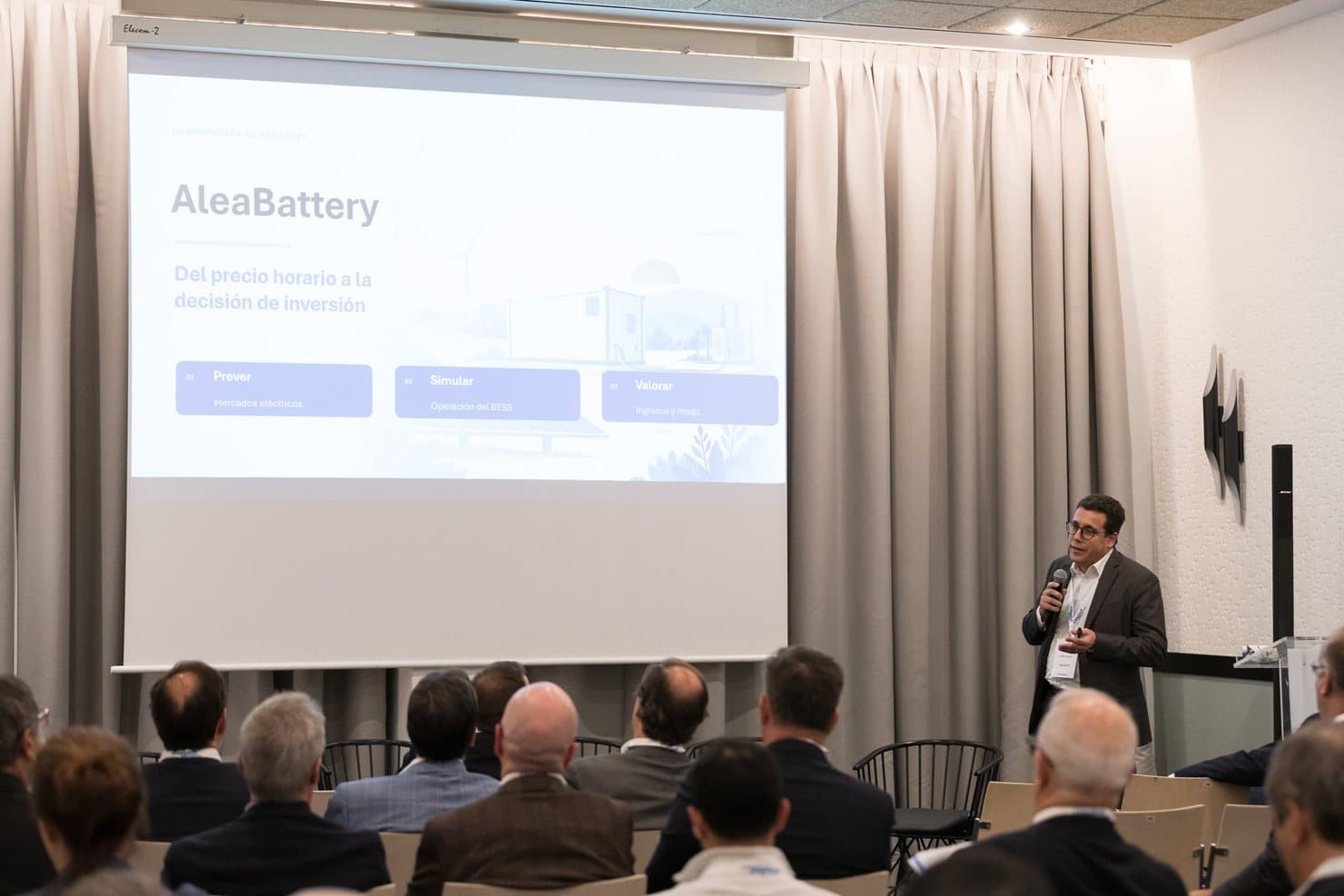 Presentation of AleaBattery at the AleaSoft Energy Forum 27.
The AleaSoft Energy Forum 27, held on October 29, 2026, addressed the challenges that the development of battery energy storage poses for revenue estimation, financing and risk management. The number 27 in its name has a double meaning. On the one hand, it marks the 27 years of AleaSoft Energy Forecasting, whose anniversary was celebrated with this event. On the other, it points to 2027, as the outlook for the energy sector for that year was also part of the programme.
An international scenario of high prices and large hourly spreads
In the opening session, Antonio Delgado Rigal, founder and CEO of AleaSoft Energy Forecasting, analysed the international context of energy markets. The prolongation of the war in Ukraine and of the conflict in Iran, whose duration has exceeded initial expectations, has put upward pressure on gas prices, with an impact on European electricity markets. The outlook for 2027 suggests that electricity prices could remain high, subject to uncertainty over how both conflicts evolve.
At the same time, the growth of renewable generation is changing hourly price profiles. Prices tend towards low levels in solar hours and can reach much higher values in hours with less renewable generation. These hourly spreads are the basis of the business of BESS systems, which store electricity when prices are low and return it to the system when prices are higher. New demand, especially from data centers, and the need for flexibility will add to this and give a growing role to the hybridisation of renewable plants with batteries.
Storage offers opportunities in different areas of the energy sector
The first panel of the forum, “BESS in different sectors: where the value lies”, moderated by Raúl García Posada of ASEALEN, featured Daniel Rodríguez del Río of Aena Aeropuertos, Alezeia González García of FORTIA Energía, Pedro González González of AEGE and Julio Nieto of ENGIE. The debate addressed the use of batteries to optimise energy management in generation and consumption, with particular attention to self-consumption.
Beyond its technical characteristics, the value of a battery depends on the needs of each project, its integration with existing facilities and the opportunities offered by electricity markets. The participants pointed out how complex it is for large consumers to decide on an investment in energy storage when it is not part of their core business, since choosing between battery configurations and durations requires assessing their applications, revenues and profitability.
Financing and the capacity market, key to the development of BESS
The second panel, “Financing and bankability of BESS projects: economic and regulatory keys”, moderated by Antonio Barrero Fernández of Energías Renovables, brought together Antonio Hernández García of EY, Rubén Martínez Cartanyà of Banc Sabadell, Tomás García of JLL, Oscar Barrero of PwC España and Jaume Pujol of Deloitte. The contributions reflected growing interest in storage and a favourable view for the coming years, with differences regarding the pace at which the market will evolve. Financing remains one of the main challenges, as uncertainty over future revenues and the need to demonstrate long-term economic viability condition investment decisions and access to credit.
The future capacity market in Spain took up a large part of the debate because of its possible contribution to project revenues and bankability. The issues raised included the reserve price, the firmness coefficients, the time horizon of the contracts and the volume of demand that will take part in the mechanism, among others. The discussion also covered pumped storage, a technology needed to provide flexibility to the system, but whose projects face significant development complexities.
The speakers also warned of uncertainty over price spreads as installed capacity grows, with hours of zero or negative prices that will continue to appear. The bankability of BESS projects will depend on the ability to demonstrate the soundness of their expected revenues, assess the risks and rely on a regulatory framework that provides certainty for investments.
AleaBattery: from the hourly price to the investment decision
Oriol Saltó i Bauzà, Associate Partner at AleaSoft Energy Forecasting, presented AleaBattery, the company’s new online platform for estimating the revenues and profitability of battery storage projects, both stand-alone and hybrid with renewable plants. The central message was that the profitability of a battery cannot be estimated with an average price spread and a fixed number of daily cycles. Two days with a similar spread can offer very different operating opportunities, because the hourly profile determines when it is best to charge and discharge, how many cycles are performed and how degradation evolves, which in turn conditions the capacity available in the following days.
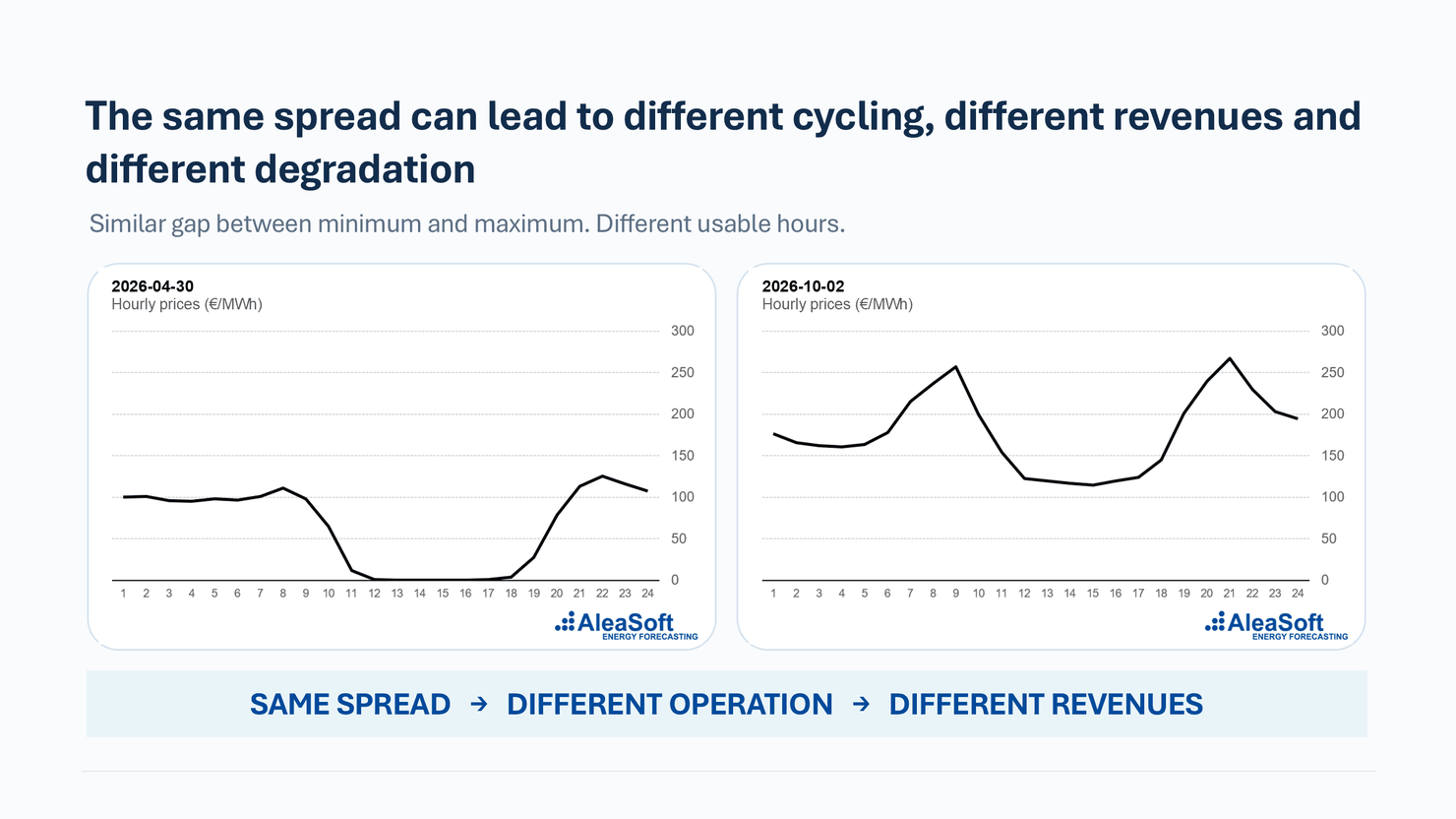 Source: AleaSoft Energy Forecasting
AleaBattery uses AleaSoft’s long-term hourly forecasts, with more than 1000 price trajectories and a horizon of up to 30 years, to simulate hour by hour the operation and degradation of the batteries over the entire useful life of the project. The platform estimates revenues from arbitrage and balancing services, compares configurations and sizing, and analyses profitability and the capacity to service debt. By incorporating multiple price scenarios, it makes it possible to measure revenue uncertainty through probabilistic metrics, such as the P10-P90 range. AleaBattery is commercially available, for the time being, for the Spanish market.
Outlook for 2027: more moderate returns and the need to manage risks
In the conclusions of the forum, Antonio Delgado Rigal presented AleaSoft’s view of the energy sector in 2027. The growth of renewables and the need for flexibility will continue to drive storage, and the combination of photovoltaic energy and batteries represents one of the main opportunities for the electricity system in the coming years. According to AleaSoft’s studies, there are profitable investment opportunities in BESS projects, although returns will tend to be more moderate than those of the first projects, because competition between batteries will reduce part of the initial arbitrage opportunities. For this reason, the assessment of these projects must consider their long-term evolution, beyond current market conditions.
Antonio Delgado Rigal also stressed the importance of using realistic price forecasts. Delgado Rigal recalled the consequences for the photovoltaic sector of some overly optimistic forecasts of long-term prices and captured prices that were used a few years ago to value solar projects. In the case of batteries, estimating an expected return is not enough. It is necessary to know the distribution of possible revenues, assess unfavourable scenarios and analyse their impact on cash flows and the capacity to service debt. Risk management and hedging are essential to reduce exposure to market volatility and provide financial stability for investments.
Finally, Delgado Rigal announced that AleaSoft is working on new solutions to optimise short-term operating decisions and to analyse the risk exposure of generation, consumption, PPA and storage portfolios in the mid-term.
The future of storage depends on sound investments and reliable forecasts
Batteries increase the flexibility of the electricity system and facilitate the integration of renewable energy, but their growth must be based on well-founded investment decisions. Financing, the regulatory framework and the availability of analysis tools will be decisive for BESS projects to consolidate as viable, profitable and financeable long-term investments.
Source: AleaSoft Energy Forecasting