


AleaSoft Energy Forecasting, March 4, 2026. The evolution of electricity markets is reflected not only in hourly prices but also in the internal dynamics of the scheduling of generation units. In an environment characterised by greater volatility, increasing renewable energy penetration and continuous adjustments between markets, the difference between the Provisional Viable Daily Program (PDVP for its acronym in Spanish) and the Final Continuous Hourly Program (PHFC for its acronym in Spanish) becomes a relevant indicator of strategic behaviour. The analysis of data for the period 2023 to 2025 for a solar thermal power plant makes it possible to observe how the initial scheduling from the day‑ahead market evolves after intraday trading, revealing adjustment patterns that provide valuable information about operational flexibility and economic optimisation.
In electricity market analysis, attention is usually focused on prices and actual production, but there is another dimension that is equally revealing: the evolution of scheduling between the Provisional Viable Daily Program (PDVP for its acronym in Spanish) and the Final Continuous Hourly Program (PHFC for its acronym in Spanish). Beyond a purely numerical comparison, the contrast between the two schedules allows us to observe how a generating plant adjusts its position after the day‑ahead market and how it uses the intraday markets as an optimisation tool in an increasingly dynamic environment.
The PDVP is the schedule resulting from the day‑ahead market once bids have been matched, bilateral contracts incorporated and the first technical constraints resolved by the system operator. It constitutes the operational reference following the day‑ahead market and reflects the energy scheduled before the intraday markets are traded. It is not the actual production nor the final settlement, but rather the first viable schedule of the day from the perspective of the market and the initial operation.
The PHFC is the schedule resulting after the intraday auctions and trading in the continuous intraday market. It represents the final market schedule before balancing services and real‑time operation. It does not correspond to the actual production either, but it does constitute the final consolidated position after the entire trading process in the wholesale markets.
Comparing the two schedules allows us to go beyond the marginal price and open a complementary window onto the functioning of the system. Analysing their difference helps to understand how positions are adjusted before actual operation, identify seasonal optimisation patterns and quantify the intensity with which the intraday market is used. Ultimately, it provides an indirect but robust measure of strategic market behaviour and effective operational flexibility.
The structural signal of the hourly profile and its seasonality
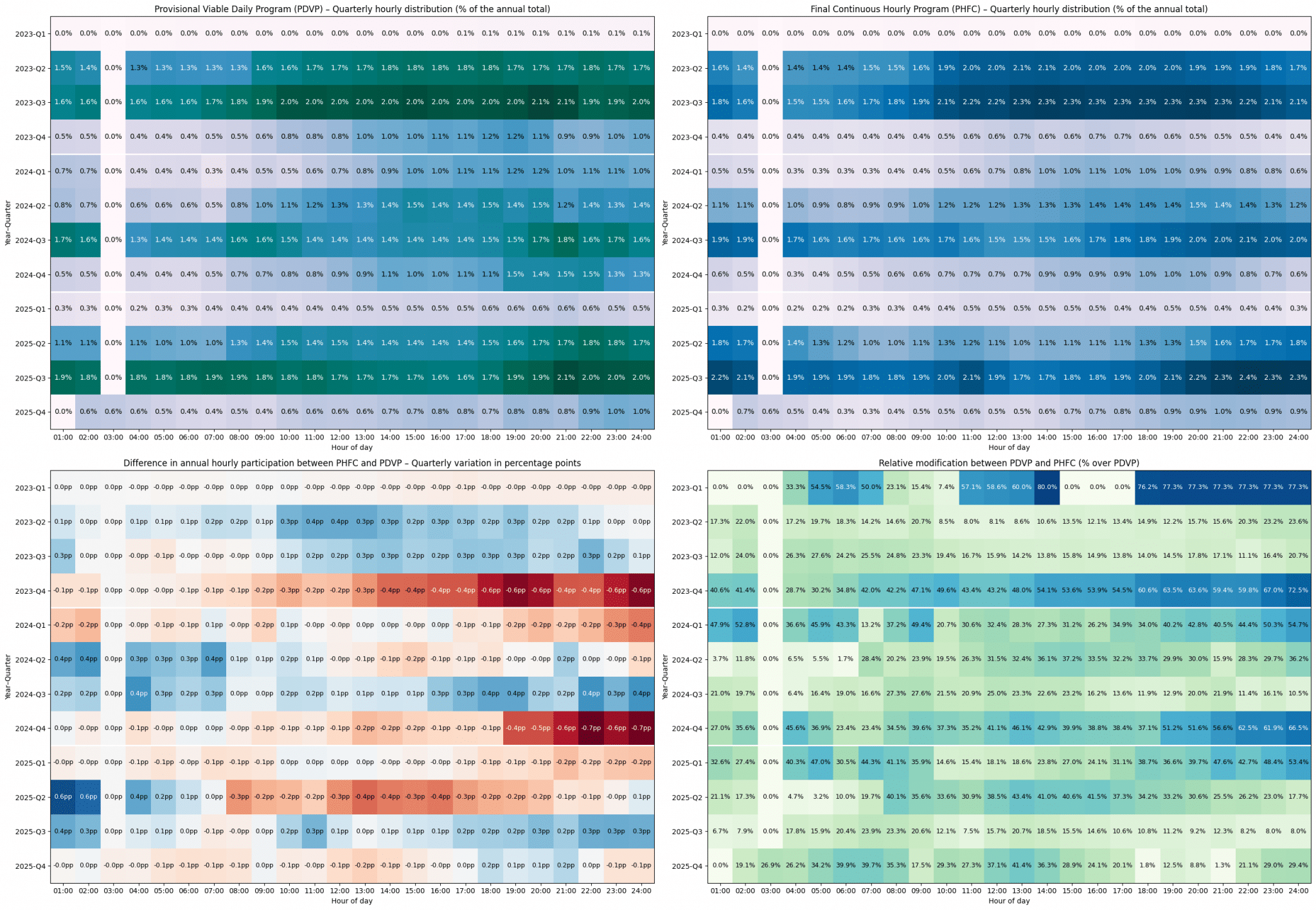
In the upper part of the figure, the hourly distribution of the scheduled energy of the solar thermal power plant is shown for each hour of the day, expressed as a percentage of the annual total in PDVP and PHFC and broken down by quarters for the period 2023‑2025. The results show that the hourly structure of the PHFC is not an exact replica of the PDVP. Although they share a common basis, systematic shifts in participation appear between certain time slots that are repeated throughout the years included in the analysis. In some quarters the central and evening hours are reinforced in the final schedule, associated with intraday rescheduling processes driven by updates to operating conditions and the available resource.
The generation of a solar thermal power plant depends primarily on the solar resource and this is the main pattern observed, both throughout the day and throughout the year. However, solar thermal power plants have a certain capacity for thermal storage, and this capacity represents an advantage as it provides some ability to manage that reserve strategically.
 Source: Prepared by AleaSoft using data from OMIE.
Changes and adjustments between PDVP and PHFC
The analysis of the differences in the lower part of the figure, expressed in percentage points and in relative values, shows a much clearer pattern than might be apparent at first glance.
The most significant changes are concentrated in the first and last quarters of each year. In several of these periods the relative adjustment exceeds 40% and even reaches values close to 80% in certain hours. This level of reconfiguration implies that a very significant part of the programme initially matched in the day‑ahead market is subsequently revised in the intraday market. These are not small marginal adjustments but a substantial reorganisation of the hourly profile.
In contrast, in the second and third quarters of the year, the relative change tends to be more moderate and stable. Although there are still significant adjustments, the average intensity is lower than that observed in winter and at the end of the year. This behaviour is consistent with the very nature of solar thermal energy. In the middle quarters of the year, characterised by higher irradiation and generally more stable weather conditions, the resource is more predictable and the scheduling defined in the day‑ahead market requires fewer subsequent corrections. In contrast, in the first and fourth quarters, lower solar availability, greater atmospheric variability and fewer hours of daylight increase operational uncertainty. In this context, intraday markets take on a more active role as a tool for adjustment and optimisation, which translates into much more pronounced modification percentages. The comparison between PDVP and PHFC not only reveals technical differences in scheduling, but also strategic adaptation to the seasonality of the resource and the degree of uncertainty associated with each period of the year.
Prospects for energy markets in Europe. Spring 2026
The 64th monthly webinar organised by AleaSoft Energy Forecasting will take place on March 12, 2026, at 10:00 CET, and will be dedicated to analysing the recent evolution of European energy markets, their prospects for the spring and the main developments that will influence the sector throughout 2026. During the session, the most relevant regulatory changes will be examined, as well as the increasingly decisive role of energy storage and capacity markets in an electricity system characterised by greater renewable energy penetration and growing price volatility. In this context, AleaStorage will present its advanced solutions for optimisation, revenue analysis and the structuring of storage projects and hybrid systems with renewable energy, aimed at maximising the value and profitability of assets.
The event will once again feature the participation of experts from EY, who will share their experience in regulation, storage and renewable energy project financing, PPA, self‑consumption and the valuation of energy assets and portfolios, thereby complementing AleaSoft’s market analysis. The webinar continues to consolidate its position as a reference forum for understanding the trends transforming European energy markets and the growing strategic value of flexibility within the electricity system.
Source: AleaSoft Energy Forecasting.