


AleaSoft Energy Forecasting, November 28, 2025. The global digital transformation is elevating the role of Data Centers as critical infrastructure for the economy and the future of energy consumption. In this context, Spain faces a strategic opportunity: to harness its energy strengths, its growing international connectivity and its geographical position to attract new investments and establish itself as one of Europe’s main digital hubs. However, to realise this potential, it will be essential to address the regulatory, energy‑related and planning challenges associated with the deployment of this type of infrastructure.
Data Centers are set to become a strategic component of the digital economy, and Spain has a unique opportunity to attract these investments and consolidate its position as a hub for digital infrastructure in Europe.
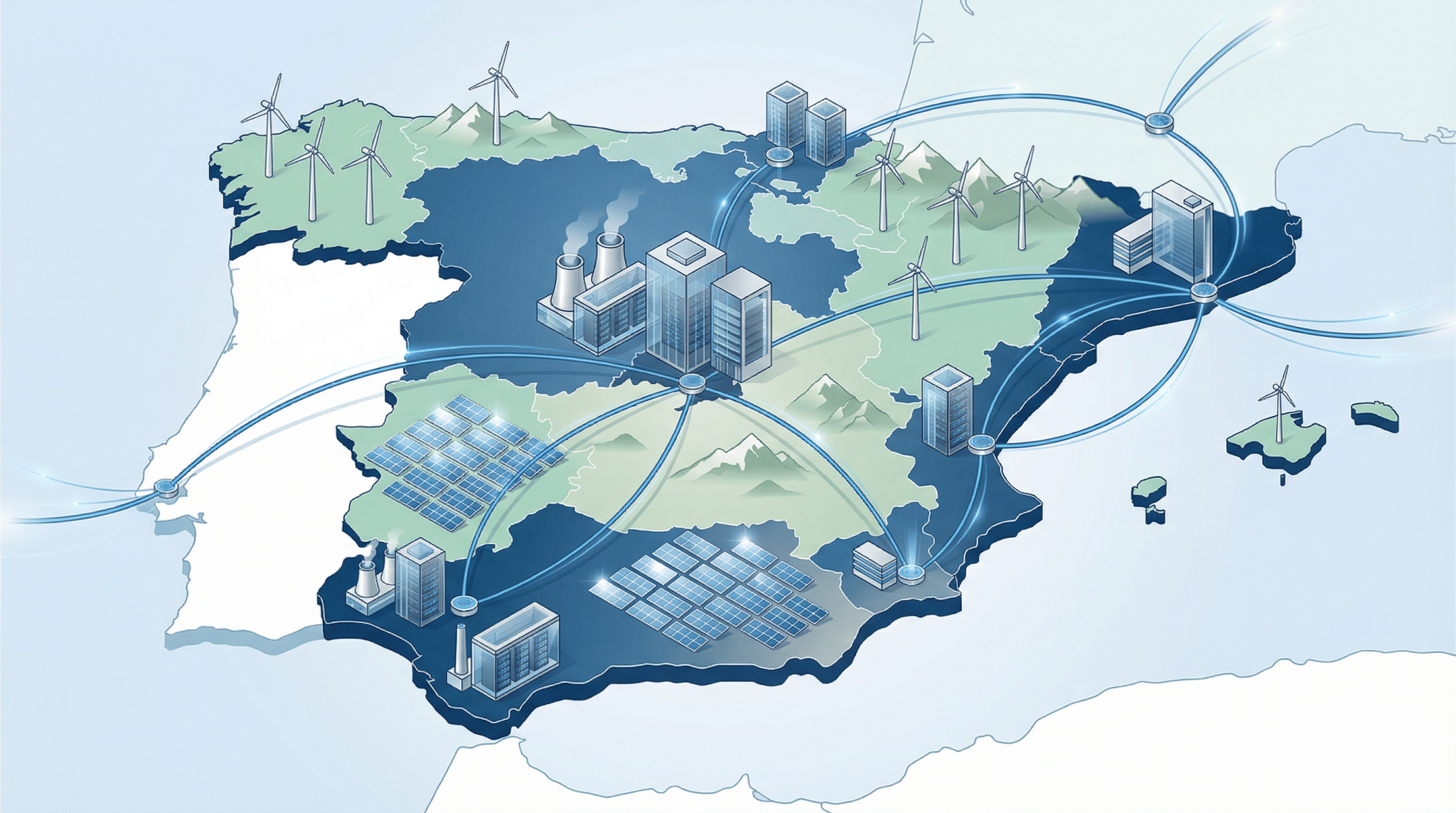
Energy consumption based on renewable energy
Data Centers are major consumers of clean energy. At a time when electricity demand is not growing at the expected rate, their deployment can be a key element to stimulate consumption, reduce renewable energy curtailments and mitigate the emergence of zero or negative prices in the electricity market, while also encouraging new investments in renewable capacity. Promoting their development is not only strategic for attracting digital industry, but also for facilitating the integration of renewable energy and improving the overall efficiency of the system.
Challenges for Data Centers
To unlock this potential, it is necessary to address the challenges currently conditioning their deployment. Among the key issues is the need to adapt the sector to the new European regulatory framework, which sets stricter environmental, efficiency and transparency requirements. The forthcoming regulation will require projects to justify their socioeconomic contribution and water use, optimise their energy performance and reuse waste heat in large‑scale facilities. Regulatory clarity will be essential for planning long‑term investments.
Another critical point is the connection and integration of Data Centers into the electricity grids. Last September, capacity maps for demand were published, confirming that more than 80% of grid nodes are saturated and cannot accept further electricity demand connections.
In addition, a very significant number of connection requests have not yet been approved, highlighting the urgent need to reinforce transmission and distribution infrastructure, increase investment in modernisation and move forward with the planning scheduled for the coming years. Defining specific processes for large consumers such as Data Centers and establishing detailed criteria to regulate both firm and flexible demand will also be essential.
Their participation in electricity markets and operation services will also be decisive. Integrating these facilities into flexibility mechanisms or future capacity markets requires updating current criteria and reviewing system operating procedures, especially following the measures discussed in the aftermath of the blackout. Progress in this area will enable these centres to contribute more actively to the security and stability of the electricity system.
Further challenges include the need to streamline administrative and environmental procedures. Processing must become more efficient, especially for strategic or highly advanced projects, through specific mechanisms that prioritise and accelerate their assessment. Other fundamental elements also play a role: initiatives to contain energy costs for intensive consumers, the review of grid remuneration mechanisms, the promotion of anticipatory investment and the development of regulatory sandboxes that facilitate reducing curtailment, demand aggregation and greater integration of renewable energy.
Ensuring competitive and predictable energy costs is crucial. Data Centers operate in a global environment and energy represents a substantial share of their costs. Spain has a significant advantage thanks to the high penetration of renewable energy and competitive prices in solar and wind PPA, although consolidating this position requires strengthening grids and maintaining stable market signals.
Spain as a key location for Data Center installation
Despite some discrepancies depending on the source and on how Data Centers are classified, it is estimated that Spain has around 200 data processing centres with an installed capacity in the range of 200 MW to 350 MW, a figure that could rise to 730 MW by 2026.
In this context, Spain has a set of strengths that position it favourably to attract Data Center installations. Firstly, it has exceptional renewable resources, thanks to high levels of solar and wind energy production that facilitate decarbonisation and improve energy competitiveness. It also benefits from a high level of security of supply, supported by a robust electricity infrastructure, expanding interconnection capacity and a diversified energy mix that ensures operational stability.
Added to this is the increasing arrival of transatlantic submarine cables, which directly connect the country with America and reinforce its role as a gateway for intercontinental data traffic. Spain also stands out for its highly developed fibre‑optic network, offering high capacity, low latency and great reliability—essential attributes for next‑generation Data Centers. Finally, its strategic location (close to Central Europe, with access to Africa and rapidly expanding international connectivity) consolidates the country as an emerging digital node.
AleaSoft Energy Forecasting as the best partner for Data Center projects
Aligning Data Center development with the energy transition will stimulate innovation, employment, industry and new opportunities in an increasingly digitalised and electrified context. AleaSoft Energy Forecasting is the strategic partner for the development of this industry, providing analyses and reports across multiple forecasting horizons to help Data Centers not only comply with current regulation but also find the most efficient ways to manage their resources. AleaSoft produces simulations of all possible energy‑consumption scenarios, considering direct consumption from the grid or the incorporation of elements that minimise costs, such as renewable energy generators or energy storage systems. These additional elements help Data Centers to optimise their energy consumption and can even create new business opportunities. AleaSoft’s extensive experience in the development and application of Artificial Intelligence models, backed by a highly qualified research team, ensures robust and consistent forecasts. In this way, the transition towards a future that drives technological advances using renewable energies as an engine can be carried out in the most efficient way possible.
Source: AleaSoft Energy Forecasting.