


AleaSoft Energy Forecasting, February 20, 2026. The growing penetration of renewable energies is transforming the temporal structure of electricity markets, increasing hourly variability and modifying system operating patterns. In this new environment, energy storage technologies, and pumped storage plants in particular, play an essential role by allowing energy to be shifted from periods of lower prices to hours of higher economic value. The analysis of matched trades in the day‑ahead market shows how these facilities not only provide operational stability but also capture economic value by efficiently managing temporal price differences.
Analysis of operations in the day‑ahead market
Using matched trades in the day‑ahead market between 2020 and 2025, it is possible to determine the operational and economic behaviour of a pumped storage plant, using the energy exchanged by that plant in the mainland electricity system and the hourly market prices. Even when limited to the day‑ahead market, these data make it possible to reconstruct the fundamental operating patterns of large‑scale energy storage and its interaction with price formation.
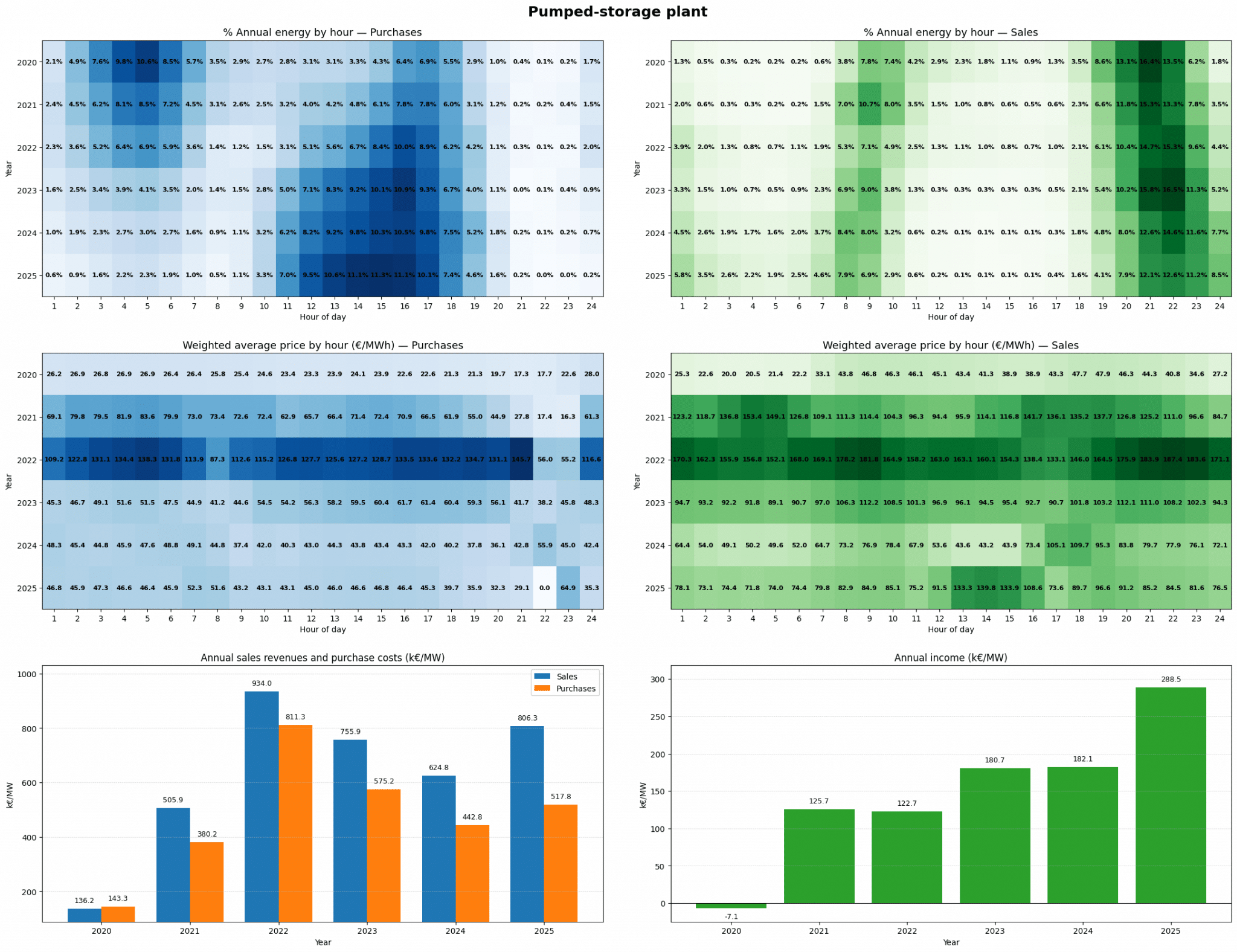
The following image summarises the plant’s operating behaviour through three key dimensions: the hourly distribution of energy actually exchanged, the hourly weighted average prices obtained from its matched purchase and sale transactions in the day‑ahead market, and the resulting annual net income from the difference between sales revenues and purchase costs of the installation, offering an integrated view of the value flexibility brings to the electricity system.
 Source: Prepared by AleaSoft using data from OMIE.
Hourly distribution of energy purchased and sold by the pumped storage plant
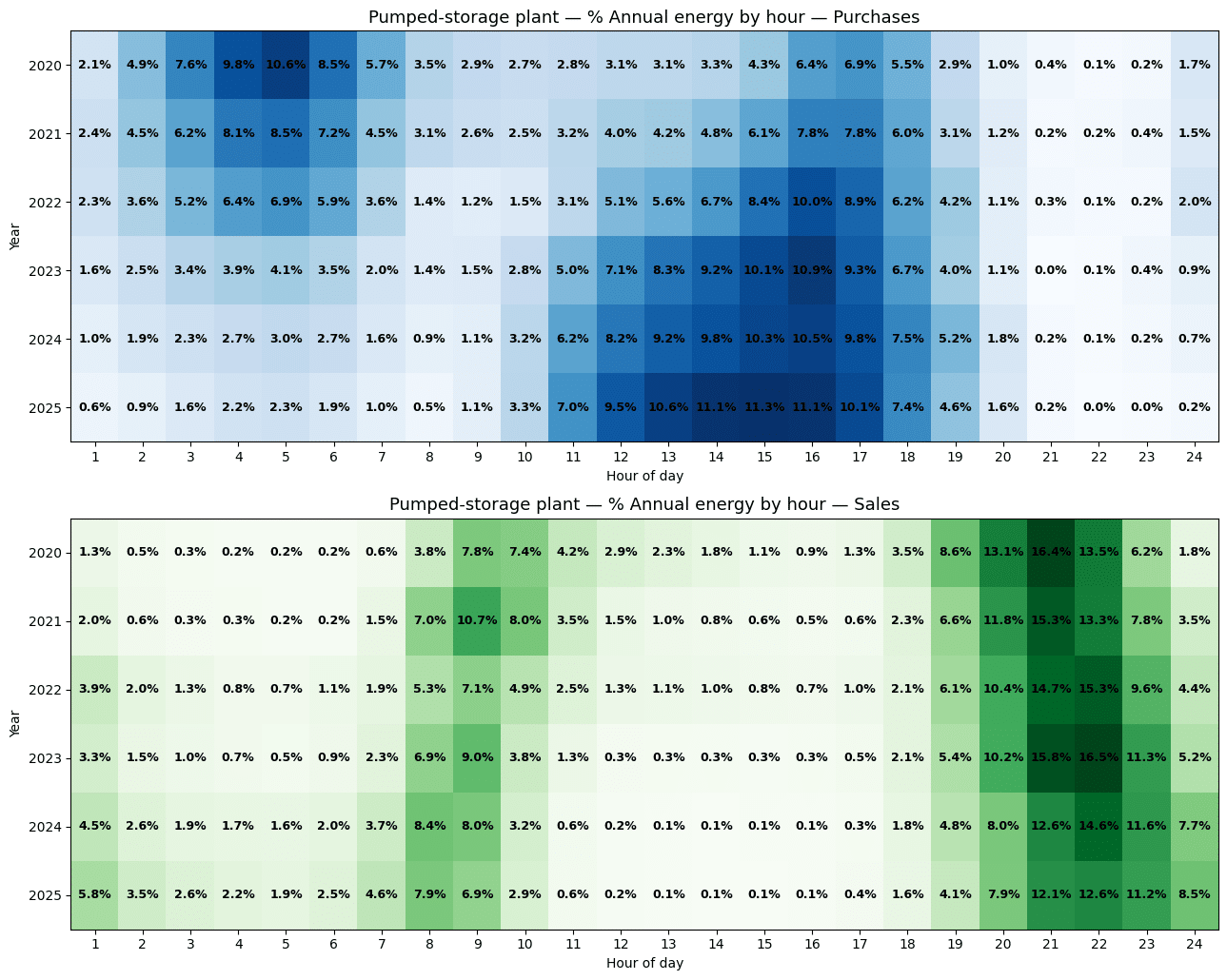
The percentage of annual energy by hour shows how the total volume of energy the plant buys and sells is distributed throughout the day, considering matched bids in the day‑ahead market. Each value indicates what fraction of the annual total is concentrated in a specific hour, making it possible to identify the operating windows in which the plant performs most of its charging and discharging cycles. This metric does not reflect prices, but actual physical behaviour in terms of energy moved.
For purchases, in 2020 and 2021 the highest concentration of energy occurs during the early morning, when lower demand pushes prices down, reaching approximately 10.6% at 05:00 in 2020 and 8.5% at the same hour in 2021. From 2022 onwards a clear shift is observed towards midday and early afternoon hours: the maximum is around 16:00 with 10.0% in 2022, 10.9% in 2023 and at 15:00 with 10.5% in 2024. In 2025 this concentration is even more marked, reaching approximately 11.3% around 15:00. This pattern shows a progressive focus of charging in central daytime hours, where prices have been cannibalised by the rapid increase in solar photovoltaic energy.
Regarding sales, the concentration is much more stable and clearly oriented towards the end of the day, with the highest percentages of annual energy recurrently between 21:00 and 22:00 and typical values in the range of 13% to 17% of the annual total. Although there are secondary volumes at other times, the main discharge is consistently concentrated in the evening and night period, coinciding with peak demand and prices.
The plant stores energy when the system has abundance, either in the early morning due to low demand or during the middle of the day thanks to solar photovoltaic energy, and returns it to the market when it is most needed in the evening and night, with higher demand and lower renewable energy production. This clearly demonstrates how storage manages energy.
 Source: Prepared by AleaSoft using data from OMIE.
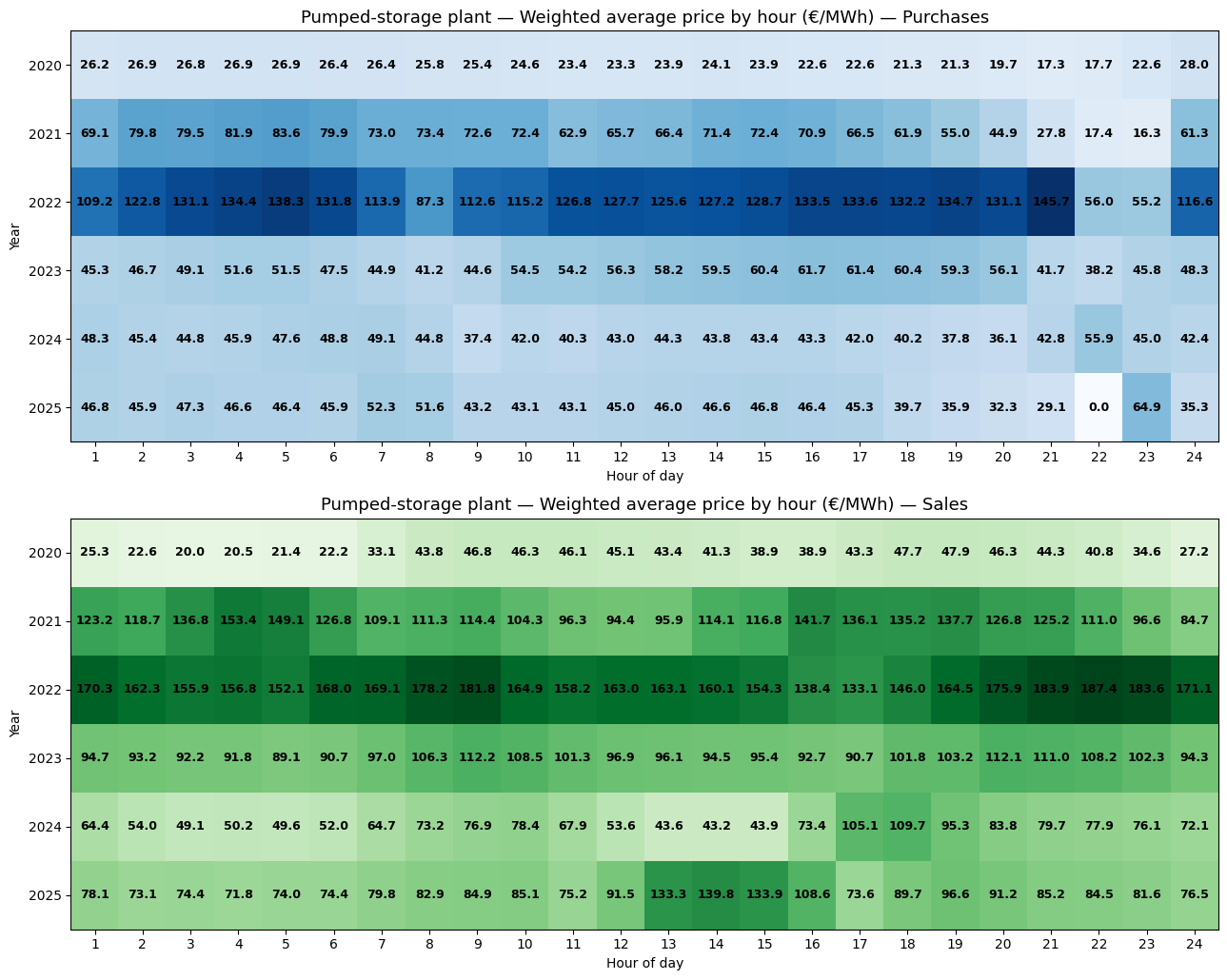
The following image shows the average price at which energy was bought or sold in each hour of the day.
 Fuente: Elaborado por AleaSoft con datos de OMIE.
Annual net income of the pumped storage plant from its matched day‑ahead market transactions
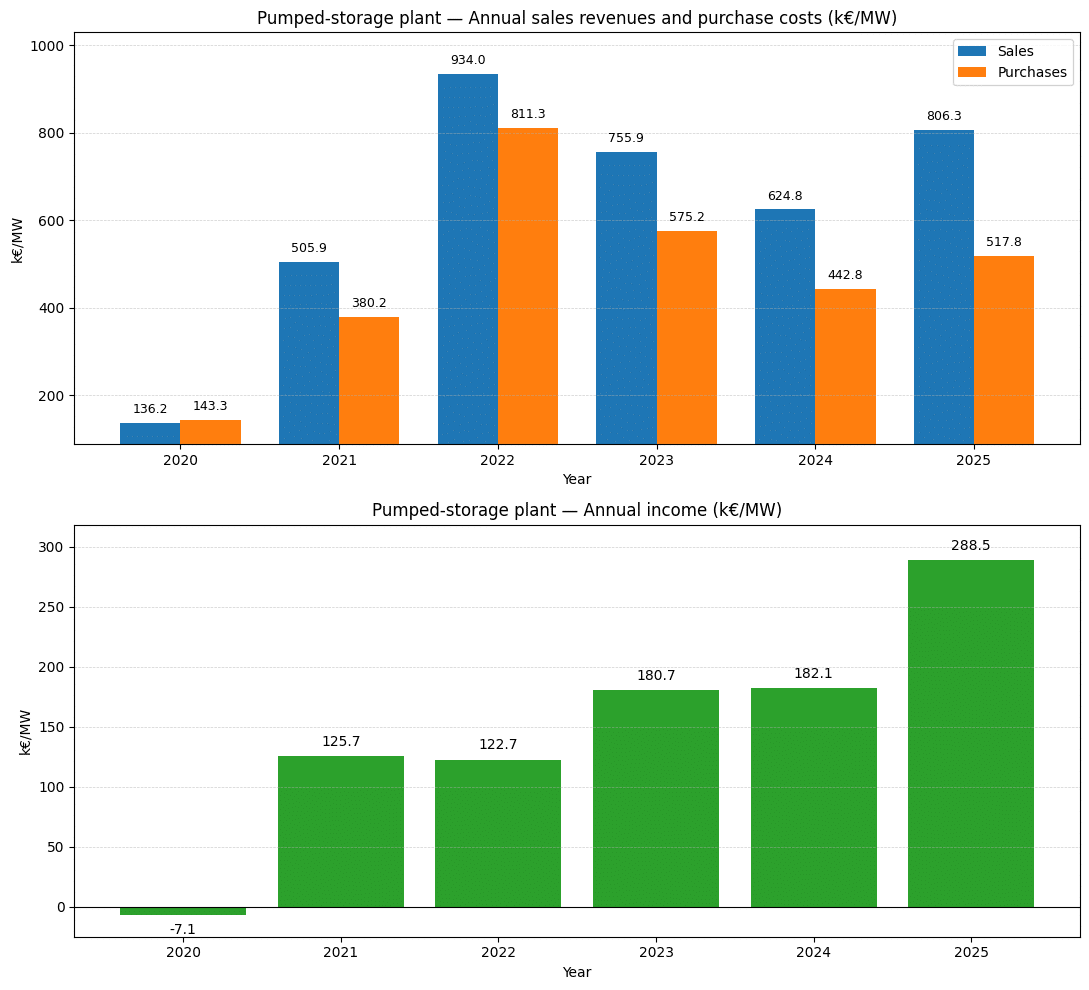
Annual net income has been calculated from the plant’s matched purchase and sale bids in the day‑ahead market, as the difference between the total value of energy sold and the total cost of energy purchased each year. These results represent the operational performance of the pumped storage plant based on the transactions it carried out.
In 2020, the cost of energy purchased in the day‑ahead market exceeded the value of the energy sold, reflecting very depressed day‑ahead market prices with low volatility due to the consequences of the COVID‑19 pandemic. From 2021 onwards a very significant increase in net revenues is observed, reaching around €126k/MW in 2021 and remaining at similar levels in 2022, indicating a day‑ahead market with greater price volatility and more favourable economic opportunities for the facility.
From 2023, the economic value generated by the plant increases clearly, exceeding €180k/MW in 2023 and 2024, and reaching approximately €289k/MW in 2025. This evolution shows radical changes in the day‑ahead market price structure, with a notable increase in volatility due to gas prices higher than before the 2022 crisis and increased renewable energy generation, particularly solar photovoltaic energy.
Overall, annual revenues reflect how the pumped storage plant has progressively captured greater economic value, making more efficient use of the temporal price differences observed in its matched transactions. The result highlights the increasingly relevant role of the operational flexibility of hydropower storage within the electricity system, from the specific perspective of this installation.
 Fuente: Elaborado por AleaSoft con datos de OMIE.
Prospects for energy markets in Europe. Spring 2026
The 64th monthly webinar organised by AleaSoft Energy Forecasting will take place on March 12, 2026, at 10:00 CET, and will focus on analysing the recent evolution of European energy markets, their prospects for spring and the main milestones that will shape the sector throughout 2026. The session will address the most relevant regulatory developments, as well as the increasingly decisive role of energy storage and capacity markets in an electricity system characterised by greater renewable penetration and increasing price volatility. In this context, AleaStorage provides advanced optimisation solutions, revenue analysis and design of projects of storage and hybrid systems with renewable energy, aimed at maximising the economic value and profitability of assets.
The meeting will once again include the participation of experts from EY, who will contribute their experience in regulation, storage and renewable energy project financing, PPA, self‑consumption and valuation of energy assets and portfolios, complementing AleaSoft’s market analysis. The webinar is consolidating itself as a reference forum for understanding the trends transforming European energy markets and the growing strategic value of flexibility in the electricity system.
Source: AleaSoft Energy Forecasting.