


AleaSoft Energy Forecasting, April 29, 2026. Energy independence in Spain is evolving from a political concept into a strategic variable in corporate decision‑making. In an environment marked by geopolitical volatility, electrification based on renewable energy generation and the use of market forecasts are consolidating as key elements for reducing risks and improving competitiveness in electricity markets.
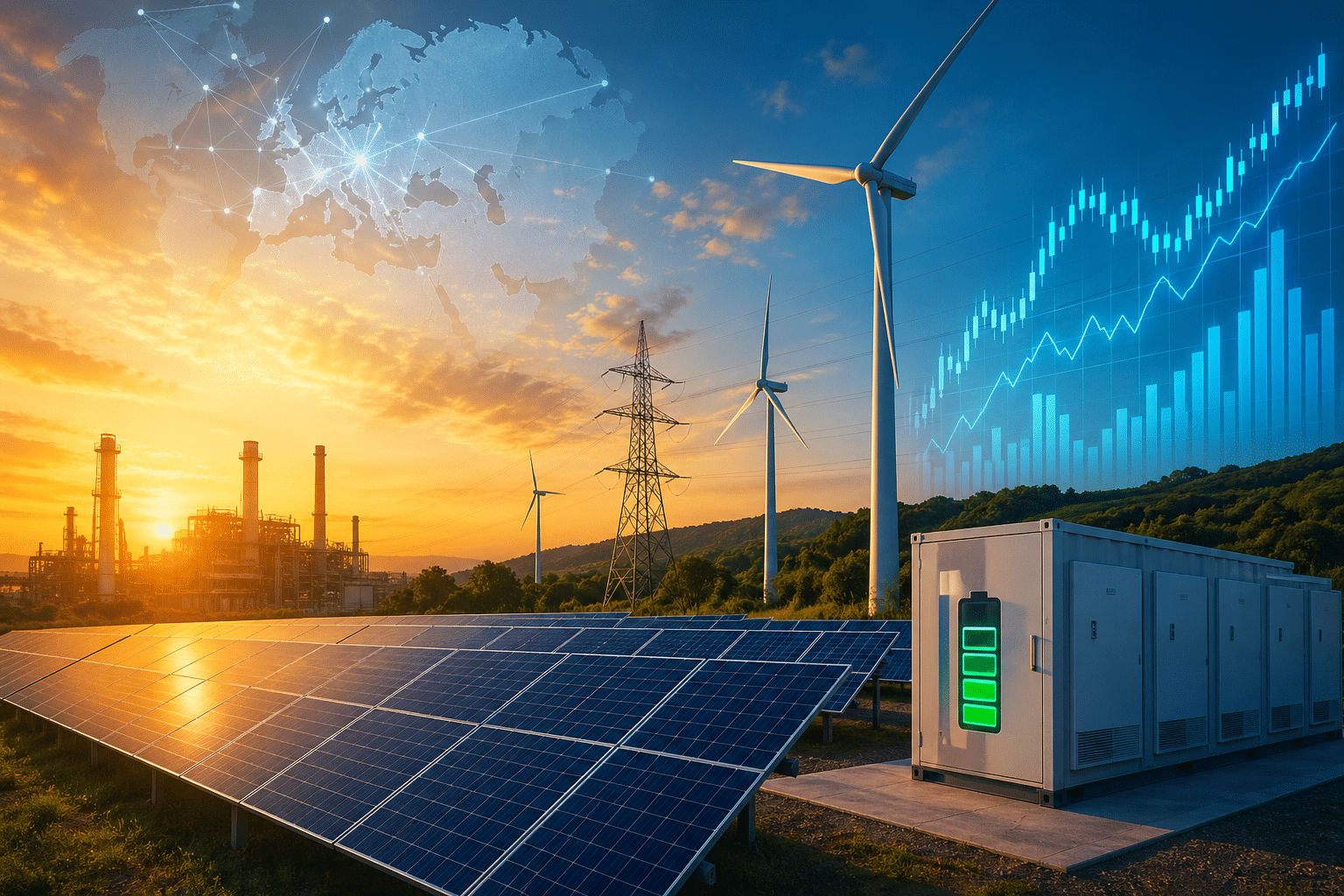
In recent years, energy independence has been a recurring concept in European political discourse. However, in 2026 that concept is rapidly evolving into something far more tangible: a critical business decision, particularly for large energy consumers.
Geopolitical instability, with persistent tensions in the Middle East and latent risks at strategic points such as the Strait of Hormuz, has once again highlighted an uncomfortable reality: a significant share of companies’ energy costs depends on factors entirely beyond their control.
From imported gas to local
Spain is in a unique position within Europe. Renewable penetration, particularly solar PV, has reached levels that make it possible to consider a structural shift: replacing imported gas with locally generated renewable electricity.
This shift is not driven solely by environmental criteria. From a strictly economic and strategic perspective, it has three key effects. First, risk reduction. Natural gas is exposed to extreme volatility, shaped by international conflicts, logistical bottlenecks and geopolitical decisions. Locally generated renewable energy, although not free from uncertainty, significantly reduces that exposure. Second, cost optimisation. Solar PV in Spain has become one of the most competitive technologies on the continent. The electrification of industrial processes makes it possible, in many cases, to stabilise energy costs over medium‑ and long‑term horizons. Finally, competitive advantage. In increasingly stressed markets, companies capable of securing predictable energy prices operate with a clear advantage over those exposed to external shocks.
Electrification is not enough
However, there is a common strategic mistake in assuming that electrifying processes is, by itself, sufficient. It is not.
The profitability of assets such as solar PV plants, PPA contracts or energy storage systems depends on complex variables such as the hourly evolution of market prices, intraday and seasonal volatility, the renewable cannibalisation effect and price spreads, the latter being essential for battery optimisation.
Ignoring these variables leads to a recurring problem in the sector: overestimated revenue expectations and poorly calibrated investment decisions.
The critical role of forecasts
In this context, energy independence ceases to be an abstract objective and becomes a quantifiable strategy, where the quality of market forecasts is decisive.
It is not just a matter of installing renewable energy capacity or signing a PPA. It is about doing so with a rigorous view of the future behaviour of the electricity market, incorporating scenarios, probabilities and risk analysis.
For electro‑intensive sectors, from the chemical industry to data centers, this approach makes the difference between electrification that reduces costs and risk, and electrification that simply transfers uncertainty from one energy vector to another.
A business decision, not ideological
The debate on energy independence no longer belongs exclusively to the political sphere. Today, it is a matter of advanced business management.
In an environment characterised by volatility, electrification based on renewable energy and supported by robust market analysis makes it possible to transform a structural vulnerability, energy dependence, into a measurable competitive advantage.
The conclusion is clear: energy independence is not a slogan. It is a strategic decision that has a direct impact on the bottom line.
Market analysis and outlooks for decision‑making
On May 21, 2026 at 10:00 CET, AleaSoft Energy Forecasting will hold webinar number 66 of its monthly series, focused on analysing the evolution of European electricity markets in an environment that is becoming increasingly complex from a structural perspective.
During the session, the discussion will examine how the interaction between renewable generation, the development of energy storage and demand transformation is altering price signals and revenue structures in electricity markets, as well as the implications this has for project viability under different scenarios. The webinar will feature Alejandro Diego Rosell, energy communicator and consultant, together with Oriol Saltó i Bauzà, Associate Partner at AleaSoft Energy Forecasting, and will be moderated by Antonio Delgado Rigal, CEO of the company.
AleaSoft Energy Forecasting develops price, demand and renewable production forecasts that make it possible to assess the evolution of electricity markets across different time horizons. These forecasts are essential for project financing, PPA structuring, asset valuation and strategy definition.
Likewise, the study of revenues associated with energy storage systems and the analysis of hybrid configurations with renewable energy generation make it possible to gain deeper insight into the role of flexibility in the electricity system and its influence on decision‑making.
Source: AleaSoft Energy Forecasting.