


AleaSoft Energy Forecasting, September 29, 2026. The difficulties facing some photovoltaic projects in Spain should not be mistaken for a crisis in the future of this technology. Low captured prices and hours with zero or negative prices pose new challenges, but the growing electrification of the economy, the development of storage and more sophisticated energy management are opening a stage of new opportunities for photovoltaics.
From capacity growth to value creation
For years, the main goal of the transition to renewable energies was to increase generation capacity. Photovoltaic energy has replaced a significant share of fossil fuel generation in the central hours of the day and has lowered electricity prices in those hours.
However, the success of this process has created a new challenge. When thousands of photovoltaic plants produce at the same time, the high supply pushes prices down and reduces the revenues of the solar producers themselves. Added to this is the risk of curtailment and output restrictions. These circumstances particularly affect projects whose investment and financing decisions were made with expectations of captured prices higher than current ones.
This situation does not mean that photovoltaics is no longer competitive. According to the IRENA report on renewable power generation costs in 2025, published in July 2026, the global weighted average levelised cost of electricity of new photovoltaic installations stood at $44/MWh, virtually unchanged from the previous year. What is changing is not so much the competitiveness of the technology as the conditions of the market in which it sells its output. From now on, in addition to producing electricity, it will be necessary to manage when that energy is produced, stored and sold.
Value management as a decisive factor for photovoltaics
The financial difficulties of certain photovoltaic projects are real and require responses tailored to each case, such as reviewing the financing structure, renegotiating contracts, adding storage or optimising how the energy is sold. However, they should not be extrapolated to the technology as a whole.
The development of photovoltaics is driving a broader change in the electricity system, which requires new investment in storage, grids and interconnections, greater demand flexibility and market signals that incentivise flexibility and backup services. These challenges also represent opportunities for retailers, generators, renewable developers, storage operators, large consumers and investors.
An electricity system with a high penetration of renewable energies will also need wind, hydro, storage, dispatchable generation and grids. In that mix, photovoltaics enjoys very favourable conditions to keep increasing its contribution to global electricity generation. Its next stage will be defined by the ability to combine solar generation, storage, electrification and smarter energy management, so that every megawatt hour produced brings more value to the system, to consumers and to projects.
Photovoltaics and batteries: hybridisation as the answer
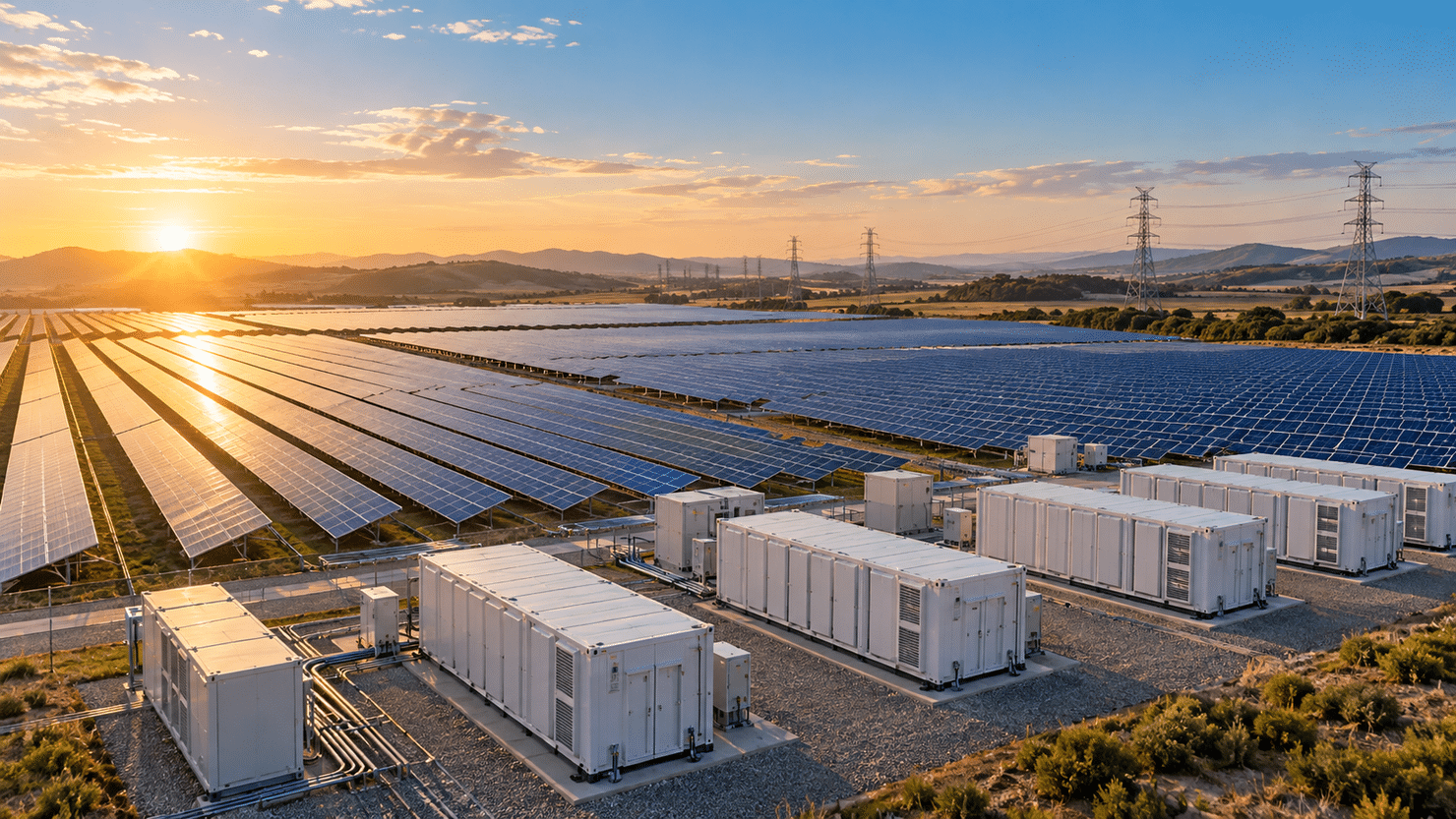
Energy storage will be key in this transformation. Combining photovoltaics with batteries makes it possible to store part of the output during the hours of highest solar generation and shift its sale to other times of the day, when demand and prices may be higher. In this way, installations can improve their captured price, reduce curtailment and diversify their revenue streams. Batteries can also take part in the intraday market and in ancillary services, as well as earn revenue through capacity mechanisms.
However, adding a battery does not by itself guarantee greater profitability. Sizing, investment costs, the evolution of price spreads, market access conditions and the operating strategy will determine the value it brings to each project. As installed storage capacity grows, it will also be necessary to anticipate how prices and arbitrage opportunities will change.
For this reason, the future of many photovoltaic plants will involve hybridisation and integrated management of generation and storage, in which flexibility and revenue optimisation will carry increasing weight compared to production volume.
The electrification of the economy will drive demand
Beyond storage, there is another structural change that opens up growth prospects for photovoltaics: the increasing share of electricity in final energy consumption. The electrification of transport, industry and heating and cooling, together with data centers, renewable hydrogen and other new loads, will drive electricity demand over the coming decades.
Solar surpluses in certain hours do not indicate that a limit has been reached for photovoltaic generation. To a large extent, they reflect a mismatch between the times when electricity is produced and when it is consumed. The challenge is to develop renewable generation, storage, electricity grids and new uses of electricity in a coordinated way, with a prominent role for demand flexibility. Industry, data centers and other large consumers will be able to adapt their consumption profiles, combine self‑consumption with storage and take part in flexibility markets.
Demand growth will widen the room for photovoltaics, although its impact on solar revenues will also depend on consumption patterns, grid development and the pace at which the different technologies are added to the system.
A technology ready to keep growing
Photovoltaics has characteristics that put it in a good position to cover a significant part of future electricity demand growth. It is a modular and scalable technology that is relatively quick to install, and it can be deployed both in small self-consumption installations and in large grid-connected plants. Its low generation cost, the abundance of the solar resource and its ability to be combined with storage systems reinforce these advantages.
Technological progress will also continue to contribute, with improvements in the efficiency of modules, inverters, storage systems and management tools that will make it possible to optimise the operation of installations.
From producing electricity to managing assets, contracts and markets
This change also calls for a new way of developing, valuing, financing and operating renewable projects. Traditionally, the main variable for assessing a photovoltaic investment has been the expected production over the installation’s useful life. Now, the value of that production under different market scenarios carries increasing weight, that is, when it can be sold, how much of it is worth storing and how to manage price exposure.
Consequently, investment and financing decisions will require analyses that integrate captured price forecasts, hourly spreads, potential storage revenues from ancillary services and capacity mechanisms, battery degradation, PPA contracts and the various hedging instruments. The profitability of projects will depend largely on the ability to anticipate market changes and to design strategies that optimise revenues and control risks. To this end, long-term price forecasts, probabilistic scenarios and the joint simulation of generation and storage will be essential tools throughout the useful life of the assets.
Forecasts and hybridisation analysis: the role of AleaGreen and AleaStorage
AleaGreen, the AleaSoft Energy Forecasting division specialising in long-term forecasts, provides electricity market price curves with hourly granularity and horizons of up to 40 years, along with solar and wind production forecasts. These forecasts make it possible to estimate the captured prices of photovoltaic production and serve as the basis for the financing of renewable energy projects, PPA valuation, hedging strategies and portfolio valuation, enabling developers, investors and banks to make decisions about their photovoltaic assets with greater confidence.
For its part, AleaStorage, the division specialising in energy storage, estimates the revenues of stand‑alone batteries and batteries hybridised with renewables in energy markets and ancillary services, analyses hybridisation projects with photovoltaics and wind to maximise revenues and reduce risks, assesses capacity market revenues and models long-term price and volatility scenarios.
Source: AleaSoft Energy Forecasting