


AleaSoft Energy Forecasting, October 20, 2026. The monthly average of the one-hour intraday spread in Spain reached €215.37/MWh in September, compared with €195.29/MWh in August. These price differences strengthen the case for battery storage, but they raise a financing question: how revenues will evolve as installed capacity grows. The bankability of BESS projects will depend on sufficient revenues under prudent long-term scenarios.

2026 spreads strengthen the case for storage
The Spanish electricity market is sending favourable signals for the development of batteries. The monthly average of the one-hour intraday spread rose from €61.90/MWh in January 2026 to €195.29/MWh in August and reached €215.37/MWh in September, an increase of 10% compared with the previous month.
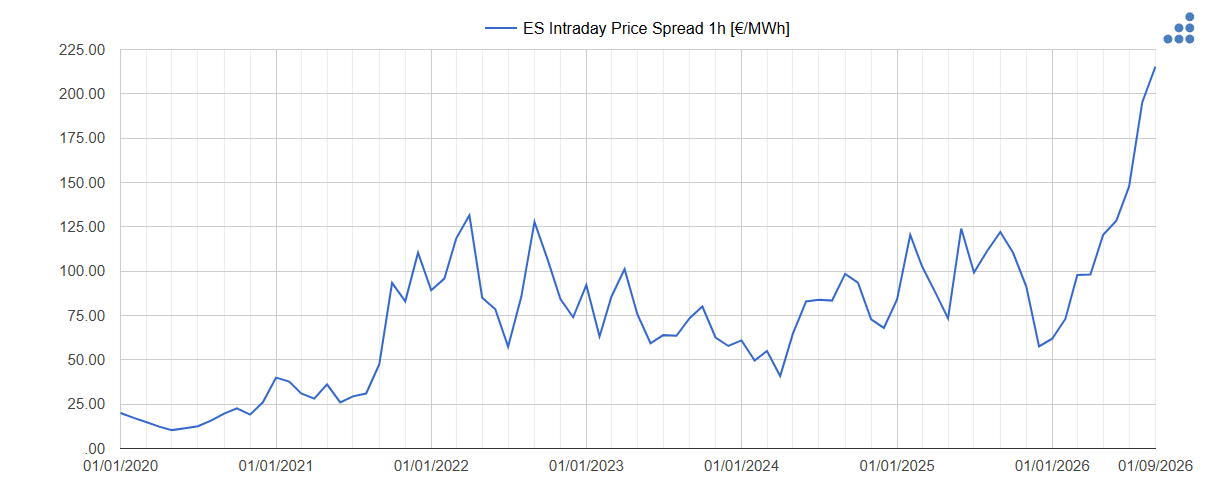 Source: Prepared by Alea Energy DataBase using OMIE data.
The evolution of this indicator reflects the opportunities offered by the differences between hourly electricity prices. The growing penetration of photovoltaics lowers prices during the middle hours of the day, while in the afternoon and evening, when solar generation falls, prices can reach much higher levels. This price structure allows batteries to store electricity during the lowest-price hours and shift its sale to the highest-price hours.
However, the intraday spread represents a theoretical arbitrage opportunity, not guaranteed revenue. The energy actually shifted, together with the battery’s duration, efficiency, degradation and operating constraints, determines how much value each installation can capture. In addition, there is a factor that will become increasingly important in revenue forecasts: batteries themselves will help to narrow the price differentials on which their profitability depends.
Cannibalisation will reshape future spreads
Adding new batteries to the electricity system will gradually change the hourly price structure. When batteries charge during the lowest-price hours, they increase electricity demand in those periods. When they discharge during the highest-price hours, they increase the available supply. Both behaviours tend to narrow the gap between maximum and minimum prices. This process, known as storage cannibalisation, may intensify as installed BESS capacity increases.
Storage development in Spain is already showing signs of acceleration. On December 30, 2025, the Ministry for the Ecological Transition and the Demographic Challenge announced the results of the call for aid for investment projects in storage, co-financed with ERDF 2021‑2027 funds, which led to the selection of 126 storage projects that, once built, will provide 2.2 GW of power and 9.4 GWh of capacity. These figures cover different technologies and reflect the scale of the planned development, although they do not represent capacity already installed.
As these and other projects come into operation, arbitrage opportunities will evolve. The scale of that change will depend on the power and duration of the batteries, their operating strategy and the simultaneous evolution of renewable generation, demand and other sources of flexibility.
It is therefore necessary to analyse different storage penetration scenarios. Hypothetical scenarios of 10, 20 or 30 GWh of batteries, combined with consistent assumptions on installed power and operation, make it possible to study how hourly prices and available revenues could change.
Cannibalisation does not necessarily mean that spreads will disappear. The growing share of renewables, the electrification of demand and the evolution of the generation mix can continue to create volatility and new opportunities for storage. The relevant question is what share of the spreads will remain available once the effect of storage itself on the market is taken into account. The spread that makes a battery attractive in 2026 will not necessarily be the one that determines its profitability in 2035.
The prudent scenario will be decisive for financing
This transformation has direct consequences for BESS project financing. A project may show attractive profitability using the price differences observed in 2026 and yet show much lower expected revenues once scenarios with higher storage penetration are incorporated.
For financial institutions, the key question is not how much a battery can earn in a particularly favourable year, but what revenues it will be able to generate over the debt repayment period, including under adverse market conditions. This requires going beyond estimates based on historical spreads or on the extrapolation of current revenues.
Financing analyses need long-term hourly electricity market price forecasts, consistent with different scenarios for the evolution of the system. These forecasts must incorporate the growth of renewables and storage, as well as the expected changes in demand, interconnections and generation technologies. Based on these curves, it is possible to simulate battery operation and estimate revenues year by year, taking into account the batteries’ technical characteristics and the different market opportunities.
The analysis must then be carried over to the financial model to assess the project’s ability to generate sufficient cash flows to service the debt and meet the coverage ratios required by lenders.
The risk is particularly relevant for projects with high exposure to merchant revenues. Tolling contracts or agreements that secure part of the revenues can reduce that exposure, but valuing uncontracted revenues still requires robust market scenarios.
It is also necessary to consider the evolution of revenues from balancing services and other flexibility mechanisms. These sources can complement arbitrage, but they are subject to their own competitive dynamics.
In this context, bankability does not depend on demonstrating that a battery will be profitable in the most favourable scenario, but on proving that it can meet its financial commitments under prudent scenarios.
Photovoltaic hybridisation requires a specific analysis
Storage cannibalisation will also affect projects with batteries hybridised with photovoltaic plants, although their exposure to prices will differ from that of a stand‑alone battery.
In a photovoltaic plant, the battery can store part of the energy produced during low-price hours and shift its sale to higher-value periods. In this way, it can improve the captured price of the installation as a whole and reduce curtailment under certain conditions. However, revenue opportunities depend on the hourly profile of renewable generation, the characteristics of the connection point and the charging and discharging possibilities.
A hybridised battery may be constrained by the availability of photovoltaic energy and by shared grid export constraints, while a stand‑alone battery may have different operational flexibility to take advantage of market opportunities. These differences make it necessary to jointly assess renewable generation, future hourly prices and storage operation.
Likewise, the optimal sizing of the battery, both in power and in energy capacity, must be based on a long-term perspective. A configuration that maximises revenues with current spreads will not necessarily be the most profitable when the price structure changes.
Therefore, the economic valuation of hybridisation should not be limited to quantifying the additional revenues that storage offers under current conditions, but should consider how its contribution to the value of the project will evolve over its entire useful life.
2035 spreads will be decisive for financing
2026 spreads are driving interest in storage, but 2035 spreads will be decisive for financing many of the projects being developed today. The difference between a battery that is profitable on paper and a project capable of securing financing will increasingly depend on the ability to demonstrate which revenues will remain available when storage reaches a much higher penetration.
The electricity market needs more batteries, but financing them requires understanding how the market will work once those batteries are operating. Long-term hourly price curves for electricity markets therefore play a key role. They make it possible to analyse the evolution of spreads, study different storage penetration scenarios and assess the resilience of projects to less favourable market conditions.
However, having a central forecast is not enough. Properly assessing risks requires alternative scenarios, consistent methodologies and traceable assumptions that make it possible to understand the origin of forecast revenues and their sensitivity to the main market drivers.
This approach is especially important when the results are to be used in investment and financing processes, in which developers, technical advisers, investors and financial institutions need to work on a consistent and verifiable forecasting basis.
Long-term hourly curves will make it possible to identify bankable projects
The growth of storage introduces a new challenge for developers, investors and lenders: anticipating how a market will evolve in which batteries themselves will transform revenue opportunities.
In this area, AleaGreen, the AleaSoft Energy Forecasting division specialising in long-term forecasts, provides electricity market price curves with hourly granularity and horizons of up to 40 years, which make it possible to analyse different scenarios for the evolution of the markets.
For its part, AleaStorage uses these forecasts to assess the revenues of battery projects, both stand‑alone and hybridised with renewables, optimise their sizing and analyse different operating strategies over the useful life of the installations.
The combination of market forecasts, scenario analysis and operation simulations makes it possible to build consistent revenue estimates and assess their evolution, providing a technical basis for investment and financing decisions.
Source: AleaSoft Energy Forecasting