


AleaSoft Energy Forecasting, September 15, 2026. The Spanish electricity market’s one-hour intraday spread reached an average of €195.29/MWh in August 2026, the highest monthly level of the year, compared with an average of €121.78/MWh so far in 2026. This context widens the opportunities for battery storage, but the intraday spread is only the starting point of a profitability analysis, not the actual revenue of a BESS project.
A gradual escalation throughout the year
Spain’s one-hour intraday spread has risen almost continuously throughout 2026, from €61.90/MWh in January to €195.29/MWh in August, the highest monthly average of the year and well above the €121.78/MWh average accumulated so far. This escalation is largely due to growth in photovoltaic production, which pushes down prices in the central hours of the day while evening demand keeps prices high in the hours of highest consumption, widening the gap between the lowest-priced hours and the highest-priced hours of each day. This context offers significant opportunities for energy storage with batteries, which can take advantage of price differences by buying electricity in the lowest-priced hours and selling it in the highest-priced hours.
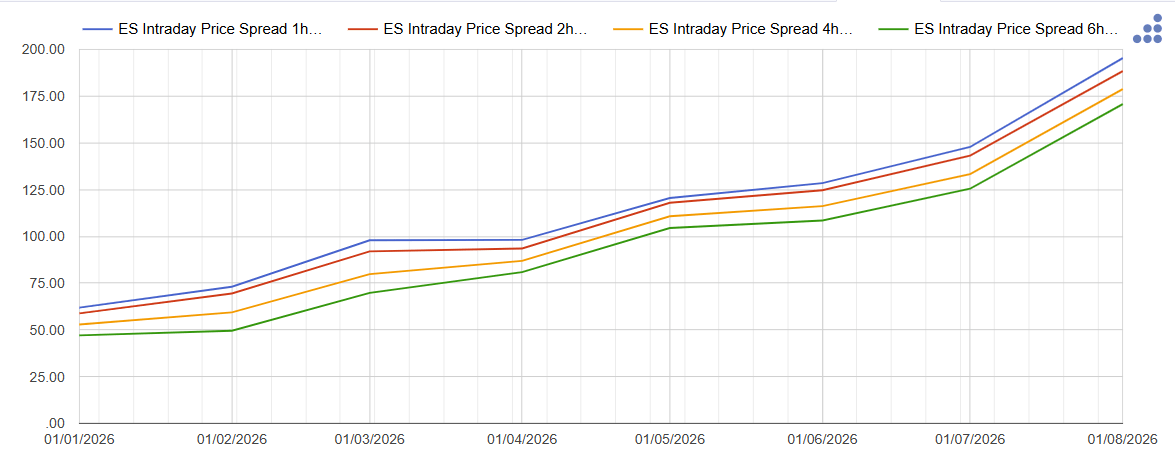 Monthly averages of intraday spreads in the Spanish electricity market, in €/MWh. Source: Alea Energy DataBase.
However, translating these spreads directly into the revenue of a BESS project can lead to overestimating its profitability. The spread represents a market opportunity, not guaranteed revenue, and between the two lies the battery’s actual operation, shaped by its duration, efficiency, availability and, above all, by the quality of the price forecasts and the operating strategy used.
The hourly spread, a theoretical ceiling
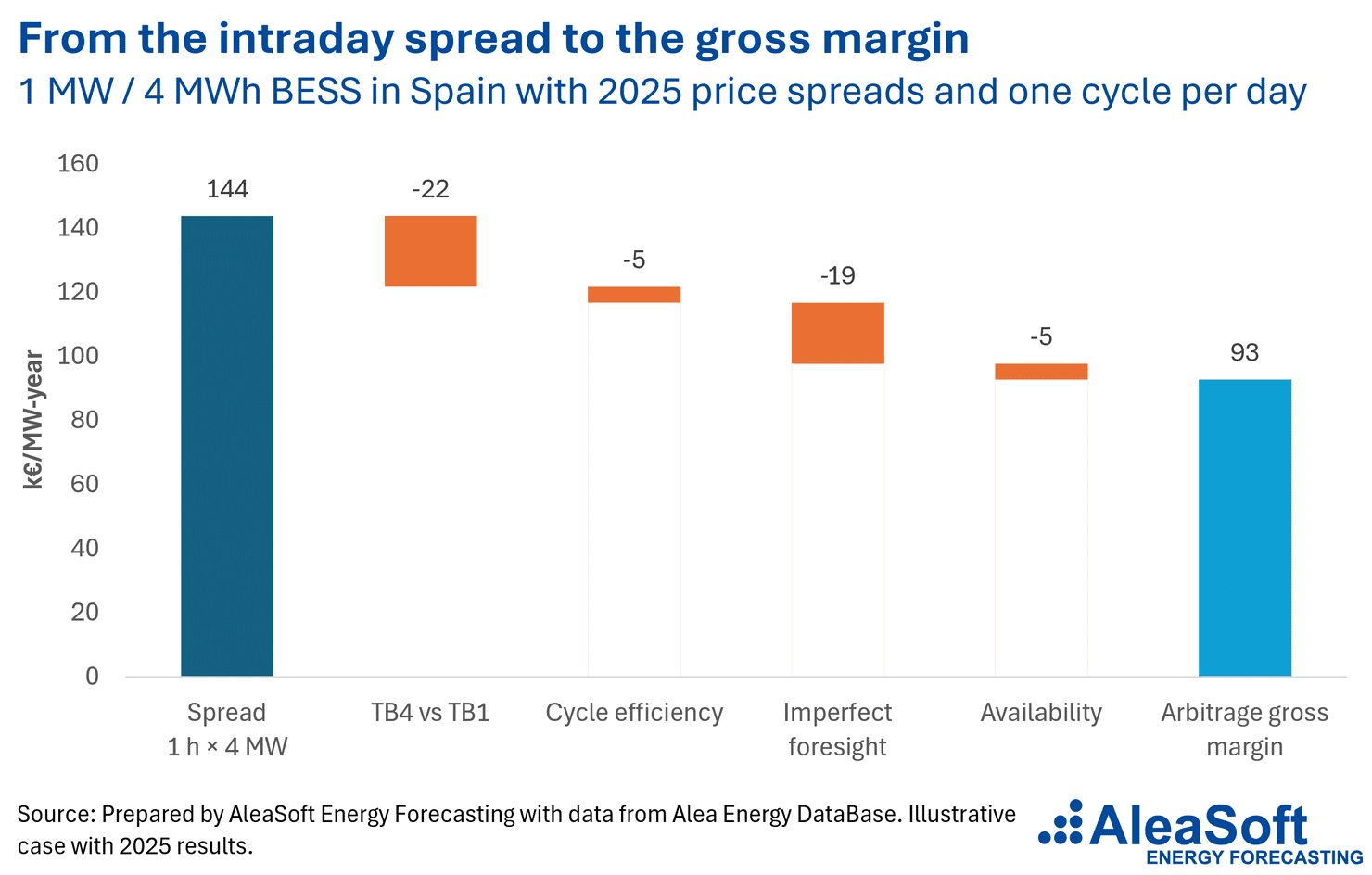
A simple way to gauge this difference is to consider a 1 MW battery with a four-hour duration that completes one full daily cycle. In 2025, the annual sum of Spain’s one-hour daily spread reached €35 931/MWh, which, multiplied by the 4 MWh of a full discharge, gives a theoretical ceiling of €143 724/MW per year. This figure is purely theoretical, as a real battery cannot capture it in full.
The first limitation is the ability to capture that spread across all of the battery’s hours. The one-hour spread captures the difference between the day’s highest-priced hour and its lowest-priced hour, whereas a four-hour battery needs to charge and discharge over several hours, so its real reference is the difference between the average price of the four highest-priced hours and that of the four lowest-priced hours. In Spain, this effect reduced the potential spread by around 15% in 2025, a smaller reduction than the approximately 18% seen in Germany, thanks to the characteristic shape of the Spanish hourly price curve, with a relatively wide, flat solar dip in the central hours of the day.
Efficiency, a cost that depends on the charging price
The charge-discharge cycle’s round-trip efficiency is another determining factor, although its economic effect is not directly proportional to the nominal efficiency. Assuming that a battery with 85% efficiency directly loses 15% of the spread is not correct. To sell 1 MWh at that efficiency, the battery needs to buy approximately 1.176 MWh, so the real cost of the inefficiency depends on the price at which charging takes place.
If charging takes place at €40/MWh, the efficiency-related penalty is around €7.1/MWh. With a charging price of €20/MWh, it drops to about €3.5/MWh, and with €5/MWh it falls below €1/MWh. This nuance is especially relevant in a market like Spain’s, where the rise in photovoltaic production multiplies the hours with very low, zero or negative prices. When the price is negative, the additional energy needed to cover cycle losses stops being a cost and starts generating revenue from that same consumption.
Forecasting, the variable that determines how much is captured
Calculations based on historical prices assume perfect foresight, with the day’s highest- and lowest-priced hours known in advance. This does not happen in real operation. Charging and discharging decisions must be made based on price forecasts, and the peak or the trough may occur earlier or later than expected.
For this reason, having quality forecasts and a suitable optimisation strategy has a direct impact on revenue. As installed storage capacity increases and more batteries compete for the same hours, this forecasting capability will become even more important in differentiating the profitability of one project from another. Added to these factors is the asset’s actual availability, as maintenance operations, battery outages and possible grid unavailability further reduce the number of opportunities that can be captured throughout the year.
From theoretical potential to business case: the role of AleaStorage
Taking duration, efficiency, forecasting capability and availability together, a battery may end up capturing around 65% of the theoretical ceiling calculated directly from the hourly spread, according to the example analysed for 2025. In other words, approximately a third of the theoretical value can be lost before becoming real margin, which confirms that the business case for a storage project cannot be built by simply multiplying the historical spread by the battery’s capacity.
In this context, AleaStorage, the division of AleaSoft Energy Forecasting specialising in energy storage, focuses on the strategic analysis of batteries and hybridisation projects, providing revenue estimates for stand-alone batteries in the day-ahead market and intraday markets, and in balancing markets, hybridisation analysis with renewables (photovoltaic and wind) to maximise revenue and reduce risks, and long-term price and volatility scenario modelling that reproduces the technical characteristics and operating strategy of each asset throughout its useful life.
Flexibility as a source of value in an increasingly volatile market
In an electricity market with renewable penetration on the rise, intraday spreads will continue to set the value of flexibility, and 2026’s progression, with August already the year’s month with the highest average spread, points to exceeding the volatility recorded in 2025. But a battery’s profitability does not depend solely on the existence of price differences, but rather on the ability to anticipate and capture them efficiently through an operating strategy that is well sized and tailored to each market. Spain’s intraday spreads, along with those of other European electricity markets can also be found in Alea Energy Database, the online platform for energy market data from AleaSoft Energy Forecasting.
Source: AleaSoft Energy Forecasting