


AleaSoft Energy Forecasting, October 30, 2026. The difference between the hours with the lowest market prices and the hours with the highest prices makes it possible to assess the value of industrial demand flexibility. A simulation based on 2026 day-ahead market prices illustrates the potential of shifting part of consumption within the same day. Its application requires knowing the limits of each process, the energy purchasing conditions and the risks of operational decisions.

The difference in hourly prices changes the cost of industrial consumption
The Spanish electricity market shows differences between prices in the middle hours of the day and those at dusk. One example is October 24, when the average price on the day-ahead market was around €137/MWh, but a large share of the middle hours of the day cleared at a price of zero, while prices rose at dusk. In September, the monthly average of the day-ahead market was €143.25/MWh, more than double the figure of a year earlier. However, there were 32 hours with zero or negative prices during the month. In the first three quarters of the year, the average price was €74.10/MWh, although 936 hours with zero or negative prices accumulated during that period.
This difference may represent an opportunity for large consumers that can shift their consumption to hours with lower prices. However, the value of shifting part of consumption to the hours with lower prices must be quantified for each plant. The answer depends on the production process and the energy purchasing conditions. A daily or monthly average is not enough to estimate the cost of different consumption profiles.
Demand management requires relating each operational decision to the price of the hours affected. Before modifying a production schedule, it is advisable to compare the expected energy savings with the operating requirements and the costs of adapting the process. The aim should be to improve the economic performance of the industrial activity while maintaining its production requirements.
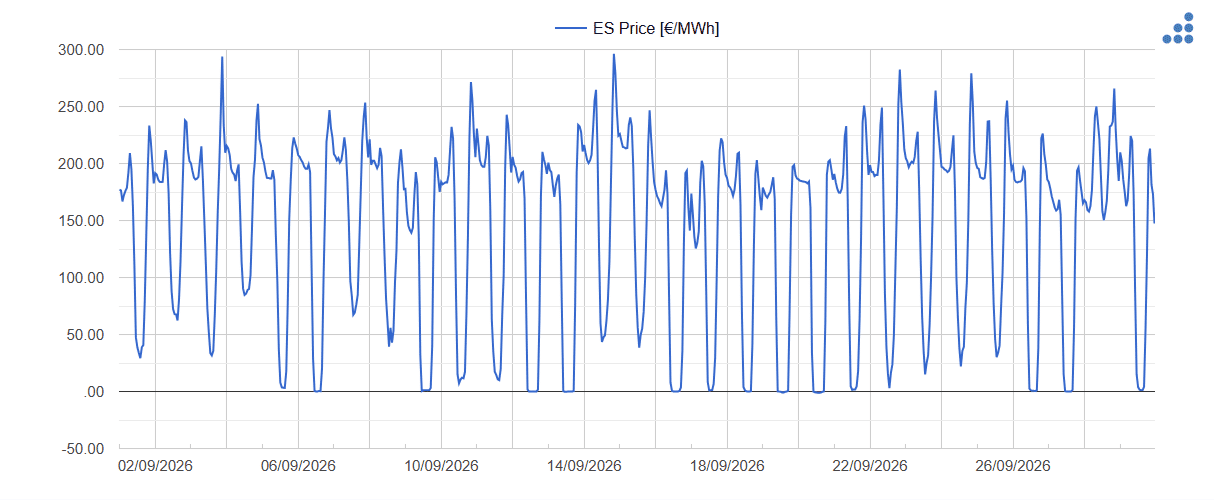 Source: Hourly prices of the MIBEL market for Spain in September 2026, available in Alea Energy DataBase.
A simulation to quantify the value of shifting consumption
To give an idea of the order of magnitude, AleaSoft Energy Forecasting has simulated the energy cost of an industrial consumer with a flat profile compared with that of another that shifted 10% and 20% of its consumption to the hours with the lowest prices within the same day. The exercise uses day-ahead market prices from January 1 to October 27, 2026, a period of 300 days.
The flat profile would have paid an average of €81.70/MWh. By shifting 10% of consumption, the average falls to €69.24/MWh, a difference of €12.46/MWh and a saving of 15.3%. With a 20% shift, the average cost falls to €60.93/MWh, a difference of €20.77/MWh and a saving of 25.4%.
Results vary from day to day. For the 10% shift, the daily saving ranges from €4.35/MWh in the 10th percentile to €20.78/MWh in the 90th percentile, with a median of €11.86/MWh. For the 20% shift, the corresponding values are €7.21/MWh, €35.05/MWh and €20.09/MWh. This dispersion makes it advisable to analyse the distribution of results, as well as the average saving, when assessing a flexibility strategy.
The conditions of the exercise define its scope
The calculation only considers the day-ahead market energy price. It excludes tolls and charges, retail margins and other costs outside that price. Therefore, the percentages obtained refer to the component analysed and do not represent an equivalent reduction in total electricity costs.
The simulation assumes a constant consumption of 1 MWh every hour, every day of the period. Consumption in any hour cannot exceed its base level by more than 50%, and the shift takes place within the same day. These conditions define the adaptation capacity attributed to the consumer in the exercise.
Nor does the analysis assume that all industrial processes can be shifted. Its results reflect the prices observed in the period studied and do not constitute a savings forecast. When applying the exercise to a specific plant, its operational constraints would have to be incorporated and the cost compared against its supply contract. The simulation provides a reference for studying the potential for adaptation, without guaranteeing that another consumer will obtain the same results.
Flexibility requires knowing the limits of the production process
An industrial company wishing to explore this possibility should start by identifying what shiftable load it has and for how long it can modify its consumption. It should then forecast its hourly availability within the limits of the process and optimise it against forecast prices. Comparing forecast consumption with actual consumption makes it possible to review the assumptions used. In this way, the company can assess whether the strategy provides sufficient savings to justify its application.
Self-consumption and behind-the-meter batteries could expand management options in some cases. Their incorporation requires a joint study of demand, available generation and storage possibilities. The analysis of each plant should determine which combination deserves a more detailed economic assessment.
Forecasts and analysis to assess industrial flexibility
AleaBlue, the AleaSoft Energy Forecasting division specialising in short- and mid-term forecasting, provides electricity price and demand forecasts. This information makes it possible to set out scenarios to study consumption adaptation and assess energy purchasing decisions.
Meanwhile, AleaStorage offers analysis of the revenues and savings of energy storage, sizing and operating strategies, with applications that include self-consumption with batteries. These analyses make it possible to study the incorporation of storage into the management options of an industrial plant.
Industrial electrification requires assessing how to adapt demand to a system with price differences between hours. Knowing the consumption profile, quantifying its flexibility and having forecasts make it possible to decide which operational changes are worth implementing. The opportunity must be measured for each consumer, with its own constraints and contracting conditions, before turning an illustrative saving into an investment expectation.
Source: AleaSoft Energy Forecasting