


AleaSoft Energy Forecasting, May 5, 2026. In April 2026, monthly prices in most major European electricity markets fell compared to March and were, for the most part, below €85/MWh, with several markets reaching their lowest levels in recent months. Lower gas prices, weaker demand and increased solar energy production supported this trend in a month that also brought historic photovoltaic energy production records and the highest average Brent futures price since August 2022.
Solar photovoltaic and wind energy production
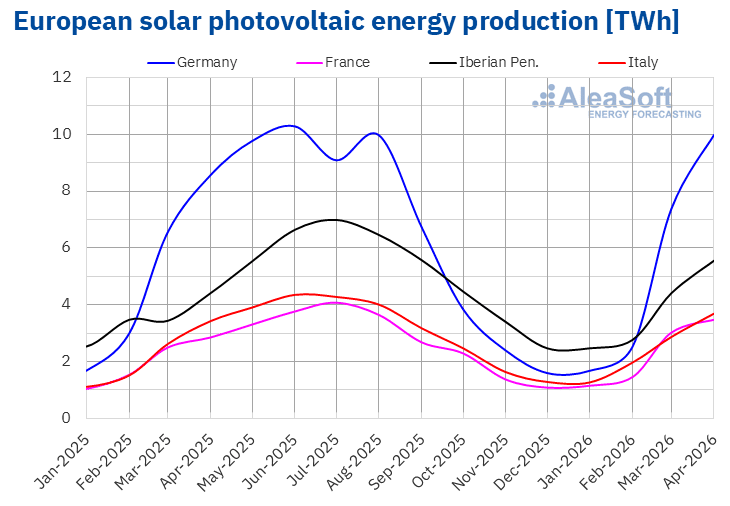
In April 2026, solar photovoltaic energy production increased in the main European electricity markets compared to the same month of the previous year. Portugal led the percentage growth with 41%, while Italy registered the smallest increase, 7.4%. Meanwhile, Germany, France and Spain increased their production by 11%, 22% and 24%, respectively.
Compared to March 2026, solar photovoltaic energy production also grew in the main analysed European electricity markets. In this case, the German market registered the largest increase, 40%, followed by rises of 38% in Portugal and 33% in Italy. The French and Spanish markets increased by 19% and 29%, respectively.
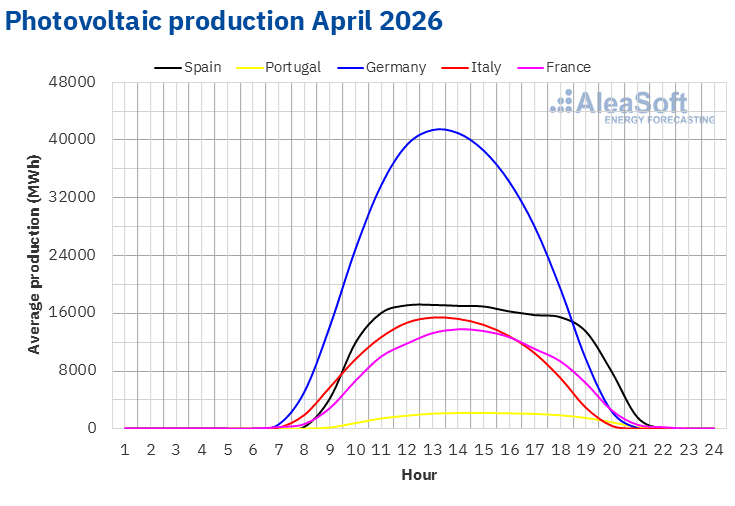
All analysed markets reached alltime records for solar photovoltaic energy production for an April month. Germany topped the list with 9969 GWh, followed by Spain with 4966 GWh, Italy with 3677 GWh, France with 3473 GWh and Portugal with 580 GWh.
These solar photovoltaic energy production records reflect the yearonyear growth in installed capacity. Between April 2025 and April 2026, the Spanish market added 8434 MW of solar photovoltaic energy capacity, excluding selfconsumption, according to data from Red Eléctrica. During the same period, the Portuguese market added 879 MW to the system, according to REN data.
 Source: Prepared by AleaSoft Energy Forecasting using data from ENTSO-E, RTE, REN, Red Eléctrica and TERNA.
 Source: Prepared by AleaSoft Energy Forecasting using data from ENTSO-E, RTE, REN, Red Eléctrica and TERNA.
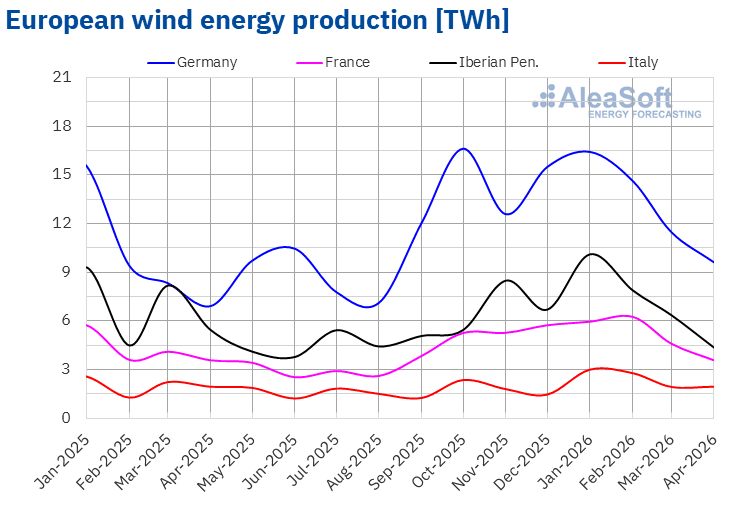
In April 2026, wind energy production increased year on year in the German and Italian markets. The German market registered the largest rise, 39%, while the Italian market registered more moderate growth, 0.7%. In contrast, the markets of the Iberian Peninsula and France reduced their wind energy production. Portugal registered the largest fall, 34%, while Spain and France reduced their production by 16% and 0.1%, respectively.
Compared to the previous month, wind energy production increased in the Italian market by 4.2%. By contrast, wind energy production decreased in the markets of the Iberian Peninsula, France and Germany. Portugal registered the steepest drop, 36%, followed by a 27% decline in the Spanish market. Germany and France registered decreases of 13% and 20%, respectively.
According to Red Eléctrica data, between April 2025 and April 2026 the Spanish market added 894 MW of new wind energy capacity, excluding selfconsumption. Over the same period, the Portuguese market added 48 MW to the system, according to REN data.
 Source: Prepared by AleaSoft Energy Forecasting using data from ENTSO-E, RTE, REN, Red Eléctrica and TERNA.
Electricity demand
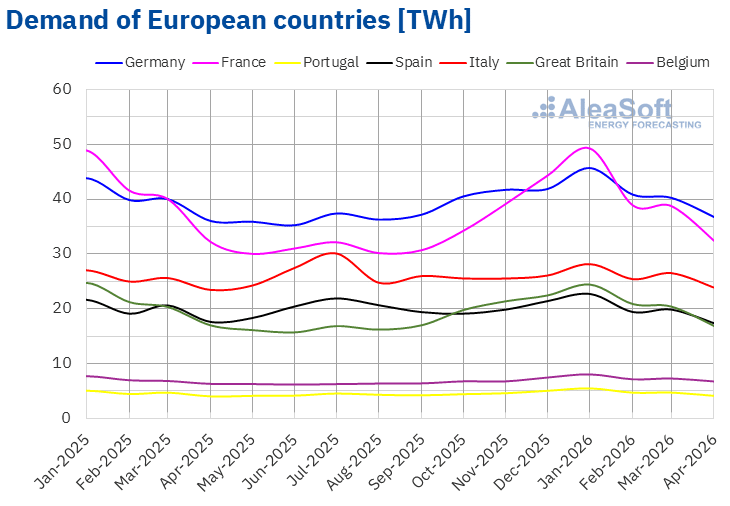
In April 2026, electricity demand increased year on year in most major European markets. The Belgian market registered the largest increase, 7.5%, while the French market registered the smallest rise, 0.7%. In the Italian, German and Portuguese markets, demand rose by 1.8%, 2.0% and 2.8%, respectively. By contrast, the British and Spanish markets registered yearonyear declines of 0.6% and 1.3%, respectively.
Compared to March 2026, demand fell in April across the main analysed European markets. Great Britain and France registered the largest declines, 14% and 13%, respectively, while Belgium registered the smallest, 4.3%. In Germany, Italy, Portugal and Spain, demand fell by between 5.6% in the German market and 9.7% in the Spanish market.
Average temperatures were colder than those of April 2025 in most analysed European markets. France, Belgium, Great Britain and Germany registered decreases ranging from 0.1 °C in France to 1.3 °C in Germany. On the other hand, the Iberian Peninsula and Italy registered higher average temperatures, with increases of 0.9 °C in Italy, 1.2 °C in Spain and 1.4 °C in Portugal.
Compared to the previous month, average temperatures in April increased in all analysed markets. Spain registered the largest rise, 4.5 °C, while Great Britain registered the smallest increase, 2.2 °C. In the remaining markets, average temperatures rose by between 2.3 °C in Belgium and 4.2 °C in Italy.
 Source: Prepared by AleaSoft Energy Forecasting using data from ENTSO-E, RTE, REN, Red Eléctrica, TERNA, National Grid and ELIA.
European electricity markets
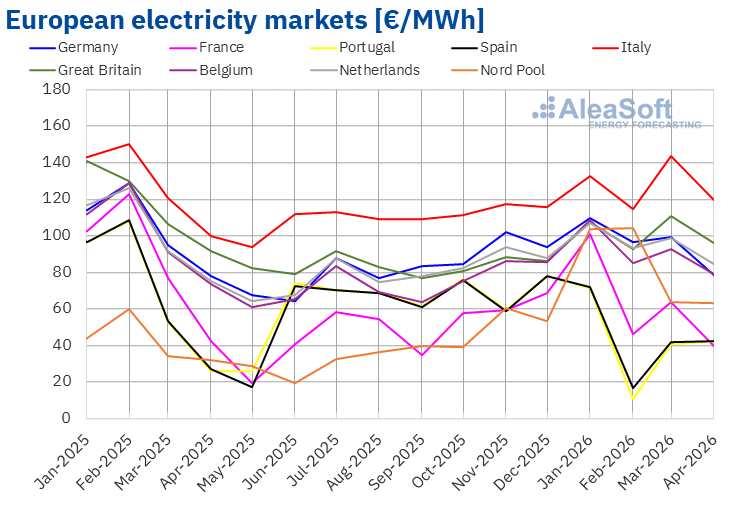
April 2026 closed with monthly prices below €85/MWh in most major European electricity markets. Only the British and Italian markets stood apart from this trend, with averages of €95.75/MWh and €119.47/MWh, respectively. At the opposite end, France, Portugal and Spain registered the lowest values of the month, €39.80/MWh, €42.42/MWh and €42.44/MWh, respectively. In the rest of the markets analysed at AleaSoft Energy Forecasting, averages ranged from €63.33/MWh in the Nordic market to €84.59/MWh in the Dutch market.
Compared to March, April was marked by an almost generalised fall in prices across the European electricity markets analysed at AleaSoft Energy Forecasting. Spain and Portugal were the exceptions, with slight increases of 1.6% and 3.8%. France led the declines, with a fall of 38%, while in the remaining markets reductions ranged from 0.7% in the Nordic market to 21% in the German market.
However, in yearonyear terms the trend was different. Compared to April 2025, prices increased in almost all European markets. France was the exception, with a decline of 5.7%. By contrast, Spain, Portugal and the Nordic market registered the largest percentage increases, 58%, 64% and 99%, respectively. In the other markets, rises were more moderate, ranging from 0.7% in the German market to 20% in the Italian market.
The monthly fall in prices allowed several markets to reach their lowest levels in recent months. The German market registered its lowest monthly average since September 2025, the French market since October 2025, and the Belgian and Dutch markets since November of that same year.
Behind the fall compared to March were mainly lower gas prices, increased solar energy production and weaker demand. In Italy, in addition, the rise in wind energy production reinforced this downward trend.
By contrast, the yearonyear comparison was shaped by a context of gas prices and CO2 emission allowance prices higher than those of April 2025, together with increased demand in most markets. In the Iberian Peninsula, lower wind energy production was an additional factor that helped push prices up in Spain and Portugal.
 Source: Prepared by AleaSoft Energy Forecasting using data from OMIE, RTE, Nord Pool and GME.
Brent, fuels and CO2
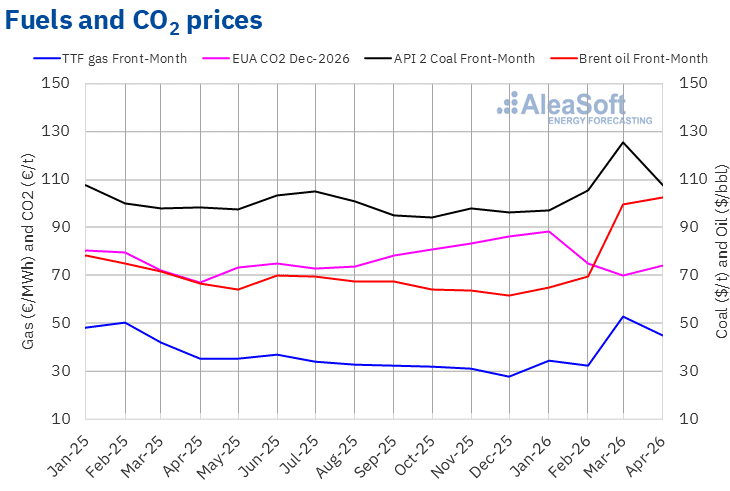
Brent oil futures for the FrontMonth in the ICE market registered a monthly average price of $102.46/bbl in April 2026. According to the data analysed at AleaSoft Energy Forecasting, this monthly average was the highest since August 2022. This value was 2.9% higher than that reached by the March 2026 FrontMonth futures, $99.60/bbl. It was also 54% higher than that corresponding to the FrontMonth futures traded in April 2025, $66.46/bbl.
During the month of April, the conflict between the United States and Iran continued to shape the evolution of Brent oil futures prices. While peace negotiations and the agreed truce exerted downward pressure on prices, the lack of progress in negotiations, threats, as well as the closure of the Strait of Hormuz, supported price increases during April. As a result, the monthly average ended above $100/bbl.
As for TTF gas futures in the ICE market for the FrontMonth, the average value registered during April 2026 was €44.98/MWh. Compared to the average of the FrontMonth futures traded in March 2026, €52.87/MWh, the April average fell by 15%. By contrast, compared to the FrontMonth futures traded in April 2025, when the average price was €35.41/MWh, there was an increase of 27%.
In April, concerns over liquefied natural gas supply due to instability in the Middle East and the low levels of European storage reserves continued to exert upward pressure on TTF gas futures prices. However, the fall in demand associated with milder temperatures contributed to the decline in prices compared to the previous month.
Regarding CO₂ emission allowance futures in the EEX market for the reference contract of December 2026, they reached an average price of €74.04/t in April. This monthly price rose by 5.7% compared to the March 2026 average, which was €70.07/t. Compared to the April 2025 average, which stood at €67.09/t, the April 2026 average was 10% higher.
 Source: Prepared by AleaSoft Energy Forecasting using data from ICE and EEX.
AleaSoft Energy Forecasting’s analysis for energy storage and hybridisation
Energy storage projects are currently facing decisive challenges in order to achieve profitable and bankable investment. It is not enough simply to install capacity; it is necessary to determine which configuration allows revenue to be maximised, how arbitrage and balancing service participation opportunities will evolve, what impact the growing penetration of batteries will have on those revenues and what the optimum sizing is in hybrid projects. Resolving these uncertainties is particularly relevant both in standalone systems and in hybrid installations, such as solar photovoltaic or wind power plants with batteries. In response to these challenges, AleaSoft Energy Forecasting, through its AleaStorage division, develops analysis for energy storage projects aimed at optimising revenues, sizing and profitability.
Source: AleaSoft Energy Forecasting.