


AleaSoft Energy Forecasting, 28 April 2026. The growing complexity of electricity markets, driven by renewable penetration, the development of storage and the transformation of demand, is positioning Artificial Intelligence as a key tool in electricity system analysis. Its application now extends well beyond forecasting, becoming increasingly relevant in areas such as project financing, asset valuation and strategic decision-making.
In recent years, Artificial Intelligence has become an omnipresent concept. Everything seems to be AI. Everything claims to be AI. However, in complex sectors such as the electricity system, it is worth distinguishing between noise and genuine experience. This is where an interesting case emerges: AleaSoft. Because there is a substantial difference between adopting AI today and having built an entire business model around it for almost three decades.
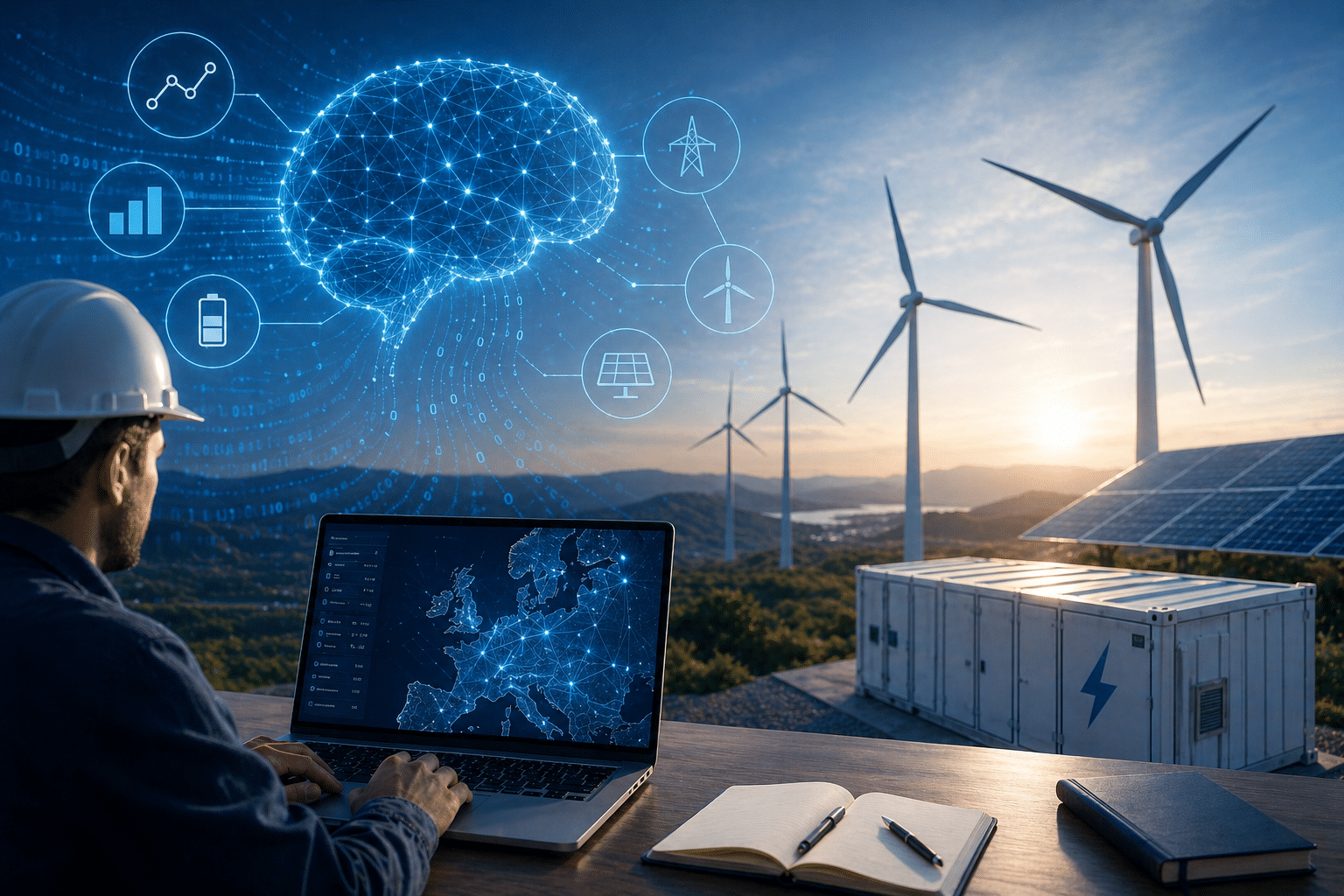
AI before the AI “boom”
In the late 1990s, talking about Artificial Intelligence applied to electricity markets was not a trend, it was an anomaly. Computing capacity was limited, data were scarce and electricity markets in Europe were only just beginning their liberalisation process.
In that context, AleaSoft Energy Forecasting chose to rely on neural network techniques, advanced statistical models and time series analysis not as a complement, but as the very core of its methodology. This has far-reaching implications: it was not an opportunistic adoption, but the gradual accumulation of knowledge, errors, adjustments and validation in real market environments over more than 27 years.
The key point: hybridisation
One of the major mistakes currently being made in the use of Artificial Intelligence in the electricity system is the belief that it can fully replace all other approaches. Experience shows precisely the opposite.
The approach that has ultimately prevailed, and that AleaSoft Energy Forecasting has defended for years, is the hybrid model. Artificial Intelligence makes it possible to capture non-linearities and complex patterns, classical statistics provide stability and long-term temporal coherence, and fundamental models make it possible to represent the physical and economic structure of the system. This balance is far from trivial. In fact, it is precisely where the real value lies.
Because electricity markets are not just data, they are regulation, human behaviour, meteorology, technology and geopolitics interacting continuously in a non-linear way.
From forecasting to decision-making
The evolution of AI in this field also reflects the maturity of the sector itself. In an initial phase, it focused on electricity demand forecasting, later on price forecasting, then on the integration of renewable energy and probabilistic risk analysis, until reaching the current stage, where it supports investment, financing and strategic decisions.
Today, Artificial Intelligence is no longer used solely to forecast, it is also used to support multi-billion-euro decisions, such as the structuring of PPA contracts, the financing of renewable projects, the viability assessment of energy storage systems and trading strategies. In this context, accuracy alone is not enough. What is required is long-term consistency and robustness under extreme scenarios.
The current problem: the illusion of pure AI
The recent rise of Artificial Intelligence has also brought with it an obvious risk: oversimplification. Models based purely on machine learning, without a proper market structure behind them, can overfit, ignore regulatory changes, fail under extreme events or generate misleading signals over long-term horizons.
In electricity markets, this is not an academic problem. It is a financial one. That is why the sector is increasingly converging on a clear conclusion: Artificial Intelligence does not replace the model, it strengthens it.
A lesson for the energy transition
Amid the energy transition, with the massive expansion of renewables, batteries and new sources of consumption such as data centers, the complexity of the electricity system is increasing rapidly. And with it, the need for more sophisticated analytical models.
The experience accumulated over 27 years shows that the path forward does not lie in technological fashions, but in methodological integration, continuous validation and a deep understanding of market behaviour.
Artificial Intelligence applied to energy is not a recent revolution. It is a silent evolution that some began much earlier. Cases such as that of AleaSoft Energy Forecasting reveal an uncomfortable but highly relevant reality: in complex sectors, competitive advantage does not lie in adopting technology, but in having understood it before everyone else. And in the current context, that difference is beginning to prove decisive.
Storage and market signals in AleaSoft’s analysis
On 21 May 2026 at 12:00 CET, AleaSoft Energy Forecasting will hold webinar number 66 of its monthly series, where the evolution of European electricity markets will be analysed in a context marked by growing structural complexity.
During the webinar, the discussion will focus on how the interaction between renewable generation, storage development and demand transformation is reshaping price signals and revenue structures in electricity markets, as well as the implications this has for project viability under different scenarios. The webinar will feature Alejandro Diego Rosell, energy communicator and consultant, together with Oriol Saltó i Bauzà, Associate Partner at AleaSoft Energy Forecasting, and will be moderated by Antonio Delgado Rigal, CEO of the company.
AleaSoft Energy Forecasting develops price, demand and renewable energy generation forecasts that make it possible to analyse the behaviour of electricity markets across different time horizons. These forecasts are essential for project financing, PPA structuring, asset valuation and strategy definition.
Likewise, revenue analysis for storage systems and the assessment of hybrid configurations with renewable energy generation provide a deeper understanding of the role of flexibility within the electricity system and its impact on decision-making.
Source: AleaSoft Energy Forecasting.