


AleaSoft Energy Forecasting, December 19, 2025. Lithium‑ion (Li‑ion) batteries dominate energy storage in electronic devices, vehicles and power supply systems. However, the emergence of solid‑state batteries promises to revolutionise the sector by offering higher energy density, efficiency and safety, as well as a lower environmental impact. Their development opens up new opportunities for electric vehicles and industry, although it also faces technical and manufacturing challenges that will need to be overcome to enable widespread adoption.
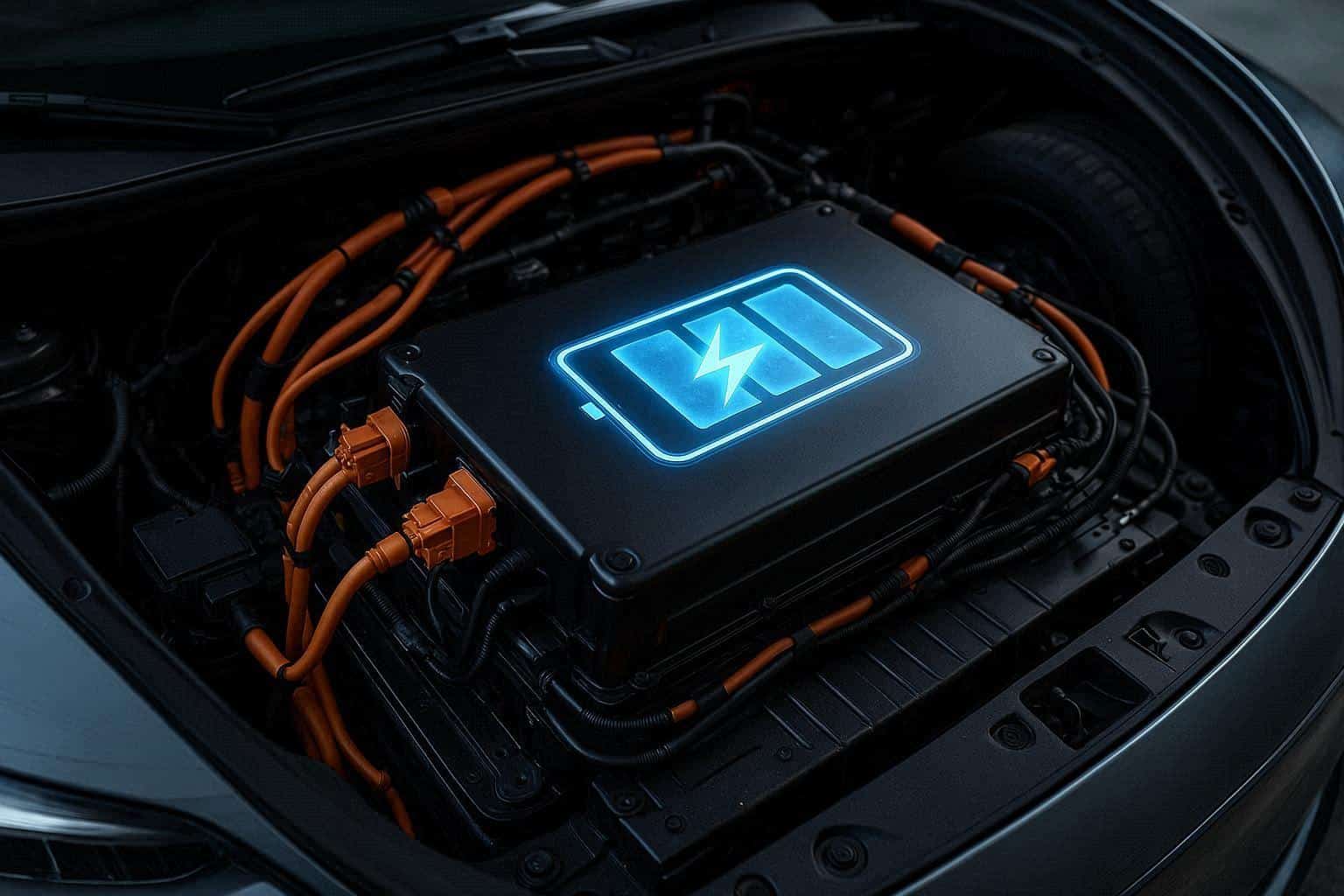
The dominance of Li‑ion (LIB) batteries is evident across all areas where energy storage is required: electronic devices, vehicles, grid supply and even aerospace projects such as the James Webb Space Telescope (JWST). However, this technology may face market competition with the emergence of other battery models. Previously, nickel‑hydrogen batteries were analysed as the main competitors for large‑scale projects. However, they are not optimal for smaller applications or for electric vehicles. To address the lack of competition in these sectors, solid‑state batteries (SSB) are emerging. These offer higher energy density than LIBs, requiring less volume to store the same amount of energy, extending battery lifespan, and providing improved stability and safety.
Higher energy density
Solid‑state batteries replace the liquid electrolyte used in LIBs between the anode and the cathode with a solid one, usually ceramic. The absence of a flammable liquid reduces potential safety issues such as fires or leaks and makes them less sensitive to extreme temperatures. In fact, they are particularly efficient at low temperatures, as they are able to maintain ionic conductivity at sub-zero temperatures.
Their energy density in models designed for electric vehicles ranges between 250-800 Wh/kg, compared with 160-250 Wh/kg for Li‑ion batteries. In addition, being more compact, they take up 33% less space and weigh 40% less (in models of around 450 Wh/kg). Their higher conductivity allows for faster charging and generates less heat. A fast‑charging Li‑ion battery requires around 30 to 60 minutes to charge from 80% to 100%, compared with 10 to 20 minutes for an SSB.
Their higher energy density, conductivity and resistance to dendrite formation result in a longer and more efficient lifespan. After around 8000 charge cycles, LIBs fall below 60% efficiency, whereas SSBs, under optimal conditions, could maintain 90% efficiency after 30000 cycles (around 30 years). These capabilities also increase vehicle range. Manufacturers are estimating that more than 1000 km could be driven without recharging. Self‑discharge performance also improves, with an annual rate of 2‑3%, compared with 2‑10% per month for LIBs. Together, these characteristics make solid‑state batteries well suited for long‑term energy storage.
Reduction of CO₂ emissions and other pollutants
Emissions from road vehicles using fossil fuels account for around 15% of total global carbon emissions. For governments to meet their proposed sustainability targets, stronger action is required across all possible areas. The effects of climate change need to be addressed at a faster pace than they currently are, as the 1.5 °C threshold above pre‑industrial levels has already been exceeded. One of the proposed measures to mitigate these effects is that, from 2035 onwards, no more than 10% of vehicles sold should have internal combustion engines, while ensuring that the manufacturing process and emissions of these vehicles have the lowest possible impact (an agreement that not all countries have joined).
Battery manufacturing is a polluting process. Producing a solid‑state battery requires fewer materials than a LIB, reducing the battery’s climate impact by up to 39% compared with its competitor. The use of longer‑lasting, more efficient and more compact batteries further reduces environmental impact and carbon footprint, as they are equivalent to replacing several Li‑ion batteries in terms of volume and service life.
Finally, as vehicles reduce their exhaust emissions, attention has shifted to another source of pollution linked to their use: tyre wear pollution. Prolonged use and friction with the road surface release microplastics and toxic substances (such as zinc, heavy metals or 6PPD‑quinone) into the environment. These emissions are estimated to account for around a quarter of all microplastics generated. The particles reach rivers, oceans and soil, contaminating ecosystems and the flora and fauna that inhabit them. This ultimately also affects people, both through direct inhalation and through the consumption of contaminated animal products. To reduce these emissions, in addition to less aggressive driving and proper tyre maintenance, reducing vehicle weight is key. As the battery is the heaviest component of an electric vehicle (making it heavier than a comparable combustion vehicle), a significant reduction in battery mass, such as that offered by SSBs, would make an important contribution to tackling this pollution problem.
Challenges faced by SSBs
During each charging and discharging cycle, the battery expands and contracts, subjecting its components to mechanical stress that can lead to delamination, structural degradation and material pulverisation. As a result of this deformation, the electrolyte may crack or fracture, increasing the electrical resistance of the material and reducing its efficiency.
The use of a solid electrolyte makes it more difficult to achieve good contact between the surfaces of the battery components (interfacial impedance) than when using a liquid electrolyte, which can adapt to the contact surfaces. To compensate for this effect, carbon additives are used or external pressure is applied. Maintaining this contact during battery operation is complex due to volume changes during charging and discharging processes, especially in higher‑capacity materials, which are also those that undergo the greatest volume variations.
Firstly, because the solid material used as an electrolyte is more expensive to produce than a liquid electrolyte. Added to this is the difficulty of scaling up laboratory‑designed models to large‑scale production. SSB manufacturing differs from that of LIBs and has specific requirements that make it necessary to create assembly line processes without established precedents or standards. Large‑scale production is facing difficulties in meeting quality standards, partly due to the high sensitivity of SSBs to moisture. If moisture enters the battery, it causes loss of conductivity, crack formation, corrosion and short circuits. The accumulation of these factors makes manufacturing processes highly demanding, reaching costs up to three times higher than those of LIBs.
The automotive sector at the forefront of SSB development
The world is moving towards electrification and decarbonisation, a process in which the automotive sector is fully involved. It is not only necessary to transform industrial and transport processes towards alternatives that do not generate greenhouse gas emissions, but also to do so in the most beneficial way for all stakeholders involved, including the environment. The use of batteries is the key component in this energy transition in order to fully exploit its potential. Many countries are already deeply engaged in this process, such as Spain with the Auto 2030 plan, which promotes the transition towards electrified vehicles, strengthens the Spanish automotive industry and ensures sustainable, accessible mobility aligned with emissions reduction commitments. The implementation of these measures has had an immediate effect, as the number of electric vehicle charging points across the peninsula has doubled this year.
SSBs may become a strong competitor in the energy storage market compared to LIBs. As they offer higher energy density, lower volume and weight, and greater safety, they present themselves as the logical successor. Their main drawbacks are fragility, high production costs and difficulties in large‑scale manufacturing. It should be noted that SSBs are still in the research and development phase, so these issues are expected to be progressively resolved.
To address mechanical challenges, research is being carried out using different materials for the anode, cathode and electrolyte, such as silicon or various polymers. Other alternatives are also being considered, such as semi‑solid‑state batteries, which contain less than 10% liquid electrolyte. This solution helps to mitigate volume change and interfacial contact issues but, in return, reduces the battery’s energy density and further increases manufacturing complexity.
Manufacturing costs and processes are also expected to be optimised and reduced over time. Many of the leading automotive companies, as well as emerging brands, mainly those based in China, are investing part of their capital in solid‑state battery research. Some have already announced the launch of their first models using this technology from 2027 or 2028 onwards. This high level of investment and competition will drive rapid sector development, and the improved performance of new vehicles will make them competitive with current internal combustion models, accelerating electrification.
AleaSoft Energy Forecasting as a benchmark in the evolution of the energy storage market
The characteristics of SSBs make them attractive not only for the electric vehicle sector, although given current investment trends, this is where they are expected to be introduced first. Subsequently, expansion is anticipated into other sectors, not only transport, drones and electronic devices, but also industry, stand‑alone storage systems, data centres and hybridisation with renewables.
The AleaStorage division analyses the feasibility of battery storage projects, both stand‑alone and hybridised with renewable plants. Its combination of a team made up of experts in research and the energy sector, together with a proprietary hybrid forecasting model that uses Artificial Intelligence to generate simulations across thousands of possible scenarios, enables it to adapt to and anticipate market evolution in order to deliver robust and reliable forecasts. AleaSoft Energy Forecasting is a key partner in driving the energy transition, working with expertise, commitment and the best tools to make it a reality.
Source: AleaSoft Energy Forecasting.