


AleaSoft Energy Forecasting, August 26, 2026. With the first capacity mechanism auction on the horizon, one discussion carries a direct impact on storage revenues, the batteries’ de-rating coefficient. The extension of Almaraz to 2030 also requires a review of the analyses underpinning the mechanism. Data on Spain’s mainland residual demand from 2021 to 2025 show that stress episodes are becoming increasingly shorter.
A range that can more than double a single project’s firm capacity
The capacity mechanism in Spain will remunerate the firm capacity each technology can provide during the system’s highest-stress hours. For batteries, that contribution is adjusted through a coefficient known as de-rating, a reduction coefficient that translates installed MW into firm MW. Under current estimates, the coefficient for batteries would stand between 0.27 and 0.70. That range means the firm capacity recognised for a given project, and with it the mechanism’s revenue within the asset’s revenue structure (revenue stack), can more than double depending on the value ultimately adopted.
The European reference confirms the scale of what is at stake. In European capacity markets, the coefficients applied to a two-hour battery range between 0.14 and 0.44, while for a four-hour battery they stand between 0.28 and 0.67. The discussion in Spain is taking place mostly at the level of principles. AleaSoft Energy Forecasting provides the data.
Almaraz’s extension shifts the mechanism’s starting point
On August 14, 2026, Spain’s Official State Gazette (BOE) published the order renewing the operating licence of the two units at the Almaraz nuclear power plant until June 8, 2030. The adequacy analyses that justify the capacity mechanism before the European Commission were prepared assuming the nuclear closure schedule then in force, with Almaraz out of the system in 2027 and 2028.
Keeping around 2 GW of firm nuclear capacity in the system until 2030 changes that starting scenario. As a result, the first auction may not be as close as previously expected, and some design parameters, including the coefficients of de-rating and the volume of capacity to be contracted, may be revised. This revision makes it more necessary, not less, for the discussion on de-rating for batteries to be grounded in data on the system’s actual behaviour, because the parameters set now will shape investment decisions in energy storage in the years ahead.
The system’s stress episodes are becoming shorter
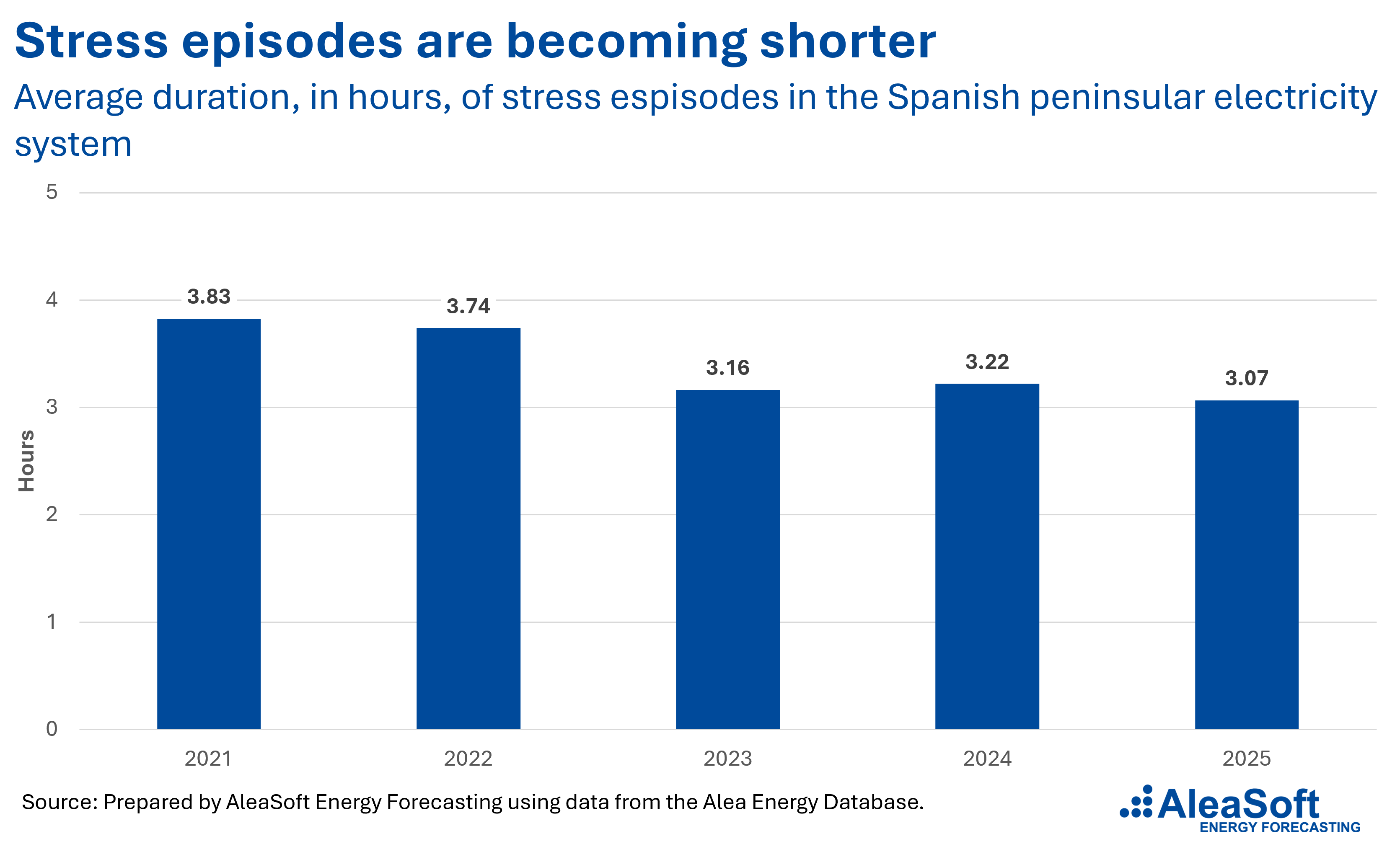
Based on hourly residual demand for the Spanish mainland power system, that is, demand minus wind and solar production, AleaSoft Energy Forecasting has analysed the period from 2021 to 2025, selecting each year’s 10% most stressed hours, the threshold the mechanism sets for stress hours, 876 hours a year. On that basis, the analysis measures how long the episodes last, that is, how many consecutive hours the system remains under stress.
The result is that the duration of stress episodes is shortening. In 2021, an episode lasted 3.8 hours on average, and in 2025 less than 3.1 hours. Episodes resolved within two hours or less have risen from 38% to 49% of the total. As the number of stress hours is fixed by construction, what has happened is that there are more episodes and they are shorter, from 229 to 286 a year.
The coverage a battery can offer, by duration
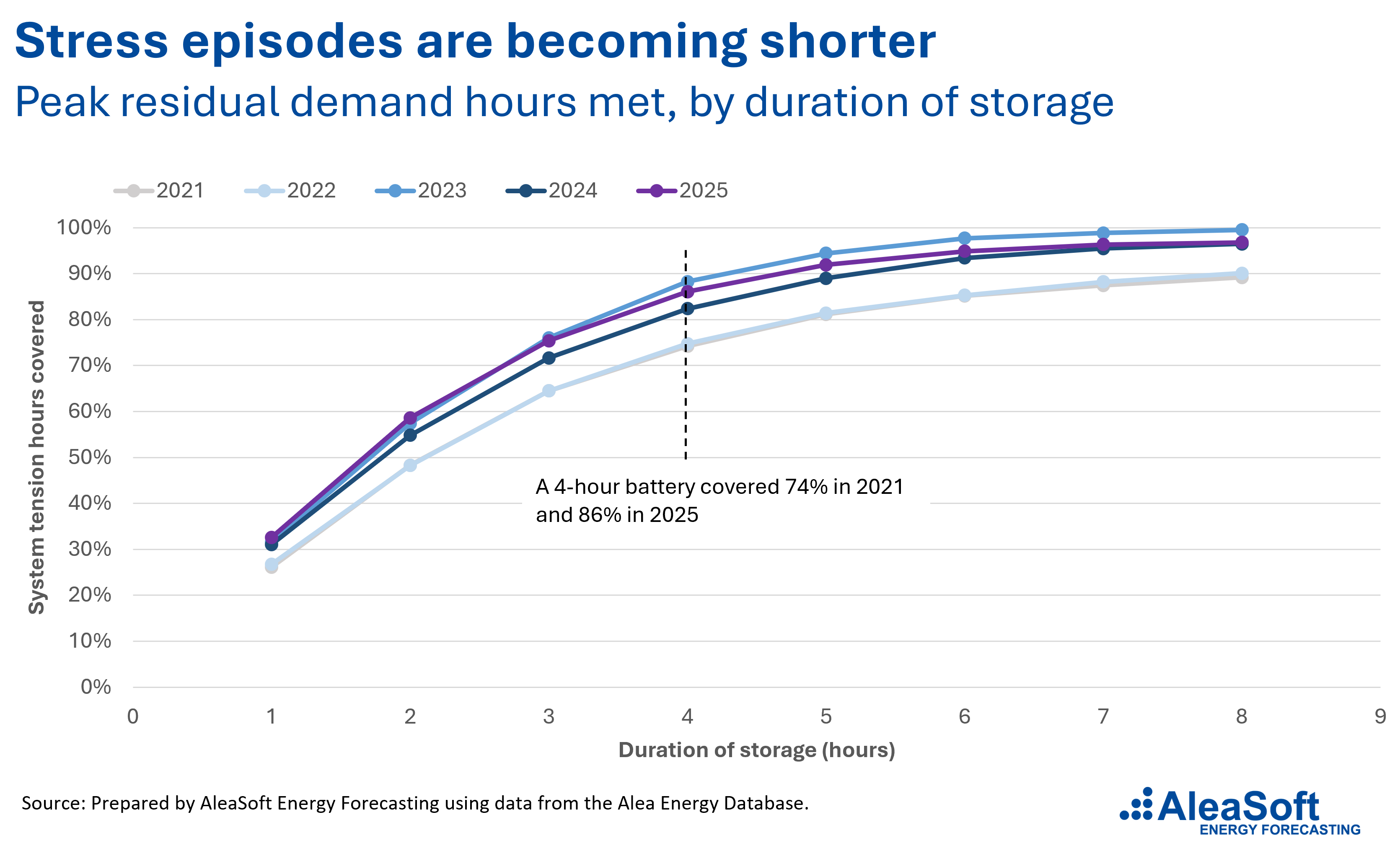
For the de-rating coefficient, what matters is the percentage of stress hours a battery can cover according to its duration. A two-hour battery could cover 48% of stress hours in 2021 and 59% in 2025. A four-hour battery went from 74% to 86%, and a six-hour battery from 85% to 95%.
The cause is solar PV. By shifting stress from the afternoon to the sunset ramp, it splits one long problem into several short ones. The median start time for episodes falls at hour 19, and two out of every three begin between 18:00 and 22:00. Annual coverage of 86% for a four-hour duration is well above the most conservative coefficients of de-rating currently under discussion, and the trend of the last five years favours short-duration storage. The pattern of stress episodes differs between summer and winter, a nuance that deserves its own analysis.
A coefficient that will evolve with each auction
What determines the value of a given storage duration is how long the stress episode it has to cover lasts. In Spain, that episode is the ramp following sunset, lasting several hours, not a one-hour peak. Under these conditions, a two-hour battery provides much lower firm capacity than a four-hour battery, as reflected in the European ranges cited, 0.14 to 0.44 versus 0.28 to 0.67.
It is also worth remembering that the deployment of storage itself changes the problem it has to solve. As more MW of batteries are installed, the residual demand peak flattens and stress episodes lengthen, so the de-rating coefficient for short durations tends to fall over time. A de-rating coefficient is not a constant input over 15 years. It will evolve at each of the capacity auctions, and revenue models and investment decisions must factor in that evolution from the project’s design stage.
Data as the basis for regulatory decisions
The evidence from mainland residual demand shows that stress episodes are becoming increasingly shorter and that four-hour storage already covers the large majority of stress hours. Quantifying that contribution at each auction, and anticipating its evolution, will be decisive for investment in storage in Spain.
Storage revenue analysis: the role of AleaStorage
AleaStorage, the division of AleaSoft Energy Forecasting specialising in energy storage, focuses on the strategic analysis of batteries and hybridisation projects, providing revenue estimates for standalone batteries in energy and balancing markets, hybridisation analysis with renewables, both solar PV and wind, revenue assessment for capacity markets, and long-term price and volatility scenario modelling. The real data series for demand, renewable generation and hourly prices for Spain and the rest of Europe used in this analysis are available on the Alea Energy DataBase, AleaSoft’s online data platform.
Source: AleaSoft Energy Forecasting