


AleaSoft Energy Forecasting, August 25, 2026. The rebound in TTF gas and its impact on electricity market prices puts the spotlight once again on the purchasing strategies of large consumers. In a highly volatile environment, deciding when and how much to hedge requires analysing not only market prices, but also the risks and outlook for their evolution. Medium-term forecasts help underpin these decisions and better manage exposure to the price of electricity.
The sharp rebound in the price of TTF gas over the past few weeks has once again highlighted a reality that can be overlooked when markets go through periods of relative stability: for large consumers of electricity, not making a hedging decision is also a decision.
European gas has returned to levels not seen since 2023, driven by a combination of relatively low European gas reserves, greater international competition for LNG and a growing geopolitical risk premium. European TTF gas futures for the Front‑Month on the ICE market have exceeded 68 €/MWh, reaching 68.31 €/MWh on August 24. The consequence is not limited to the gas market. In Europe, gas continues to be a key reference for electricity price formation, and its movements end up being passed through, with varying intensity depending on the market, to the entire futures curve for electricity.
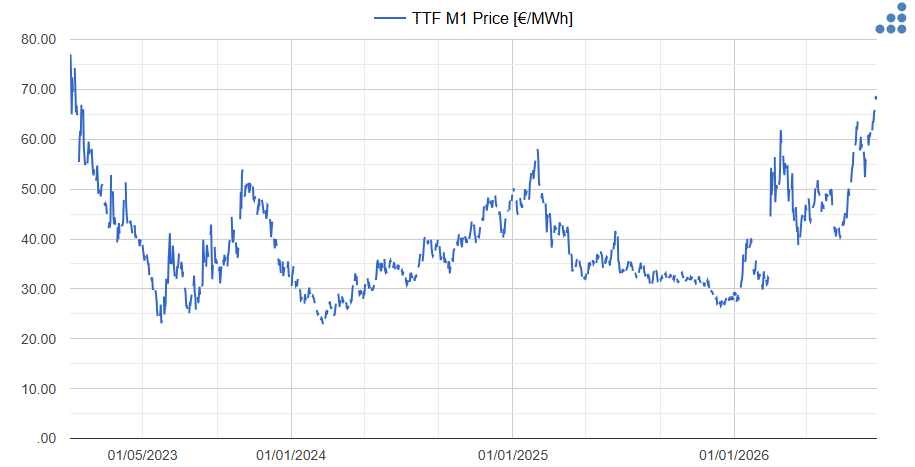 Source: TTF gas futures for the Front‑Month on the ICE Market available in the Alea Energy DataBase.
In Spain, this effect has been clearly visible over the past few weeks. The electricity futures for the fourth quarter of 2026 reached, on August 24, 121.77 €/MWh in the OMIP market, marking a high for this contract. At the end of May it was trading at around 91.20 €/MWh, which shows the magnitude, and above all the speed, of the move seen in just a few months.
 Source: Spain electricity futures for Q4‑2026 on the OMIP Market available in the Alea Energy DataBase
For an electro-intensive consumer, a change of 20, 30 or 40 €/MWh is not a financial detail. It can be enough to change budgets, industrial margins and even production decisions. A consumer of 100 GWh a year, for example, faces a difference of 3 million euros for every 30 €/MWh of variation in its average purchase price.
The problem is not guessing the minimum
These episodes usually raise a recurring question: should hedging have started earlier? Framed this way, the question is misleading. A good hedging policy is not about pinpointing the market’s minimum, something that can only be known in hindsight.
The right question is different: what level of risk can the company take on, and what purchasing strategy is consistent with its margins, its budget and its expectations for the market? Hedging all demand too early can carry an opportunity cost if prices later fall, but waiting indefinitely also has a cost. Once the market clearly starts to perceive a risk, much of that risk is usually already priced in.
Waiting until a risk becomes evident usually means hedging once it is already priced in.
This is precisely one of the reasons why hedging strategies tend to work better when built progressively, across different horizons and price levels, rather than trying to get a single purchasing decision right.
Futures are a signal, not a perfect forecast
There is also a frequent confusion between the futures curve and a price forecast. Futures reflect the market balance at each moment, the available information, the positions of buyers and sellers, hedging needs, liquidity and existing risk premiums. They are an extraordinarily valuable reference, but they should not automatically be interpreted as the best estimate of the price that will ultimately materialise.
The curve can incorporate significant risk premiums and can also change very quickly when new data emerges on gas, weather, renewable output, nuclear availability, interconnections, demand or geopolitics. This means that basing a purchasing strategy solely on watching the futures screen amounts to knowing the price the market offers today, but not necessarily understanding whether that price is attractive or high relative to the fundamentals expected for the coming months and years.
Forecasting as a risk management tool
This is where medium-term forecasts become especially relevant for large consumers and electro-intensive industries.
A forecast does not remove uncertainty. Its purpose is precisely to quantify it and help decisions be made within it. Having central and probabilistic scenarios makes it possible to compare the market price with a well-founded expectation of its future evolution, and to assess, for example, whether it makes sense to increase the percentage of hedged demand or keep part of it indexed, whether the price offered in a fixed contract includes a reasonable risk premium, or how the market could evolve under different scenarios.
It also makes it possible to analyse the impact of a fresh rise in gas prices or, conversely, what could happen if the geopolitical risk premium were to fall or disappear over the coming months.
These decisions should be part of an ongoing risk management process, not a one-off reaction to a sudden market spike.
Gas is once again a reminder of where the risk lies
The current TTF situation is a good example. Europe now has a much more diversified gas and LNG infrastructure than before the 2022 energy crisis, but that greater diversification has not eliminated volatility. The European system remains exposed to the global LNG balance, the behaviour of Asian demand, the level of reserves and to geopolitical events capable of changing the perception of supply security within just a few days.
As long as gas remains the marginal technology for a significant number of hours, these factors will keep passing volatility through to the electricity market. For the industry, the conclusion should not be that hedging is always necessary or that it should always be done as soon as possible, but rather that it is worth analysing the market context, the risks and the outlook at each point in time before deciding what share of consumption to hedge and over what horizon.
The conclusion matters more: electricity purchasing policy should be approached as a strategic risk management decision. In volatile markets, buying energy without an in-house medium-term view leaves a significant share of business margin exposed to market swings and to decisions made without a well-founded reference for what may happen in the coming months.
A forecast cannot say exactly where the price will be in six months, but it does help evaluate scenarios, measure exposure and make a better-informed decision today about how much risk to take on and how to manage it.
Source: AleaSoft Energy Forecasting.