


AleaSoft Energy Forecasting, October 14, 2026. After almost three decades of transformation of the electricity market, the next major challenge is no longer just installing more renewable capacity. Storage, demand flexibility, grids and an operation ever closer to real time will be decisive in efficiently integrating renewable energy production and making the most of its potential.
A market unrecognisable in barely a generation
Today’s Spanish electricity market has little in common with that of the late 1990s. When AleaSoft Energy Forecasting began its activity, on October 8, 1999, the Spanish liberalised market had been operating for barely two years. Generation was much more concentrated in large conventional plants, renewable energies still had a limited presence and the market operated with hourly resolution.
Twenty-seven years later, the transformation is profound. Wind energy and, later, photovoltaic energy have changed the generation mix, new participants and business models have emerged and decisions are made in an increasingly interconnected and complex environment. According to Red Eléctrica, at the end of 2025 the Spanish electricity system had 142.5 GW of installed capacity, after adding 10 GW of new renewable capacity during the year, of which 8.8 GW were photovoltaic. Including self‑consumption installations as well, installed capacity reached 150.8 GW, of which 68.9% was renewable generation.
One year of the quarter-hourly market
On October 1, 2025, the European day-ahead market moved from hourly resolution to a 15‑minute resolution, with the first trading session held on September 30. One year on, this technical change sums up much of the evolution the electricity system is undergoing. The exact moment at which electricity is generated, consumed, bought, sold or stored matters more and more.
Greater granularity makes it possible to better represent the variations in renewable energy production and in electricity demand and gives market agents more options to adjust their positions. But it also increases the need for good forecasts and the capacity to react. For renewable energy producers, retailers, traders, representatives, aggregators, control centres and battery operators, differences of a few minutes in production, demand or prices can end up shaping operational decisions.
The move towards markets ever closer to real time therefore goes beyond time resolution. It is part of a broader transformation of the electricity system.
From installing renewables to integrating them
For much of the last few decades, one of the main objectives of the energy transition was to increase renewable capacity. That process still has to continue, but the growth of wind energy and, especially, photovoltaic energy is changing the nature of the challenge.
The abundance of solar generation during certain hours pushes prices down precisely when these installations produce the most. Captured prices, cannibalisation, hours with zero or negative prices and renewable energy curtailment have come to occupy a central place in project analysis.
In 2025, renewable energies generated 55.5% of the electricity in Spain and their share reached 56.6% when the estimated contribution of self-consumption is included. As this percentage increases, adding new generation capacity will have to go hand in hand with a greater capacity to decide when that electricity is consumed and when it is delivered to the system. That is where the next stage begins.
Storage will change the value of time
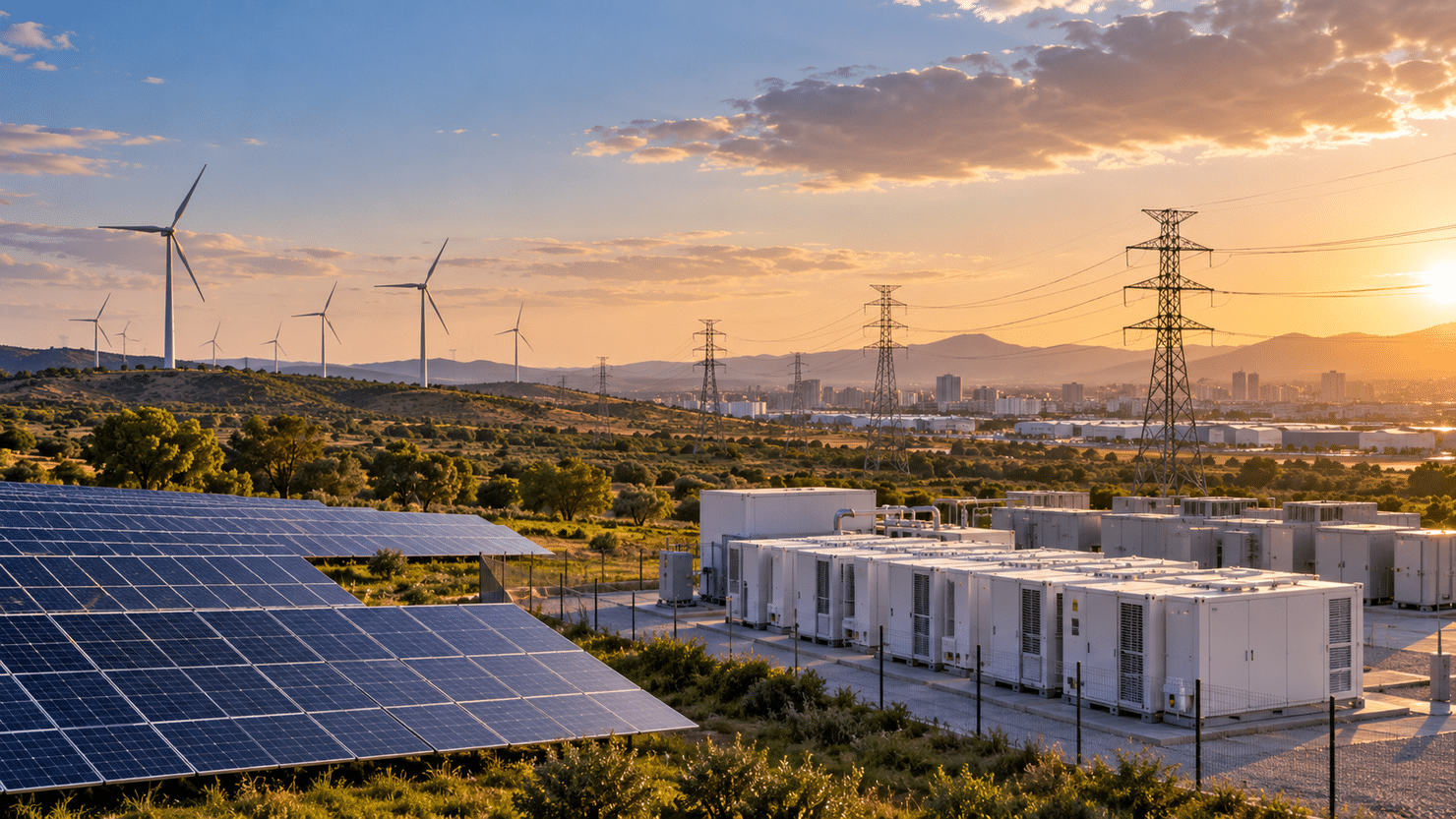
Batteries are set to play a fundamental role because they make it possible to decouple, at least partially, the moment of generation from the moment of consumption. A photovoltaic installation without storage depends to a large extent on the price of the solar hours. With a battery, part of that production can be shifted to other hours, participate in different markets and help provide services to the system.
This is why the value of an energy storage project cannot be analysed by looking only at average electricity prices. What matters are the spreads between periods, the volatility of the intraday market, the ancillary services, the capacity mechanisms and how all these revenue streams will evolve over the lifetime of the asset.
Spain closed 2025 with 3427 MW of storage capacity and, according to Red Eléctrica, these systems made it possible to integrate 9213 GWh during the year, 6.2% more than in 2024. At the same time, numerous battery, hybrid installation and pumped storage projects continue to move forward.
The challenge lies in valuing projects whose revenues will depend precisely on a market that will also change as a result of the massive deployment of storage. The more batteries take part in arbitrage and in certain services, the greater their influence on the very spreads and opportunities that underpin their revenues.
Demand will also have to be flexible
Flexibility will not come only from generation and storage. The electrification of industry, electric vehicles, heat pumps, self-consumption, data centers and other new consumers will increase electricity demand over the coming years. But just as important as how much it grows will be when that consumption takes place.
A system with abundant renewable energy production will need signals that encourage shifting part of the demand towards the moments of greatest electricity availability. Demand will thus progressively cease to be a variable the system simply has to meet and will also become a resource that can be managed.
For large consumers, this evolution opens up opportunities, but it also adds complexity. The supply strategy will have to combine the market, forward contracts, PPA and other hedging instruments with the possibilities of self-consumption, storage and flexibility.
Grids, a precondition for integrating new generation and new demand
Generating, storing and consuming electricity at the right moments will not be enough if the grid does not allow them to be connected. The deployment of new generation, batteries and electricity demand is increasing the strategic value of grid access and connection capacity. In the coming years, the location of projects will become increasingly important.
For an existing renewable energy installation, its future value will depend on the electricity it produces and also on the possibilities for repowering, hybridisation with batteries and use of its connection point. At the same time, new large consumers will need to locate where capacity is available or where the electricity grids can be reinforced. The planning of generation, storage, demand and grids will therefore have to be increasingly coordinated.
Forecasting will be more difficult and more necessary
Paradoxically, the more flexible the system becomes, the harder it will be to anticipate its behaviour. Twenty-seven years ago, the main variables explaining prices were relatively few. Today it is necessary to take into account the evolution of the generation mix, fuels, CO2, interconnections, storage, self‑consumption, new consumers, demand flexibility and regulatory changes, among many other factors.
Furthermore, every decision has its own horizon. A control centre needs to anticipate the next few hours, a trader the movements of the coming days or months, while a developer, a bank or an investment fund need to assess what may happen over decades.
Artificial Intelligence offers new possibilities for processing data, automating analysis and improving decision-making. AleaSoft Energy Forecasting was born in 1999 precisely by applying Artificial Intelligence, statistics and econometrics to energy forecasting. But technological evolution does not reduce the need for market knowledge. The greater the amount of information available and the more complex the interactions between the different technologies, the more important it will be to understand the relationships that explain the behaviour of the system.
The next transformation will be flexibility
The last 27 years show just how much a market can be transformed in barely a generation. First came liberalisation and the progressive integration of the European electricity markets. Then, the large-scale deployment of renewable energies. Now a different stage is beginning.
Batteries will shift energy between periods. Demand will respond more and more to market conditions. Grids will have to integrate new generation and new consumers. Electrification will drive demand and markets will keep moving closer to real time.
In this scenario, the value of electricity will depend less and less on how much energy is produced and more and more on when it is produced, when it is consumed, how much can be stored and how it is managed. After almost three decades transforming the way electricity is produced, the next major challenge for the electricity sector is to build a system capable of efficiently managing its renewable abundance.
Forecasts for managing a more flexible system
Managing this system requires consistent forecasts across all time horizons, from the next quarter hours to the coming decades, produced with a single methodology. The methodology developed by AleaSoft, with 27 years of experience in the sector, combines Artificial Intelligence, time series and statistical models working together, not as isolated technologies.
AleaSoft Energy Forecasting provides forecasting services for the energy markets in the short, medium and long term. The AleaBlue division of AleaSoft Energy Forecasting produces electricity market price forecasting, renewable energy production and demand forecasts in the short‑ and mid‑term for operations, trading and purchasing, sales and hedging strategies. The AleaGreen division offers long‑term forecasts with confidence bands and captured prices for asset valuation, PPA and the financing of renewable energy projects. For its part, AleaStorage, the AleaSoft Energy Forecasting division specialised in energy storage, analyses the revenues and risks of stand-alone batteries and hybridisation projects throughout their useful life.
Source: AleaSoft Energy Forecasting