


AleaSoft Energy Forecasting, August 31, 2026. Interview by Ramón Roca, director of El Periódico de la Energía, with Antonio Delgado Rigal, PhD in Artificial Intelligence, founder and CEO of AleaSoft Energy Forecasting.

European gas prices have risen sharply again this summer, and electricity futures for the coming months have also become more expensive. Are we looking at an episode linked to geopolitical tensions and storage levels, or are there reasons to think prices could remain elevated throughout the winter?
There is a combination of cyclical and structural factors. The most immediate trigger is geopolitical, especially the situation in the Middle East and the uncertainty over LNG flows through the Strait of Hormuz. But Europe is also entering this episode with gas reserves below the usual levels for this time of year, and with strong competition from Asia for LNG.
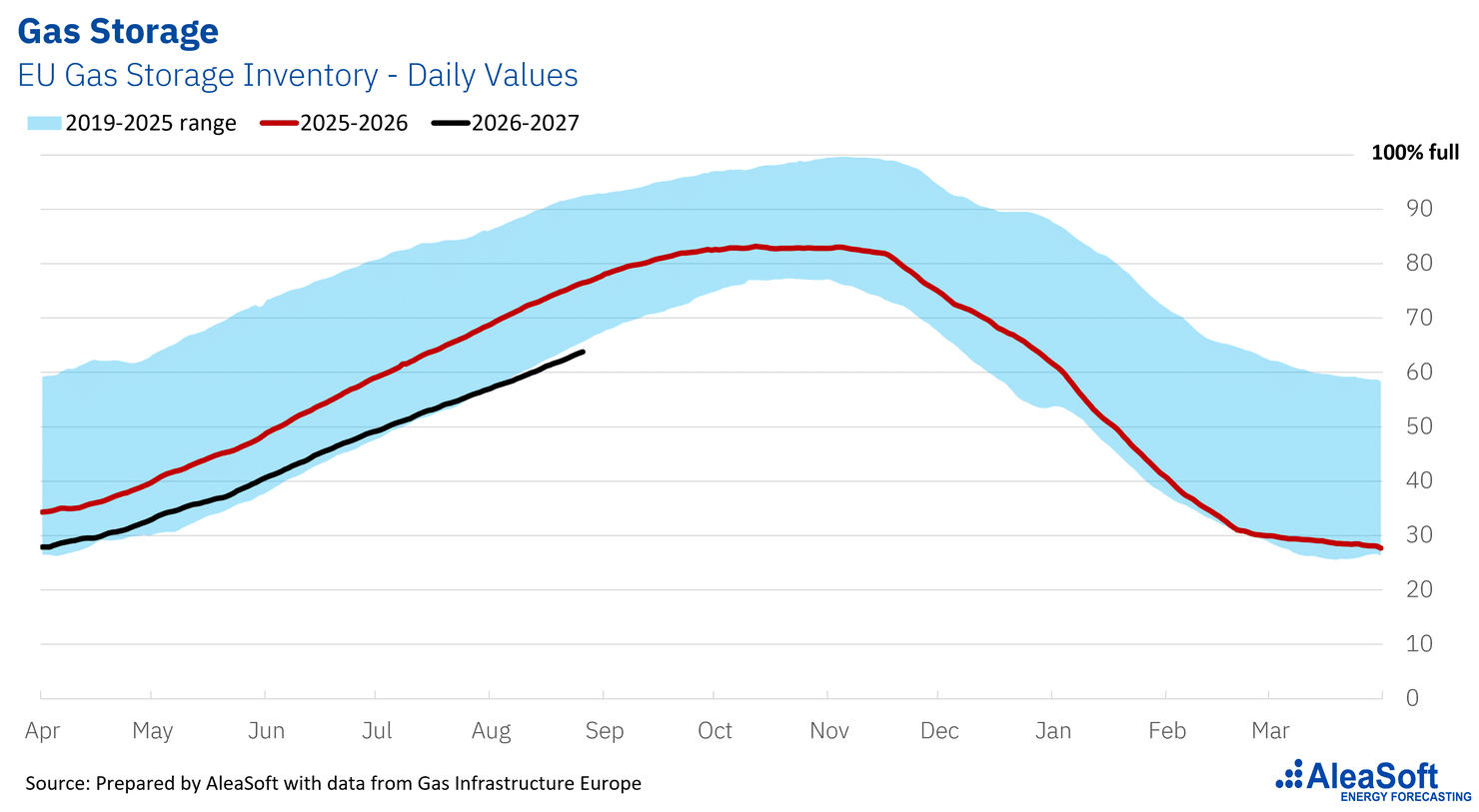
TTF gas futures for the Front‑Month stood at around €68/MWh in the last week of August, while European gas reserves are around 63%‑64%, compared with levels close to 80% that were usual for this time of year. This explains why the market is factoring in a significant risk premium ahead of winter.
 Source: TTF gas futures for the Front‑Month on the ICE Market, available in the Alea Energy Database.
Electricity is reacting very clearly. The Spanish fourth-quarter future on the OMIP market reached €121.77/MWh on August 24 and closed around €120/MWh on August 25. This is a very different signal from the one the market was giving just a few months ago.
This does not necessarily mean prices will stay this high throughout the winter. If geopolitical tension eases, LNG flows increase or we have a mild winter, the risk premium could fall quickly. But the episode again demonstrates something important: Europe remains highly sensitive to the international gas price, and that exposure passes through quickly to the electricity market.
Futures are already factoring in part of that risk. To what extent do they reflect what is likely to happen, and to what extent do they include a risk premium? For an industry that has to decide today whether to hedge, what information does the futures curve provide, and what can a market forecast add?
These are two different pieces of information, and both are necessary.
The futures curve tells us at what price a company can hedge today. It is the price the market is currently putting on risk. A forecast tries to answer a different question: what is the most likely evolution of the fundamentals that determine prices.
When a geopolitical crisis emerges, futures can quickly incorporate a risk premium. That does not mean the market is wrong: it means that whoever sells a hedge is taking on a risk and charging a price for doing so.
That is why a purchasing strategy should not consist of deciding whether we “believe” more in futures or in a forecast. A forecast helps put the futures curve into context and analyse scenarios. And futures allow a hedge to be executed.
At AleaSoft Energy Forecasting we work precisely with that combination of horizons. For a large consumer, knowing what will happen tomorrow is not enough. It needs to understand what could happen over the coming months to decide on its hedges, but also what the price of electricity could be in five, ten or twenty years if it is considering a PPA, an industrial investment or a new plant.
In just a few months we have seen very significant movements in electricity futures prices. What is the most common mistake you see in the purchasing and hedging strategies of large consumers?
The main mistake is trying to time the bottom.
A hedging policy should not be based on waiting to find the perfect moment to buy. That moment is only known in hindsight. When a company waits because it thinks the price might still fall, it is taking a market position, even if it is not aware of it.
The strategy needs to start much earlier, by defining what percentage of consumption it wants to hedge, over what horizon and what level of risk the company can take on. From there, the spot market, futures, bilateral contracts and PPAs can be combined.
It is also important to work with scenarios. Knowing the central scenario is not enough. A CFO should know what happens to their budget if an extreme situation in gas occurs again, if we have a year with low renewable production, or conversely, if PV continues to grow rapidly and many low-price hours appear.
Hedging is fundamentally risk management, not speculation. And forecasting should help quantify that risk.
Spain wants to attract data centers and electro-intensive industry by relying, among other factors, on its high renewable production. However, we are still seeing episodes of high prices and significant volatility. Is Spain still competitive for this type of ten- or twenty-year investment? What does a multinational need to know before deciding where to locate a large electricity consumption site?
Spain still has a very important structural advantage: it has one of the best solar resources in Europe, a good wind resource and an enormous pipeline of renewable projects. That should translate into competitive electricity in the long term.
But a multinational does not decide where to invest in a factory or a data center by looking at the market’s average price over the past year. It is making a decision for twenty or thirty years.
It needs to know the expected cost of energy, its volatility, the possibilities of closing a PPA or setting up a hedging strategy, the real availability of grid connection and the growth prospects of the electricity system.
And there is an aspect that is sometimes underestimated here: having a lot of renewable generation is not enough. Grid, energy storage, interconnections and new demand capable of consuming that electricity are also needed.
The European Commission has indeed pointed out that Spain needs to keep increasing storage and interconnections and reinforcing its grids.
If we get those investments right, the combination of renewables, storage and new industrial demand can become an extraordinary competitive advantage for Spain.
The growth of renewables, storage and new large-scale consumption is radically changing the way the electricity system is used. Do we need to revise grid tolls and tariffs again to adapt them to this reality? Should that reform be different for household consumers and for industry?
Yes, but I think we need to distinguish very clearly between household and industrial consumers.
For a household, we should aim for simplicity and protection, while allowing anyone with the ability to shift consumption, for example with an electric vehicle, a heat pump, an electric water heater or a battery, to benefit from doing so. It would not make much sense to pass on to the household consumer all the hourly complexity of the electricity system.
For industry and large consumers, on the other hand, it can make sense to send more precise economic signals about when and how they use the grid. Many industrial processes have a certain capacity to adapt, and a good tolls structure can help reduce congestion, make better use of existing infrastructure and facilitate the integration of new demand.
It is also important not to confuse the market signal with the grid signal. The hourly electricity price should reflect when there is an abundance or scarcity of energy. Tolls, on the other hand, should fundamentally reflect the cost of having and using the grids needed to transport that electricity.
In addition, Spain wants to attract new industry, data centers and other large consumers, while at the same time needing to invest much more in grids. The challenge is to find a balance: financing that infrastructure without imposing costs that slow down electrification or reduce industrial competitiveness.
Therefore, rather than a reform simply aimed at lowering tolls, I think we need a tariff structure that combines three objectives: efficient use of the grid, competitiveness and electrification.
Spain has accumulated tens of gigawatts of battery projects at different stages of development, but the capacity that is actually operational remains very small. What separates a BESS project that gets built today from one that remains on paper?
It is becoming increasingly clear that having a connection point and a technically viable project is not enough.
The big leap is demonstrating that a sufficiently robust revenue model exists to secure financing. A battery can take part in daily and intraday arbitrage, balancing services and, in the future, the capacity market. But each of those revenue sources has a different risk profile.
In addition, we cannot take today’s spreads and multiply them by twenty years. When many gigawatts of batteries come online, the batteries themselves will change the spreads and compete against each other. The same applies to balancing services: they are relatively small markets and cannot absorb unlimited new capacity while maintaining current returns.
That is why we are seeing a shift in stage. The first question used to be: “Does it have a connection?” The next one was: “How much can it earn?” Now the decisive question is becoming: “Are those revenues bankable?”
That shift is fundamental. The projects that manage to demonstrate solid revenues under different scenarios, a coherent operating strategy and a resilient financial structure will be the ones most likely to get built.
The capacity market should add a new revenue source for storage. To what extent can it change the financing of a battery, or will it still be necessary to take on significant merchant exposure? What will banks need to see to incorporate those revenues into their models?
The capacity market can be a very important piece, but it does not automatically make a battery bankable.
The European Commission approved the Spanish mechanism at the end of May, with a budget of up to €9 billion over ten years. Its aim is to remunerate available capacity to produce, store or reduce consumption when the system needs it.
For a battery, relatively stable revenue linked to availability can considerably improve the financial profile because it reduces exclusive dependence on merchant revenues.
But we will need to know the real outcome of the auctions, the remuneration, the derating factors, the duration of the contracts and the associated obligations. It is one thing for a capacity mechanism to exist, and quite another how much bankable revenue can be attributed to a specific project.
I think the future of BESS financing will lie precisely in the revenue stack: combining several revenue sources instead of relying on a single one. Arbitrage, balancing markets, capacity and, where possible, long-term contracts.
The larger the predictable or contracted share of those revenues, the easier it will be to increase leverage and reduce the cost of capital.
For financing a PV plant, there is already long experience with price curves, PPAs and different financial scenarios. A battery has to estimate spreads, cycles, balancing services, degradation and other revenue sources over many years. What does a bank ask for today to consider those forecasts sufficiently robust? And which assumptions should generate more caution?
A bank needs, above all, to understand where the revenues come from and to check that the project can still repay its debt under scenarios less favourable than the central one.
In a PV plant, the problem is relatively simpler: we estimate production, captured prices and, if it exists, the PPA. In a battery, there is much greater interaction between hourly prices, the charging and discharging strategy, efficiency, degradation, the number of cycles and different markets.
One of the mistakes we most need to avoid is extrapolating the extraordinary revenues of a recent period over the entire life of the asset.
For example, high spreads today are good news for existing batteries, but they also constitute an economic signal for new batteries to enter. That new capacity will end up changing the very market we are trying to forecast.
That is why long-term hourly simulations and sensitivity analyses are essential. We are currently devoting a great deal of effort to this area, not only to forecasting prices, but to turning those forecasts into revenue scenarios for different battery configurations and hybridisations.
It is a natural step because the question is no longer just how much a battery can earn, but what part of those revenues a bank can reasonably consider when deciding how much to finance.
The continued operation of Almaraz until 2030 changes one of the important assumptions being used for the Spanish electricity market in the coming years. What could change in price forecasts, gas-fired generation, renewable surpluses and opportunities for batteries? Could it also affect projects that are currently closing their financing or a PPA?
Yes. And it is a very good example of why long-term forecasts have to be continuously updated when the fundamentals change.
The approved extension allows Almaraz to continue operating until June 2030, whereas its two units were previously scheduled to close in 2027 and 2028.
Keeping several gigawatts of nuclear generation running during those years means adding more low variable-cost generation to the system. In general terms, that puts downward pressure on electricity market prices and reduces the need for combined-cycle production at certain times.
But there is a second consequence. If PV and wind continue to grow at the same time, keeping more inflexible generation running can increase situations of excess supply and hours of very low prices.
And that is where an interesting paradox appears for batteries: a somewhat lower average price does not necessarily mean less opportunity. For a battery, the difference between low-price hours and higher-price hours matters much more than the market’s average price.
The system needs to be simulated again. For anyone financing a battery or a renewable plant, or closing a long-term PPA today, 2030 is not far away. Changing several years of nuclear generation can alter captured prices, spreads and the expected revenues of the asset.
The whole sector is now talking about artificial intelligence. AleaSoft has used artificial intelligence techniques and statistical models since its earliest years. What is genuinely new in today’s AI applied to energy markets, and what part is simply marketing?
Artificial intelligence did not begin with ChatGPT. At AleaSoft Energy Forecasting we have used neural networks and statistical models to produce forecasts since 1999.
What is happening now, however, does represent a very significant leap. Until a few years ago, we used AI mainly to model complex relationships and produce forecasts. Generative AI makes it possible to add a new layer: interpreting unstructured information, connecting large amounts of knowledge and building agents capable of using different models, data and tools.
In the energy sector, this opens up enormous possibilities. We can connect a price forecast with revenue models, market information, regulation and financial models, and make all that knowledge much more accessible.
But there is also a lot of marketing. A generative model can write an apparently outstanding explanation and still be wrong. In energy, where hundreds of millions of euros of investment can sit behind a single forecast, we cannot replace quantitative models, reliable data and statistical validation with a convincing answer from a chatbot.
That is precisely why we are setting up an artificial intelligence lab within our division AleaConsulting. The idea is not to add AI to everything because it is fashionable, but to identify specific problems where it genuinely adds value. One of the main projects is a platform to analyse battery revenues and financing. We are also working on market analysis automation and specialised agents for the energy sector.
I think the real leap will come from combining predictive models, generative AI, data and expert knowledge.
The 2021 and 2022 crises also showed the limits of any model. With more data, more computing power and increasingly powerful artificial intelligence tools, are we producing better forecasts, or is there a risk of creating a false sense of precision? What distinguishes a good forecast from a merely sophisticated one today?
We are producing better forecasts, but that does not mean we can eliminate uncertainty.
No model could know in advance the date of an invasion, the interruption of certain gas flows or an extraordinary political decision. The mistake lies in asking a forecast for something a forecast cannot provide.
A good forecast is not one that claims to know exactly how much electricity will cost in ten years’ time. It is one that correctly represents the market fundamentals, allows coherent scenarios to be built and quantifies the uncertainty around the central scenario.
That is why we advocate combining different methodologies. In our case, we use hybrid models that combine neural networks, statistical time-series models and causal regression. Each methodology captures a different part of the problem.
And there is something even more important: validation. A model can be extremely sophisticated and produce a spectacular chart, but if it is not systematically backtested and its previous forecasts are not analysed, that sophistication is of little use.
After almost 27 years forecasting energy markets, we have also learned that structural change matters just as much as historical data. The massive growth of PV, batteries, electric vehicles, data centers or a decision such as extending Almaraz’s life all change the relationships that existed previously.
Artificial intelligence is going to greatly improve our analytical capacity, but it does not remove the need for expert knowledge. It will probably make it even more important to know how to tell the difference between an answer that sounds plausible and a forecast that can be defended quantitatively. That, in my opinion, will be one of the great challenges of the next stage of artificial intelligence applied to the energy sector.
Source: AleaSoft Energy Forecasting.