


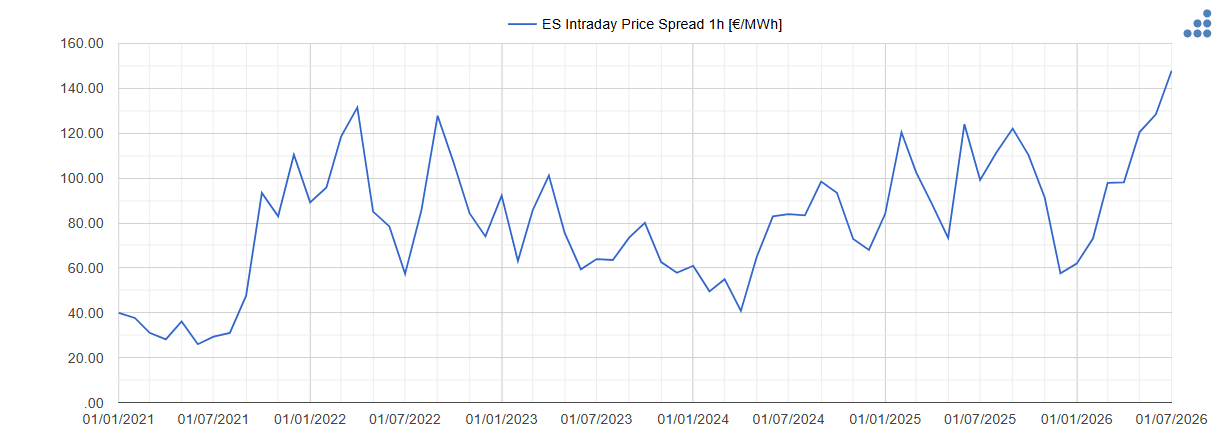
AleaSoft Energy Forecasting, August 5, 2026. In July, the average one-hour intraday spread of the Spanish electricity market reached a value of €148/MWh, a historic high even above the levels of the 2022 energy crisis. Portugal also recorded a record of €142/MWh. As relevant as the magnitude is how it is generated. While in other European markets the opportunities for batteries are concentrated in a few extreme episodes, in Spain they appear more regularly.
The one-hour spread
The one-hour intraday spread is the difference between the maximum and minimum hourly price of each day in the day-ahead market. It approximates the value a battery can capture through arbitrage, buying in the lowest-price hour and selling in the highest-value hour, although the actual revenue also depends on efficiency, degradation, the number of cycles per day and operating costs. In July, the average reached €148/MWh in Spain and €142/MWh in Portugal, record historic values for these markets.
 Source: Alea Energy DataBase
A record different from the energy crisis
The comparison with 2022 is revealing. Back then, the widening of spreads was linked to extraordinary natural gas prices, which set the price in the hours of highest demand. Now, the price of gas remains high, but far from those levels. The July record has a different cause. The growing penetration of photovoltaic solar energy pushes prices down at midday, and when solar production falls while demand is still high, technologies with higher variable costs come into play. This contrast between an increasingly deep solar trough and a high evening peak widens the daily spread. It is not short-term volatility, but a structural signal stemming from the transformation of the electricity mix, the same signal that storage and the rest of the flexibility technologies need.
In Spain, opportunities are less concentrated
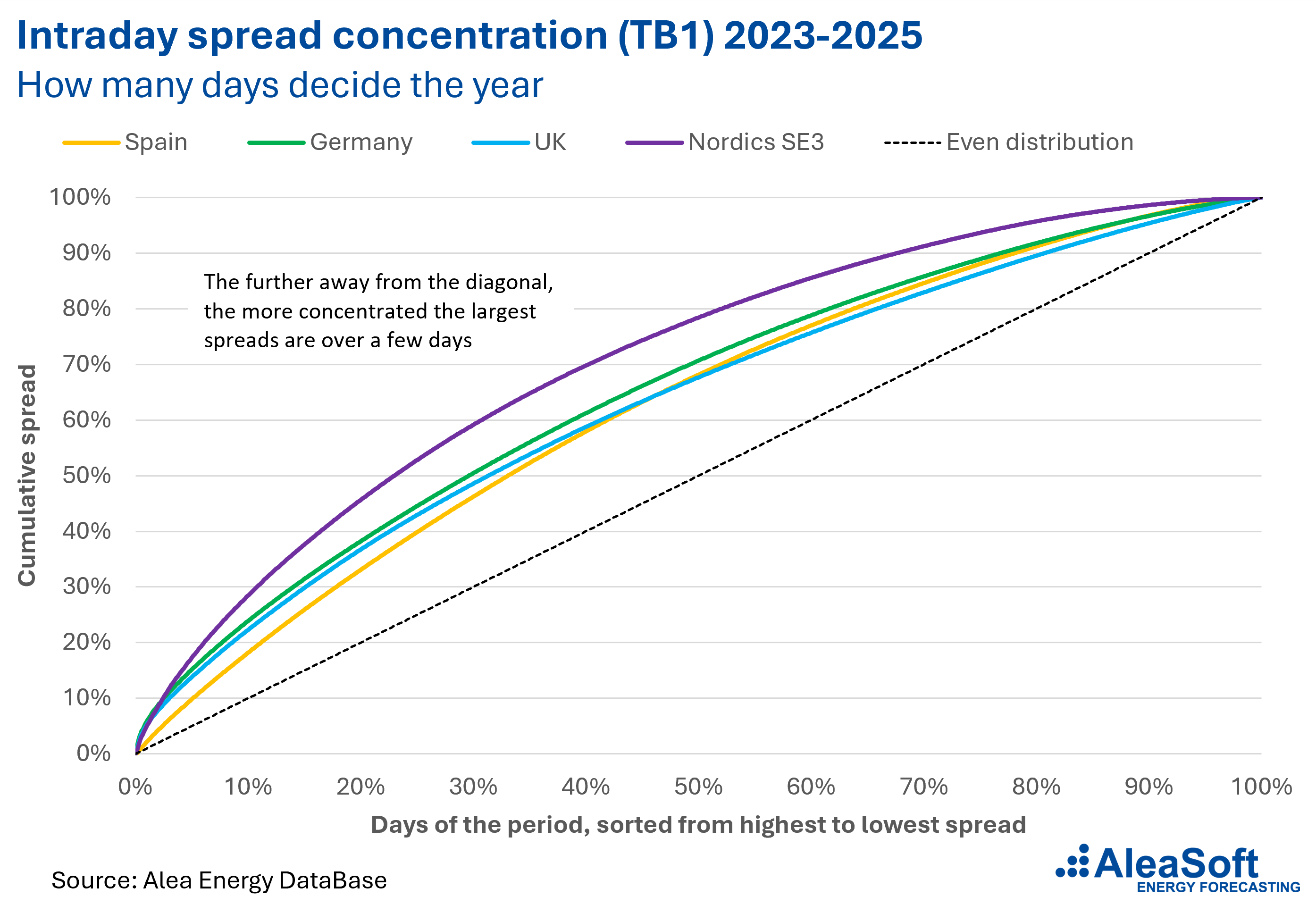
To analyse to what extent a battery’s potential revenue depends on exceptional days, the 1096 days between 2023 and 2025 were ranked by their daily spread in Spain, Germany, the United Kingdom and the SE3 zone of Sweden’s day-ahead market. The 10% of days with the highest spread contributed 18% of the accumulated spread in Spain, compared with 22% in the United Kingdom, 23% in Germany and 29% in Sweden SE3. The same conclusion emerges when calculating the days needed to accumulate half of the annual spread. Only 85 days are needed in Sweden, but 124 are needed in Spain. This lower concentration reduces dependence on exceptional episodes and allows arbitrage opportunities to appear more frequently.
The difference lies in the fundamentals
The origin of the spread determines its magnitude and its distribution throughout the year. In the United Kingdom, the largest differences are linked to scarcity during winter peaks. In Germany, Dunkelflaute episodes, with low wind production over several days, push prices up, while high photovoltaic capacity pushes them down in spring and summer. In Sweden, hydro availability, temperatures and heating demand determine the episodes of high spread. In these markets, the battery must capture value in specific episodes and at the exact moment. In Spain, the growing spread is explained the other way around. It is not the exceptional nature of high-price hours, but the recurrence of low-price hours generated by photovoltaic production at midday, followed by a price rise after sunset.
The differences between markets are also reflected in the ratio between the average summer spread and the winter spread. It stands at 0.60 in Sweden SE3 and 0.76 in the United Kingdom, where the largest spreads are concentrated during winter, and 1.59 in Germany, where the largest spreads are observed in summer. In Spain, this ratio stands at 1.12, the only one of the four markets without a clearly dominant season. This more balanced distribution reduces a battery’s exposure to specific weather conditions determining a large part of its annual result.
More regularity does not necessarily mean more revenue
The lower concentration of spreads does not imply a higher absolute level. In 2025, Germany recorded an average daily spread of approximately €124/MWh, compared with €98/MWh in Spain, so perfect arbitrage would have generated more revenue in the German market. Spain’s advantage lies in regularity, not in the size of the opportunity. Furthermore, the theoretical spread does not equate to a battery’s net revenue, which also depends on efficiency, degradation, the number of cycles and participation in intraday markets and balancing services.
Spreads as a signal for flexibility
The record spreads in Spain and Portugal in July should not be interpreted solely as an episode of volatility, but as a structural transformation of the electricity system. Solar energy reduces prices during more hours, but demand has not yet shifted at the same pace, and energy storage makes it possible to move electricity from hours of abundant renewable generation to hours of higher demand. The greater the capacity of batteries, pumped storage, active demand management and interconnections, the greater the system’s capacity to absorb renewable generation, which will moderate spreads in the future without eliminating the value of storage.
The spread series, available on AleaApp
To turn these market signals into investment and operating decisions, AleaStorage, the division of AleaSoft Energy Forecasting specialised in energy storage, offers battery revenue analysis, hybridisation projects and flexibility strategies. With that same objective, AleaSoft has added to Alea Energy DataBase the historical series of one, two, four and six-hour intraday spreads for the main European markets, making it possible to compare markets, measure spread concentration and support the valuation of storage projects.
Source: AleaSoft Energy Forecasting