


AleaSoft Energy Forecasting, October 23, 2026. Growing volatility in electricity markets poses different risks for renewable producers and large consumers. While the former seek to protect their revenues against low prices, the latter need to limit their exposure to possible price rises. PPA contracts can provide stability to both parties, provided their terms are adapted to market prospects and to generation and consumption profiles.

The need to establish hedges against price risk was one of the central topics of the 70th webinar by AleaSoft Energy Forecasting, held on October 15 with the participation of Deloitte. During the session, AleaSoft stressed that any hedge, whether a PPA or a bilateral contract, is essential for both producers and consumers, and pointed to electro-intensive industry as the most exposed if the current tensions persist.
Producers and consumers face different price risks
Prices in European electricity markets have been on an upward trend for several months, following the evolution of gas prices. In September they rose by more than 20% compared with August in the Spanish market and in the Nordic markets. Price peaks in the hours when combined cycle plants set the price are increasingly high, while zero or negative prices continue to appear in solar hours. In Spain, the number of hours with zero or negative prices recorded in 2026 up to October already exceeds the totals for the whole of 2024 and 2025. As a result, the average intraday spread in the Spanish market exceeded €200/MWh in September.
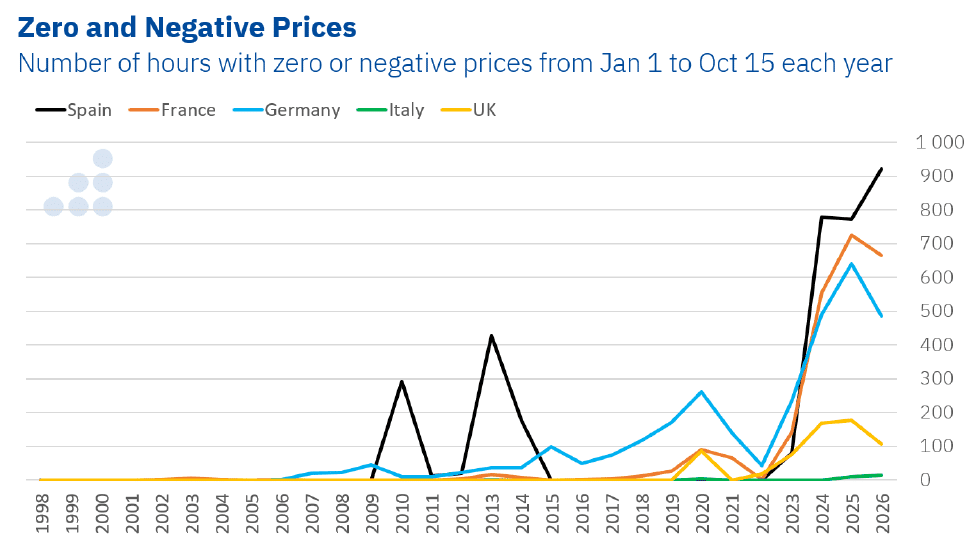 Source: Prepared by AleaSoft Energy Forecasting using data from OMIE, RTE, Nord Pool and GME.
For photovoltaic producers, the concentration of supply in solar hours reduces the captured price. Although the captured price has improved in recent months, in many cases it is not enough to service project debt, and there is a risk that prices will fall again in spring, with more photovoltaic production and more rain.
Large consumers, such as electro-intensive industry and data centers, face the opposite risk. High and volatile gas prices are expected this winter, with gas reserves in the European Union at 74% in mid-October, compared with 83% the previous year. This reduces the margin to respond to cold spells or periods of low wind. In winter there are also fewer hours with low prices, and peaks are concentrated in the evening and in the morning.
This combination of risks creates a favourable moment for agreements. Producers fear a new fall in prices and consumers fear further rises. For AleaSoft, this is the right scenario for both parties to close hedges with each other, through three- or five-year PPAs or other bilateral contracts.
PPAs provide stability but do not eliminate all risks
According to the Deloitte speakers, price risk is currently the main risk for renewable projects, and the PPA is the instrument that brings the views of developers and financial institutions closer together. With a PPA, banks can finance up to 75% of the project, compared with the 50% or 55% they rarely exceed with merchant risk.
However, the photovoltaic PPA market is currently a buyer’s market. There are few offtakers willing to take on the solar profile, and 10-year swap PPAs for photovoltaics are being offered at between €22/MWh and €25/MWh. At these levels developer profitability is low, and fixing a price that is too low over a long period can jeopardise the viability of new projects.
For large consumers, adapting the contract to their consumption profile is key. Photovoltaic production is concentrated in the middle hours of the day, which do not always coincide with the hours of highest consumption, so it is necessary to assess what share of supply the contract covers and what market exposure remains. Hybrid PPAs with batteries shift part of the solar production towards hours with higher prices, which allows higher PPA prices. Deloitte also presented the case of a photovoltaic plant connected directly to a data center, where the savings on connection costs allow a PPA of around €40/MWh with terms of 15 years or more.
In addition to price, the duration of the agreement, the committed volumes, the settlement method and the treatment of hours with zero or negative prices change the value of the contract. Financial institutions require minimum terms of between 7 and 10 years and do not consider PPAs that suspend settlement when prices are zero or negative to be bankable. The clauses also determine the accounting treatment, so it is advisable to analyse them before signing.
Price forecasts are fundamental to defining the purchasing strategy
Before signing a PPA, a large consumer must assess how prices could evolve over the life of the contract and what share of its consumption it is worth hedging. It is not enough to compare the price offered with the current price or with the prices in futures markets, which are illiquid in the long term and should not be used as price forecasts.
It is necessary to have long-term price forecasts with hourly detail and with favourable and adverse scenarios that reflect the evolution of electricity demand, new solar and wind capacity, weather conditions, fuels and emission rights for CO2. A strategy that is attractive when prices are high can have drawbacks if prices fall in a sustained way, and an unhedged position can be very costly in an extreme scenario. At the webinar, AleaSoft warned that tensions in the Strait of Hormuz coinciding with incidents in the European nuclear fleet could push prices to €500 or €600/MWh.
For Deloitte, a robust, bankable price curve that can be justified to lenders and auditors is practically the main input, both in contract valuation and in cash flow estimates.
Risk management, beyond the contract price
For large consumers, an electricity purchasing strategy must go beyond obtaining the lowest price at a given moment. The aim is to combine contracts and hedges that keep electricity costs at affordable levels without giving up the hours with low prices. Behind-the-meter batteries expand these options, as they allow energy to be stored in low-price hours and used in higher-price hours. AleaSoft is receiving a growing number of assignments from large electro-intensive consumers interested in installing batteries.
A favourable moment to close hedges
Winter 2026-2027 arrives with high gas prices and high volatility, while spring will again bring hours with very low prices. Producers and large consumers have complementary needs, and PPAs and bilateral contracts allow both parties to fix part of their revenues and costs. The success of these agreements will depend on their being adapted to generation and consumption profiles, on their clauses being analysed before signing and on both parties having a well-founded view of how the electricity market will evolve.
The role of AleaBlue, AleaGreen and AleaHub in procurement strategies
AleaSoft Energy Forecasting helps large consumers to plan their electricity and gas purchases and define hedges, with simulations to value forward contracts, futures and PPAs, and support in the negotiation of bilateral agreements. AleaBlue, the division specialising in short- and mid-term forecasting, provides hourly price forecasts and simulations with a horizon of up to three years for risk management and hedging.
AleaGreen, the division specialising in long-term forecasting, provides hourly price curves with a horizon of up to 40 years. These forecasts, with confidence bands, are the basis of AleaSoft’s consultancy in identifying risks, defining agreements and term sheets, and negotiating and closing PPAs. AleaSoft’s methodology combines Artificial Intelligence, time series and statistical models, with 27 years of experience.
In addition, AleaHub, the PPA marketplace by AleaSoft, connects offtakers and developers and checks that their needs match in terms of energy quantity, term, PPA type, price and guarantees of origin.
Source: AleaSoft Energy Forecasting