


AleaSoft Energy Forecasting, October 21, 2026. Tolling agreements, revenue share contracts and hybrid PPAs make it easier to finance batteries and manage market risk, but they complicate their valuation and accounting treatment. This was the analysis of the Deloitte speakers at the latest AleaSoft webinar, who pointed to reliable long-term price forecasts as the basis for valuing these contracts and justifying the assumptions to auditors.

New contractual structures for batteries and hybridisation
The 70th webinar by AleaSoft Energy Forecasting, held on October 15 with the participation of Deloitte for the seventh consecutive year, analysed the contracts that are accompanying the growth of energy storage. Traditional PPAs are now joined by formulas that take advantage of the flexibility of batteries, improve delivery profiles and share revenues and risks between the parties. According to Deloitte, swap PPAs for solar photovoltaic plants are currently being offered at between €22/MWh and €25/MWh, a level that reduces project profitability.
In a tolling agreement, the battery owner hands over 100% of its management to the optimiser in exchange for a fixed price. As this is contracted revenue, market risk disappears and banks can calculate the debt level on that cash flow. In the case study presented by Deloitte, a 100 MW battery with 4 hours of storage associated with a 140 MWp solar photovoltaic plant, with a tolling agreement of €70 000 per MW for 10 years, reduces the equity requirement from 142 to 86 million euros and achieves a return on equity of 10.0%, compared with 10.2% in the merchant scenario financed solely with equity.
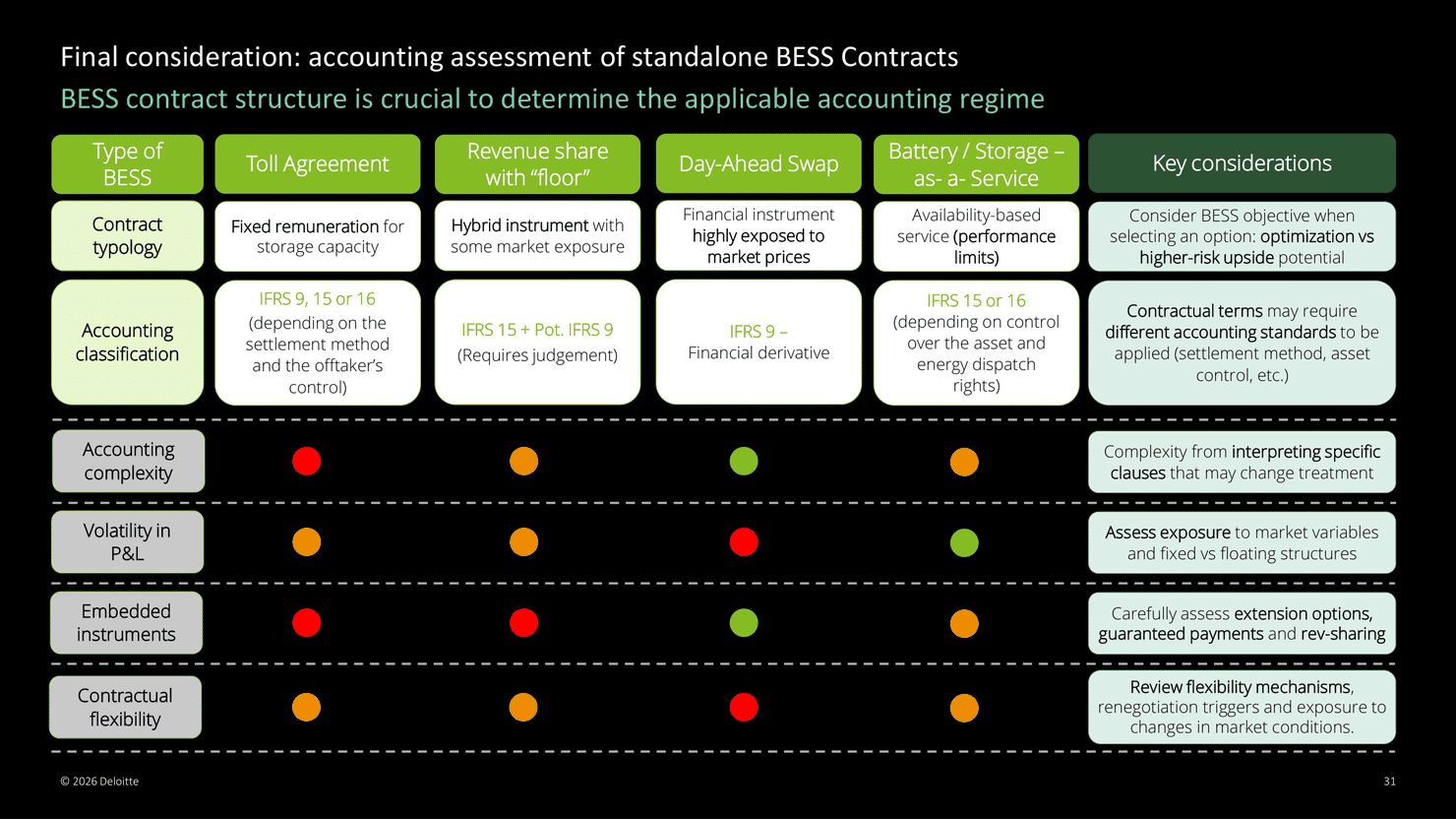
Revenue share splits the revenue generated by the battery between the parties and may include a guaranteed minimum revenue, or floor, which protects the owner while allowing them to share in additional profits. Also emerging are day-ahead swaps, linked directly to market prices, and storage as a service contracts, which remunerate the availability of storage.
Hybrid PPAs use part of the battery capacity to shift solar energy production from the middle of the day to the hours with higher prices. This profile allows a higher PPA price than that of a solar plant without a battery. In the Deloitte example, with prices between €32/MWh and €41/MWh, the return on equity ranges from 8.7% to 10.2%, and at least €40/MWh is needed to match the returns of the other scenarios.
Accounting treatment depends on the terms of the contract
Álvaro Osés Lainez, Manager of Treasury Advisory at Deloitte, explained that the structure and clauses of each contract determine its accounting treatment. For PPAs, the basic distinction is between physical and financial contracts. A physical PPA without take or pay clauses or optionality can be treated as an executory contract, in which revenue is recognised as the energy is supplied. A financial PPA with settlement by differences has the characteristics of a derivative instrument under IFRS 9 and must be recognised on the balance sheet and measured at fair value.
Changes in the value of a derivative that is not designated as a hedge go through the profit and loss account and generate volatility. With hedge accounting, these changes are recorded in equity and only affect results when the hedged energy sales reach the profit and loss account.
In battery contracts, the settlement method and control of the asset determine the applicable standard. A day-ahead swap has the characteristics of a financial derivative and is governed by IFRS 9. A revenue share with guaranteed minimum revenues is a hybrid instrument that may require IFRS 15 and, in part, IFRS 9. A tolling agreement may be subject to different standards depending on its settlement mechanisms and on who controls the asset, and for storage as a service it is necessary to analyse whether there is a provision of services or a lease, under IFRS 15 or IFRS 16. Guaranteed payments, extension options and battery operating rights can change that classification.
 Source: Deloitte
The importance of analysing the implications before signing
Deloitte stressed the need to incorporate accounting and valuation analysis from the earliest stages of negotiation, because once the contract is signed, the terms that determine whether it qualifies for hedge accounting can no longer be changed. It recommended carrying out this analysis internally or with a specialised external consultant before signing.
Otherwise, a company may find itself at year-end with a day-ahead swap already signed that it considered a contract with no accounting relevance, and with the auditor requiring it to be valued. If the company cannot apply hedge accounting, changes in value go through profit and loss and generate volatility that had not been anticipated during the negotiation.
Long-term price forecasts, fundamental for valuation
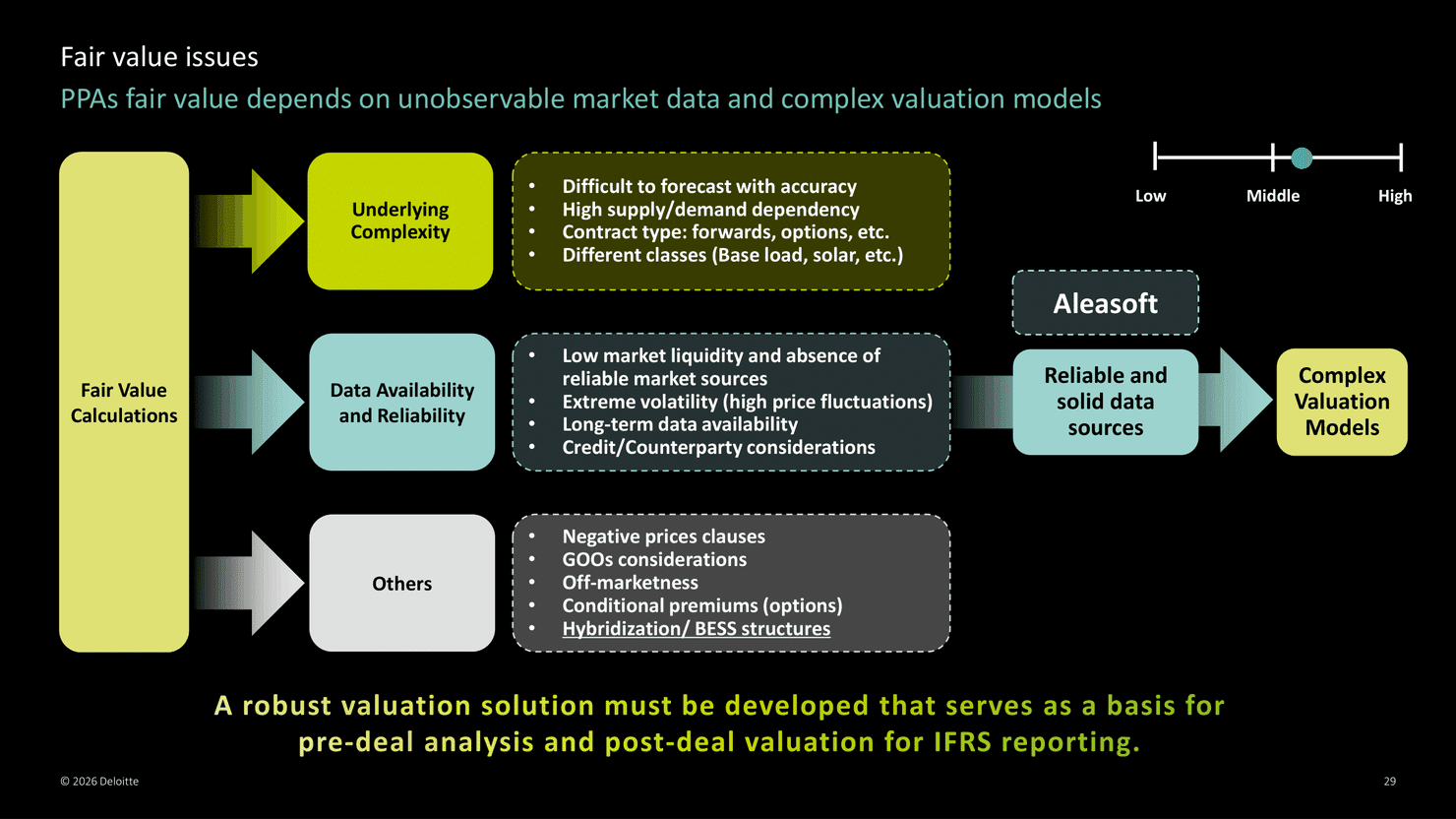
The fair value of a PPA or a battery contract depends on unobservable market data and complex valuation models. Deloitte identified the factors involved as the low liquidity of futures markets, extreme volatility, the availability of long-term data, counterparty risk, negative price clauses and structures with batteries.
In this context, Álvaro Osés highlighted the need for reliable and solid market data sources, and pointed to the role of the price curves from AleaSoft Energy Forecasting, hourly and monthly, which are accepted by auditors and other reviewers to justify the valuation of these instruments. Osés described them as practically the main input, both in the valuation of derivatives and in the cash flow estimates of financial models.
 Source: Deloitte
During the analysis roundtable, Oriol Saltó i Bauzà, Associate Partner at AleaSoft, pointed out that the future revenues of a battery can only be estimated by simulating its operation over long-term price scenarios, because its operation depends on each day’s hourly prices and on the cycles performed the previous day. Multiplying an expected price spread by a fixed number of cycles does not reflect that complexity.
Contracted revenues and prior analysis, key to financing storage
Banks remain conservative with batteries, as they do not yet have previous transactions to compare them with, and they prioritise contracted revenues. As a result, tolling agreements, revenue share with a floor and hybrid PPAs are emerging as the routes to finance the storage capacity the system needs. AleaSoft pointed to 2026 as the year in which installed battery capacity is starting to grow rapidly. Having robust price forecasts and analysing the financial and accounting consequences before formalising agreements will make it possible to manage risks and support investment decisions.
Long-term forecasts for contract valuation: the role of AleaGreen
AleaGreen, the AleaSoft Energy Forecasting division specialising in long-term forecasts, provides electricity market price curves with hourly granularity. These make it possible to analyse the future evolution of prices and hourly profiles, which determine the value of renewable generation and storage, and to support the valuation of PPAs, battery-linked contracts and energy asset portfolios.
The methodology developed by AleaSoft, with 27 years of experience, combines Artificial Intelligence, econometric models, time series and market equilibrium analysis. Its consistency and the ability to justify market assumptions facilitate its use in financial models and its review in audit processes.
For battery contracts, AleaStorage, the AleaSoft Energy Forecasting division specialising in energy storage, estimates the revenues of stand-alone batteries and of batteries hybridised with renewables by simulating their operation over long-term price scenarios.
Source: AleaSoft Energy Forecasting