


AleaSoft Energy Forecasting, July 6, 2026. In the first week of July, weekly average prices fell in the main European electricity markets after the previous week’s increases due to the heat wave. Lower electricity demand and higher wind energy production drove this trend. Portugal and Italy set all‑time records for solar photovoltaic energy production. Meanwhile, TTF gas and CO2 futures rose, while Brent futures stayed stable.
Solar photovoltaic and wind energy production
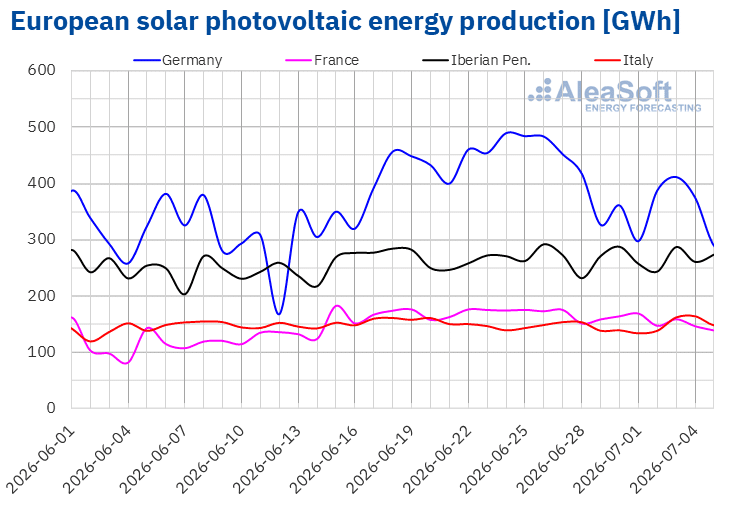
In the week of June 29, solar photovoltaic energy production increased by 12% in Portugal’s electricity market compared with the previous week. The Spanish market maintained production values similar to those of the preceding week. By contrast, Germany, France and Italy registered declines in solar photovoltaic energy production. The German market registered the largest drop, 24%. France followed with a 9.8% decline, while Italy registered the smallest drop, 1.1%, and logged its second consecutive week of decreases.
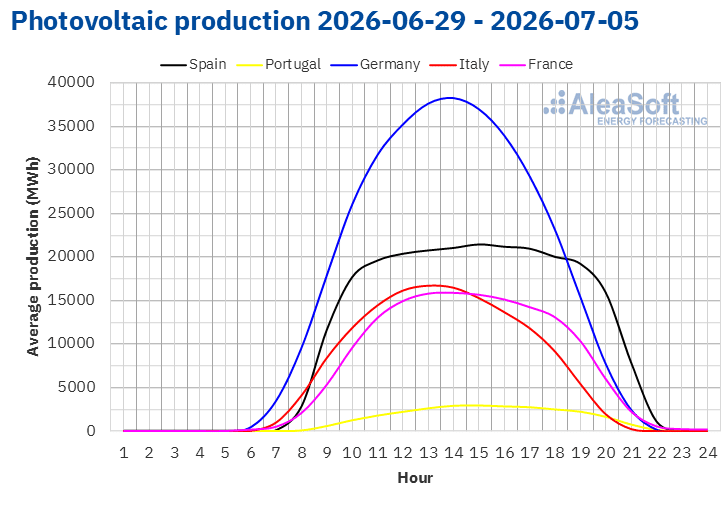
During the week, Portugal and Italy set solar photovoltaic energy production records. Portugal reached an all‑time high on June 30, with 35 GWh. Italy reached its record on July 4, with 164 GWh. Spain registered its highest solar photovoltaic energy production for a July day on July 5, with 249 GWh.
For the week of July 6, AleaSoft Energy Forecasting’s solar energy forecasts point to increases in Italy and Germany, while the Spanish market will register declines.
 Source: Prepared by AleaSoft Energy Forecasting using data from ENTSO-E, RTE, REN, Red Eléctrica and TERNA.
 Source: Prepared by AleaSoft Energy Forecasting using data from ENTSO-E, RTE, REN, Red Eléctrica and TERNA.
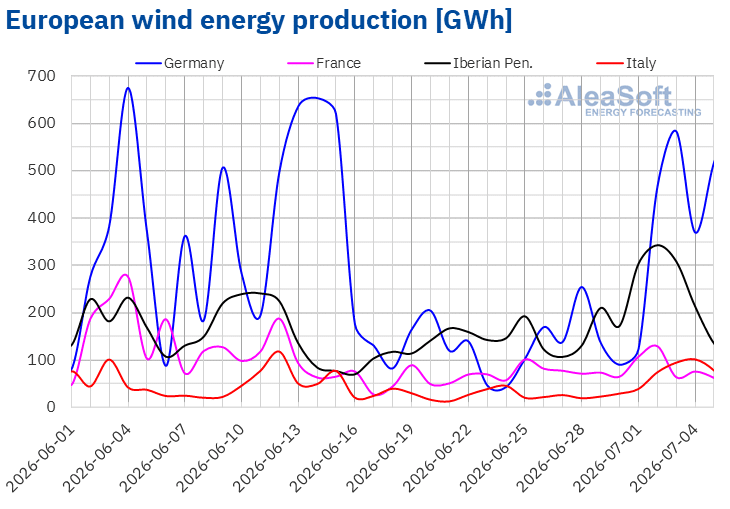
In the second week of July, wind energy production increased in all major European electricity markets compared with the previous week. Germany registered the largest increase, 156%, while France registered the smallest rise, 9.1%. Among the remaining markets, Portugal increased its wind energy production by 62%, Spain by 70% and Italy by 122%. The markets of France, Portugal and Spain maintained their upward trend for the second consecutive week. By contrast, Germany and Italy reversed the downward trend they had registered during the previous two weeks.
On Thursday, July 2, the markets of Spain and Portugal reached their highest daily wind energy production for a July day in the last four and five years, respectively. Spain registered 252 GWh, while Portugal registered 66 GWh.
For the week of July 6, AleaSoft Energy Forecasting’s wind energy forecasts point to an increase in the German electricity market. By contrast, they indicate declines in the markets of France, Italy and the Iberian Peninsula.
 Source: Prepared by AleaSoft Energy Forecasting using data from ENTSO-E, RTE, REN, Red Eléctrica and TERNA.
Electricity demand
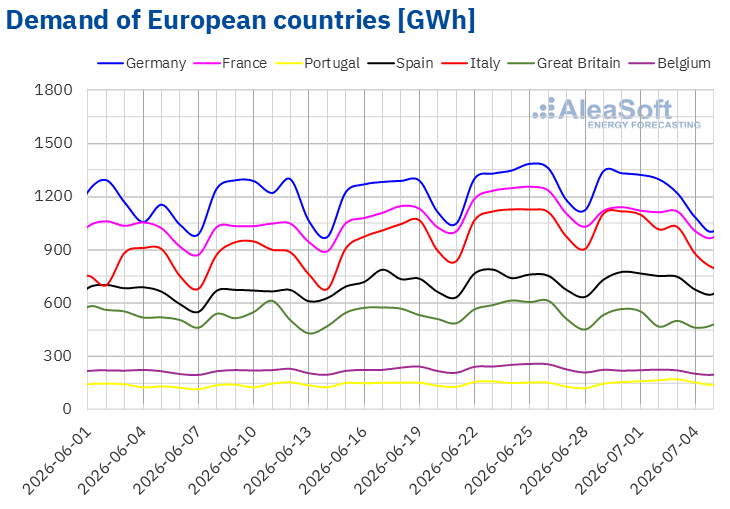
In the week of June 29, electricity demand decreased in most major European electricity markets compared with the previous week. Belgium registered the largest drop, 10%, followed by Great Britain, with a 9.8% decline. France fell by 8.5%, while Italy and Germany registered declines of 5.3% and 4.7%, respectively. Spain showed the smallest decline, 0.3%. By contrast, Portugal stood out as the only market with higher electricity demand, with a 7.0% increase, and accumulated its fourth consecutive week of growth.
During the week, average temperatures fell in most of the analyzed markets. Belgium registered the largest decrease, 8.1 °C, followed by France, with 6.1 °C, Germany, with 5.9 °C, and Great Britain, with 5.2 °C. In Italy, average temperatures fell by 0.9 °C, while Spain registered a 0.3 °C decline. Portugal stood as the exception, with a 1.6 °C increase in average temperatures.
The drop in temperatures compared with the previous week helped reduce electricity demand in most analyzed markets, after heat wave episodes affected France, Italy, Belgium and Germany during the second half of June, and after an intense heat episode affected Great Britain between June 24 and June 28. In Portugal, by contrast, temperatures remained high during the week of June 29, which influenced the increase in electricity demand in that market, in contrast with the widespread downward trend across the other analyzed markets.
For the second week of July, AleaSoft Energy Forecasting’s demand forecasts indicate increases in the electricity markets of Great Britain, France, Belgium and Spain. By contrast, demand will fall in the markets of Portugal, Germany and Italy.
 Source: Prepared by AleaSoft Energy Forecasting using data from ENTSO-E, RTE, REN, Red Eléctrica, TERNA, National Grid and ELIA.
European electricity markets
Weekly average prices fell in the main European electricity markets during the first week of July, in contrast with the previous week’s increases due to the heat wave. The Italian market registered the smallest decline, 6.8%. In the rest of the markets analyzed at AleaSoft Energy Forecasting, declines ranged from 20% in the British market to 32% in the French market, which led the percentage decline. Spain and Portugal both registered declines close to 28%. Germany, Belgium, the Nordic market and the Netherlands registered decreases between 21% and 24%.
In the week of June 29, the Italian market maintained the highest weekly average, €134.85/MWh, despite the decline. The Nordic market registered the lowest average, €52.91/MWh. The Spanish and Portuguese markets remained below €65/MWh, with averages of €63.20/MWh and €63.21/MWh, respectively. In the rest of the markets analyzed at AleaSoft Energy Forecasting, average prices ranged from €78.60/MWh in the French market to €112.08/MWh in the Belgian market.
Regarding daily prices, the French, Spanish, Nordic and Portuguese markets registered prices below €50/MWh in some sessions during the first week of July. On Sunday, July 5, the Nordic market reached the lowest average of the week among the analyzed markets, €26.95/MWh.
On the other hand, daily prices exceeded €100/MWh on some occasions during the first week of July, mainly at the beginning of the week, in most European markets. The Spanish, Nordic and Portuguese markets stood as the exceptions. The Belgian and Dutch markets reached prices above €200/MWh on Tuesday, June 30. On that day, the Belgian market reached the highest daily average of the week among the analyzed markets, €210.96/MWh.
Lower electricity demand, supported by the drop in temperatures after the heat wave, and the rebound in wind energy production across all analyzed markets drove the widespread decline in prices during the first week of July. The decline in solar photovoltaic energy production in Germany, France, Spain and Italy partially limited this decrease. Despite the drop, the Italian and Belgian markets remained among Europe’s highest‑priced markets, while the Nordic market continued to rank as the lowest, in line with the region’s usual pattern.
AleaSoft Energy Forecasting’s price forecasts indicate that, in the second week of July, prices will rise in most European electricity markets, in line with the expected increase in demand and the decline in wind energy production. Gas price trends will continue to influence European electricity markets.
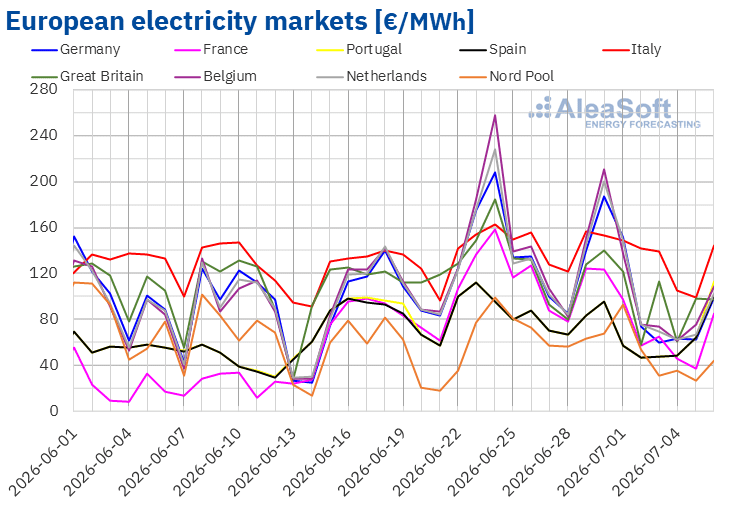 Source: Prepared by AleaSoft Energy Forecasting using data from OMIE, EPEX SPOT, Nord Pool and GME.
Brent, fuels and CO2
Brent oil futures for the Front‑Month in the ICE market reached their weekly maximum settlement price, $73.15/bbl, on Monday, June 29. Prices fell to the weekly low of $71.57/bbl on Wednesday, July 1. According to data analyzed at AleaSoft Energy Forecasting, this price marked the lowest level since February 27. In the last sessions of the week, prices recovered slightly. On Friday, July 3, the settlement price stood at $72.12/bbl, practically the same level as the previous Friday, only 0.2% higher.
During the first week of July, Brent oil futures prices remained stable as traffic through the Strait of Hormuz continued to normalize after the tensions of the previous weeks. Progress in negotiations between the United States and Iran, which had already pushed prices downward the previous week, continued to support a scenario with a lower geopolitical risk premium in the oil market.
As for TTF gas futures in the ICE market for the Front‑Month, the settlement price increased steadily throughout the week, from €42.57/MWh on Monday, June 29, to the weekly maximum of €45.22/MWh on Friday, July 3. According to data analyzed at AleaSoft Energy Forecasting, this price stood 11% above the previous Friday’s level.
The need to inject gas into European storage facilities ahead of next winter drove TTF gas futures prices higher in the first week of July. The rebound in gas demand for electricity production in some European markets, in a context of high temperatures and lower solar photovoltaic energy production, also contributed to this upward behavior.
Regarding CO2 emission allowance futures in the EEX market for the reference contract of December 2026, they registered their weekly minimum settlement price, €78.79/t, on Monday, June 29. In the last session of June, the settlement price exceeded €80/t, while in the first two sessions of July, prices remained around €79.50/t. In the last session of the week, prices increased to the weekly maximum of €80.59/t on Friday, July 3. According to data analyzed at AleaSoft Energy Forecasting, this price stood 0.4% above the previous Friday’s level, in line with the rebound in TTF gas prices. The usual correlation between both commodity markets appeared again during the first week of July.
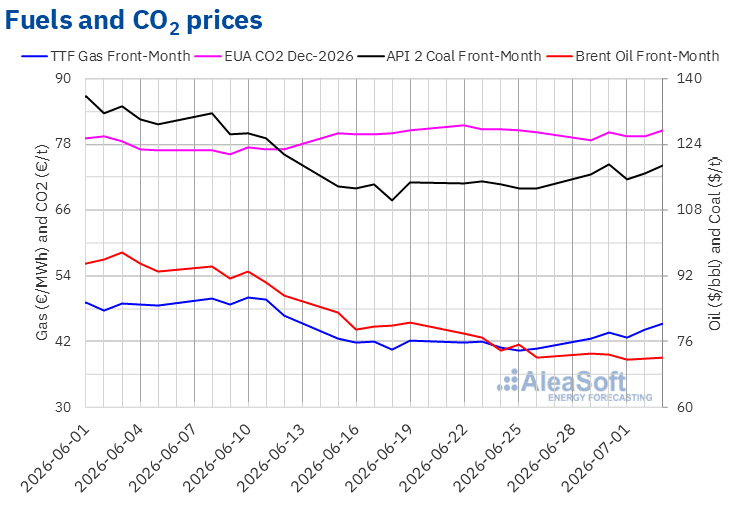 Source: Prepared by AleaSoft Energy Forecasting using data from ICE and EEX.
AleaSoft Energy Forecasting’s analysis on the prospects for energy markets in Europe
Next Thursday, July 9, AleaSoft Energy Forecasting will hold the 68th edition of its monthly webinar series. The session will address the evolution and prospects of European energy markets, along with the current status and expectations for PPA, renewable energy and storage project financing, and the opportunities that energy storage offers in combination with renewable energy hybridization and self‑consumption. The Spanish‑language webinar analysis panel will bring together Pedro González, Director‑General of AEGE, and Roger Font, Managing Director Project Finance Energy at Banco Sabadell.
Source: AleaSoft Energy Forecasting.