


AleaSoft Energy Forecasting, July 17, 2026. Artificial Intelligence is often associated today with generative models, conversational assistants and large data centres. Its history, however, runs much deeper. Its conceptual roots trace back to classical logic, and its modern development has spent decades pursuing one essential goal, turning data into useful knowledge for better decision-making.
From rules to expert knowledge
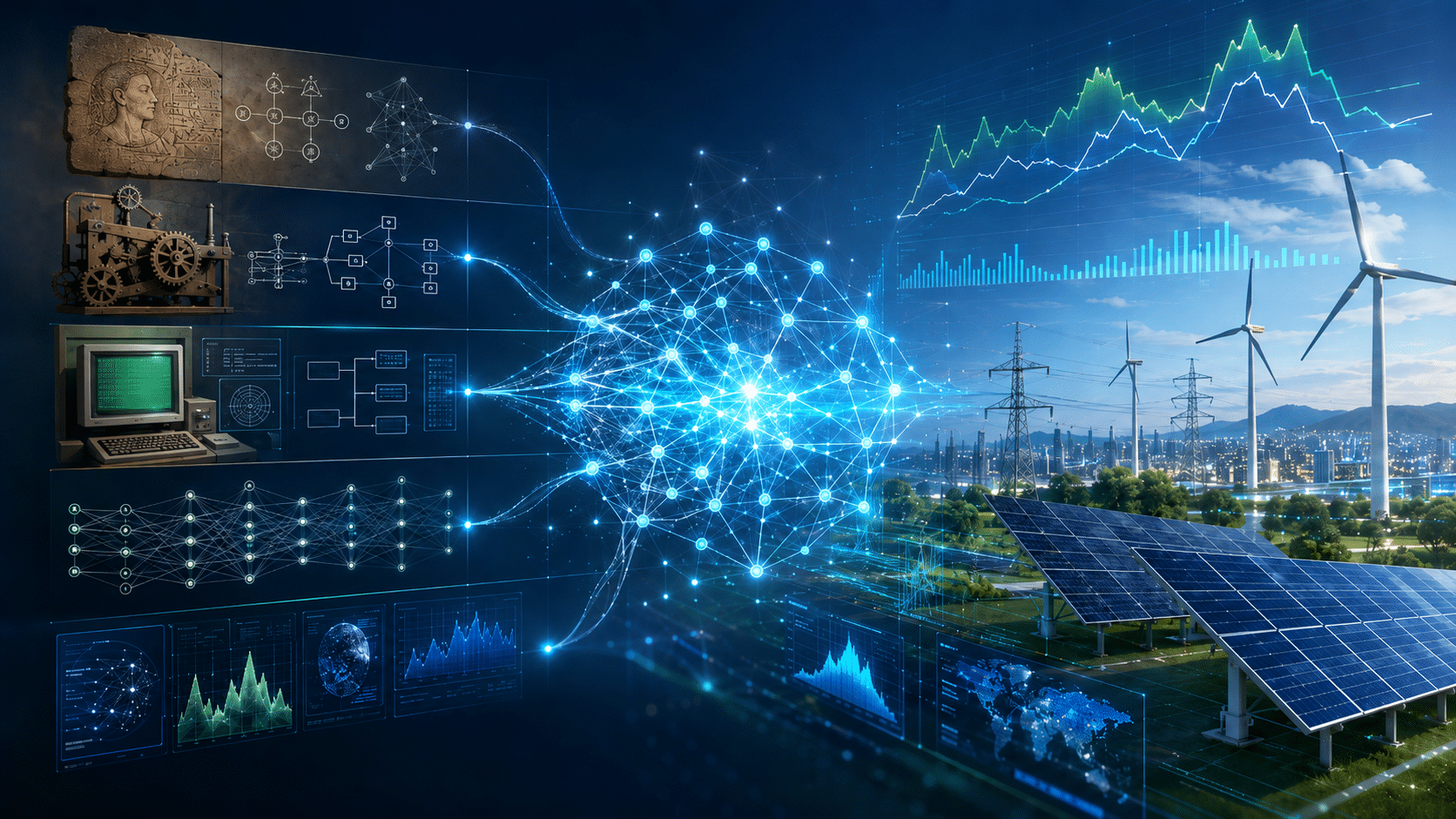
During the 1970s and 1980s, Artificial Intelligence went through a first stage dominated by expert systems. These systems represented human knowledge through logical rules, inference structures and probabilistic reasoning. Their goal was to capture specialist expertise and apply it systematically to complex problems.
Tools such as DENDRAL, MYCIN, PROSPECTOR, XCON, INTERNIST-1 and CASNET showed that a computer could support relevant decisions in fields such as medicine, chemistry, mining, industry and the configuration of complex technological systems.
These systems marked a decisive stage in the history of Artificial Intelligence. They showed that expert knowledge could be formalised and used to solve high-impact problems. They also revealed an important limitation, knowledge had to be coded manually, which made scalability and adaptation to changing environments difficult.
Learning from data
As Machine Learning advanced, Artificial Intelligence began shifting from explicit rules towards learning from data. Pattern recognition, classification, prediction and optimisation opened new applications in finance, industrial control, predictive maintenance, speech recognition, computer vision and energy forecasting.
Hybrid models for complex systems
In the 1990s, a particularly relevant idea gained traction, combining methodologies. In complex sectors such as electricity markets, energy demand or renewable production, a single technique rarely captures the full picture. That is why hybrid models integrating neural networks, Box-Jenkins models and classical statistics make it possible to draw on non-linear learning, statistical rigour and knowledge of time series behaviour together.
The same mission, more capacity
Today’s Artificial Intelligence has unmatched computational scale, but many of its core ideas were already present decades ago, learning, reasoning under uncertainty, integrating expert knowledge and turning complex data into useful decisions.
In energy markets, this vision remains decisive. The energy transition increases market complexity and demands robust forecasts, explainable models and tools capable of reducing uncertainty. The real contribution of Artificial Intelligence is not only automating tasks, but improving the quality of strategic decisions.
Utilities, traders, renewable developers and large consumers now rely on forecasts that combine modern Artificial Intelligence, historical data and expert knowledge to make decisions on investments, PPAs and hedging strategies.
Long-term forecasts turning uncertainty into decisions
In the energy sector, uncertainty over prices, demand, renewable production and profitability shapes investment, financing, PPA and energy trading strategies. The long-term forecasts from the AleaGreen division of AleaSoft Energy Forecasting, based on Artificial Intelligence, time series and statistical models, help anticipate scenarios, assess risks and make decisions with a robust view of the future. For renewable projects, storage, self-consumption or large consumers, these forecasts turn market complexity into useful information for planning, financing and optimising strategic decisions.
Source: AleaSoft Energy Forecasting.