


AleaSoft Energy Forecasting, July 3, 2026. In the second quarter of 2026, higher solar photovoltaic energy production and the seasonal fall in demand favoured the decline in prices compared with the first quarter in most of the main European electricity markets. The exceptions were Portugal, Spain and Great Britain, where prices rose. Solar photovoltaic energy set all‑time records, while tensions in the Middle East, with the Strait of Hormuz as a focus of concern, drove up Brent and TTF gas futures compared with the previous quarter.
Solar photovoltaic and wind energy production
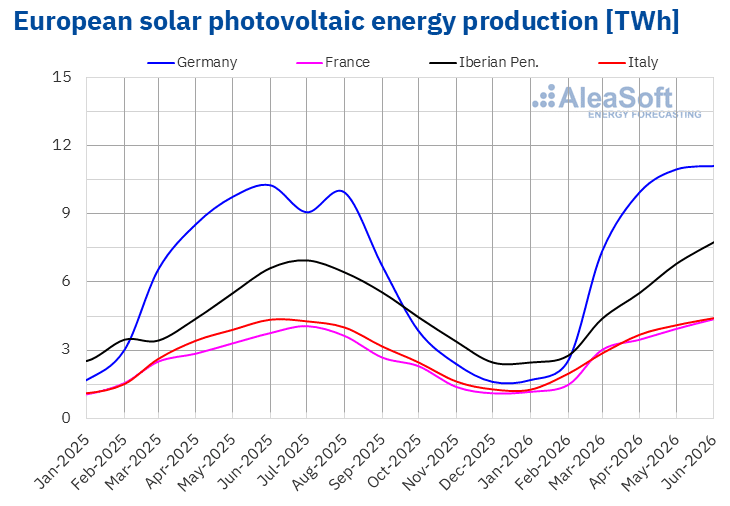
In the second quarter of 2026, solar photovoltaic energy production increased in all the main European electricity markets compared with the same quarter of 2025. The Spanish market led the percentage growth, with a 22% increase, followed by the French market, with a 19% rise. In the Portuguese market, solar photovoltaic energy production grew by 17%, while in the German market it increased by 7.9%. The Italian market registered the smallest increase, 4.0%.
Solar photovoltaic energy production also increased in all markets when comparing the second quarter of 2026 with the first quarter of the year, favoured by the higher radiation typical of spring. The German market registered by far the largest increase, 174%. It was followed by the Portuguese and French markets, with rises of 122% and 107%, respectively. In the Italian and Spanish markets, solar photovoltaic energy production grew by 97% and 99%, respectively.
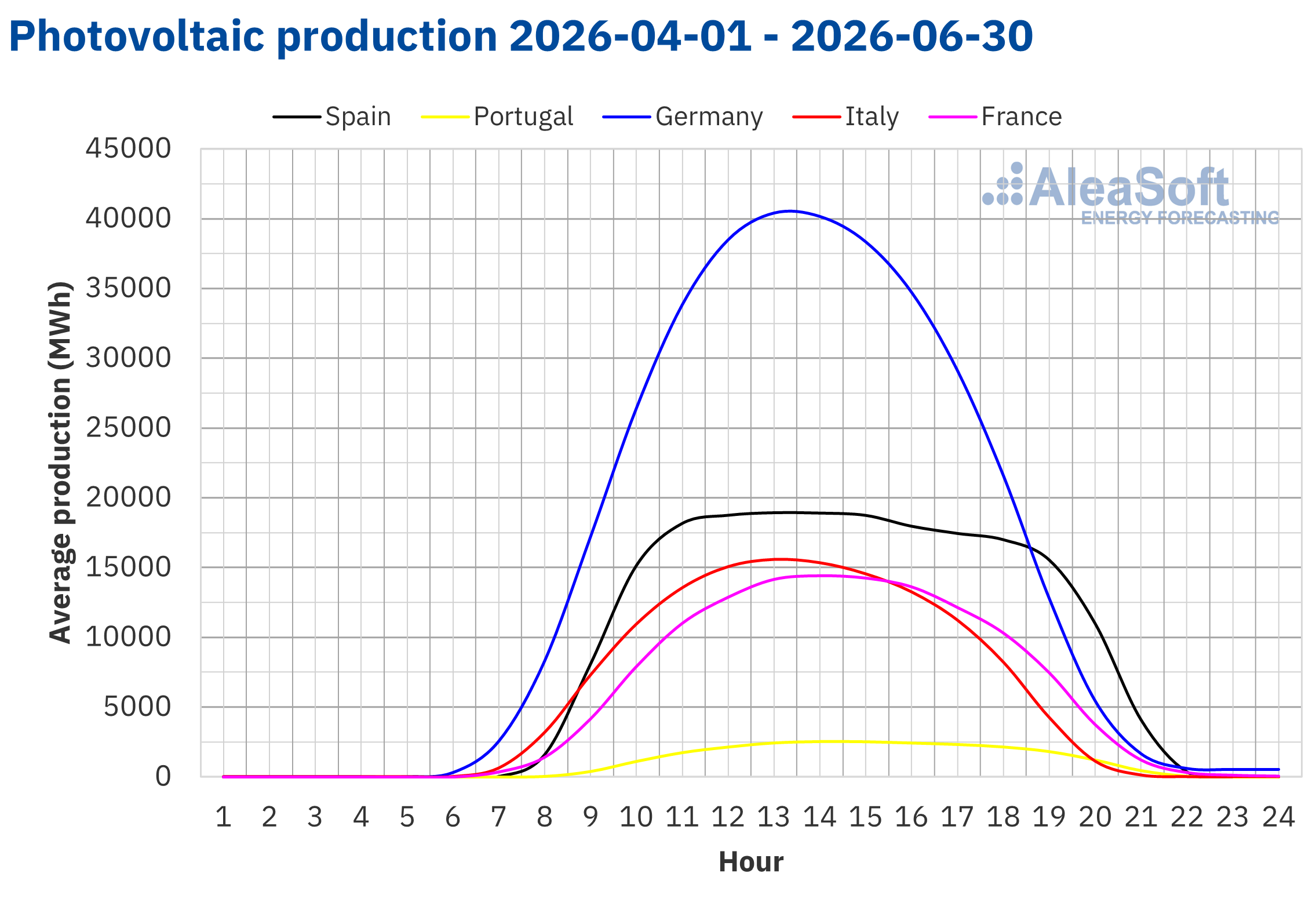
In the second quarter of 2026, solar photovoltaic energy production reached all‑time quarterly highs in Germany, Spain, Italy and France among the markets analysed at AleaSoft Energy Forecasting. Germany led photovoltaic generation, with 32 048 GWh, followed by Spain, with 18 007 GWh. Italy and France registered 12 219 GWh and 11 808 GWh, respectively. In Portugal, solar photovoltaic energy production reached 2123 GWh, the highest value ever for a second quarter and the second‑highest of all quarters on record.
These solar photovoltaic energy production records reflect the year‑on‑year growth in installed capacity. Between the end of the second quarter of 2025 and the end of the second quarter of 2026, the Spanish market added 8689 MW of solar photovoltaic capacity, excluding self‑consumption, representing a 24% increase, according to Red Eléctrica data. Over the same period, the Portuguese market added 739 MW of solar photovoltaic capacity to the system, 17% more, according to REN data.
 Source: Prepared by AleaSoft Energy Forecasting using data from ENTSO-E, RTE, REN, Red Eléctrica and TERNA.
 Source: Prepared by AleaSoft Energy Forecasting using data from ENTSO-E, RTE, REN, Red Eléctrica and TERNA.
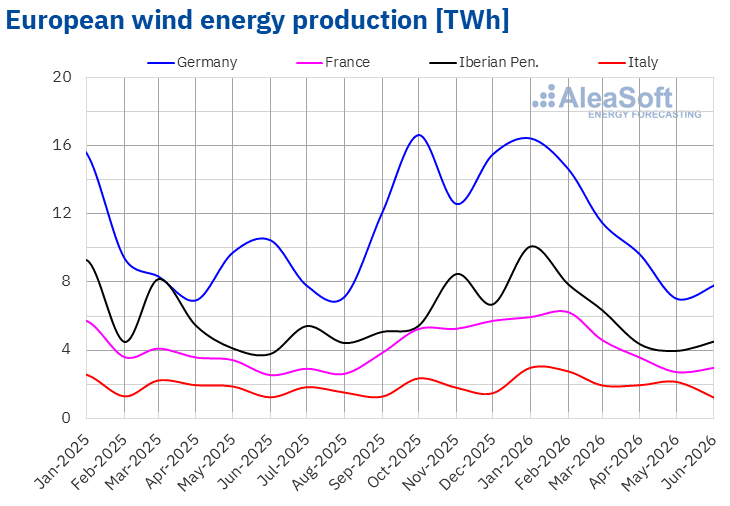
In the second quarter of 2026, wind energy production only increased compared with the same quarter of 2025 in the Italian market, with a growth of 5.4%. By contrast, wind generation fell in the German, Portuguese, French and Spanish markets, with declines of 9.8%, 4.8%, 3.0% and 0.3%, respectively.
When comparing the data of the second quarter of 2026 with those of the first quarter of the year, wind energy production fell in all the main European electricity markets. The Italian market registered the smallest decline, 32%, while the Portuguese market recorded the largest fall, 49%. In the rest of the markets, the declines were 43% in Germany and 46% in France and Spain.
The Italian market generated 5288 GWh of wind energy during the second quarter of 2026, the highest value on record for a second quarter. By contrast, Germany, France, Spain and Portugal registered low levels compared with previous second quarters. Germany generated 24 456 GWh, its lowest wind energy production for a second quarter since 2021. France reached 9255 GWh, its lowest value since 2023. Spain produced 10 675 GWh, its lowest generation for a second quarter since 2018. Portugal generated 2504 GWh, its lowest value since 2021.
Regarding installed wind capacity, the Spanish market added 729 MW between June 2025 and June 2026, representing a 2.3% increase, according to Red Eléctrica data. In Portugal, installed wind capacity grew by 121 MW over the same period, 2.2% more, according to REN data.
 Source: Prepared by AleaSoft Energy Forecasting using data from ENTSO-E, RTE, REN, Red Eléctrica and TERNA.
Electricity demand
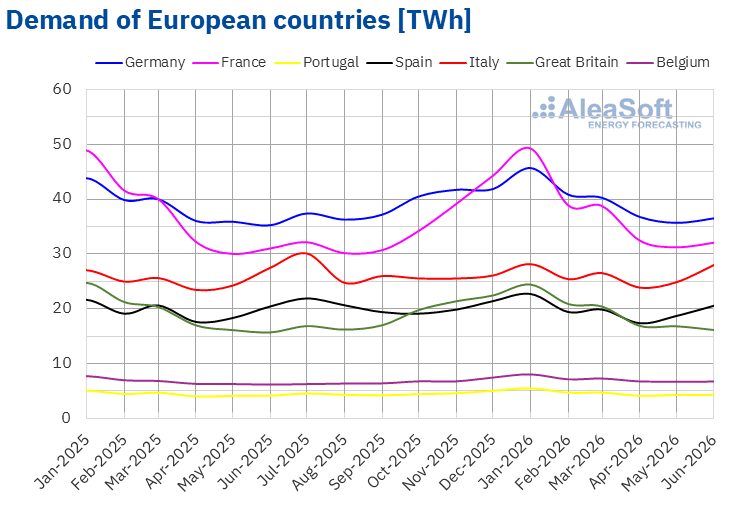
In the second quarter of 2026, electricity demand increased in all the main European electricity markets analysed compared with the same quarter of 2025. The Belgian market registered the largest increase, 7.9%. In the Portuguese market, demand grew by 3.2%, while in the French market it rose by 2.7%. The Italian and British markets registered increases of 2.1% in both cases. The German market recorded a 1.7% rise and the Spanish market the smallest increase, 1.1%.
When comparing the data of the second quarter of 2026 with those of the first quarter of the year, electricity demand fell in all the markets analysed, in line with the seasonal transition from winter to spring. The Italian market registered the smallest decline, 5.2%, followed by the Spanish market, with a 9.7% fall. In the Belgian market, demand dropped by 11%, while in the German and Portuguese markets the declines were 15% and 16%, respectively. The British and French markets registered the largest falls, 25% in both cases.
The Portuguese market reached its highest electricity demand for a second quarter in the second quarter of 2026, with 12 547 GWh consumed.
Average temperatures in the second quarter of 2026 were slightly higher than those of the same quarter of 2025 in all the markets analysed. Portugal registered the largest increase, 0.6 °C, followed by Spain, France and Italy, with rises of 0.5 °C in all three cases. In Germany, average temperatures rose by 0.4 °C. Great Britain registered the smallest increase, 0.1 °C, while Belgium maintained average temperatures similar to those of the second quarter of 2025.
After the transition from winter to spring, average temperatures rose in all markets when comparing the second quarter of 2026 with the first quarter of the year. Germany registered the largest increase, 11 °C, and Great Britain the smallest, 7.5 °C. In the rest of the markets, average temperatures rose by between 7.9 °C in Portugal and 10 °C in Italy.
 Source: Prepared by AleaSoft Energy Forecasting using data from ENTSO-E, RTE, REN, Red Eléctrica, TERNA, National Grid and ELIA.
European electricity markets
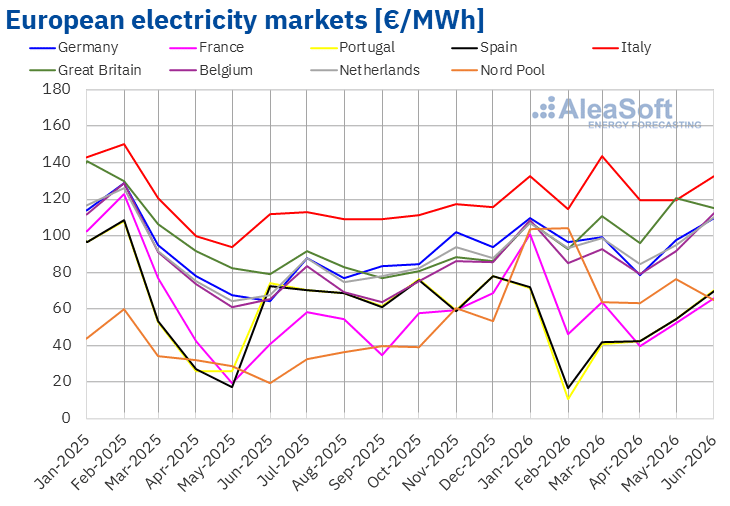
In the second quarter of 2026, the quarterly average price exceeded €90/MWh in most of the main European electricity markets. The exceptions were the French, Spanish, Portuguese and Nordic markets, with averages of €52.69/MWh, €55.41/MWh, €55.56/MWh and €68.18/MWh, respectively. The Italian market registered the highest quarterly price, €123.73/MWh. In the rest of the European electricity markets analysed at AleaSoft Energy Forecasting, averages ranged from €94.25/MWh in the Belgian market to €110.59/MWh in the British market.
Compared with the first quarter of 2026, prices fell in most of the European electricity markets analysed at AleaSoft Energy Forecasting. The French market registered the largest percentage decline, 26%, followed by the Nordic market, with a 24% fall. In the German and Italian markets, prices dropped by 6.7% and 5.3%, respectively, while in the Belgian and Dutch markets the declines were 1.6% and 3.4%. By contrast, prices rose in the Portuguese, Spanish and British markets, with increases of 33%, 25% and 6.4%, respectively.
Compared with the second quarter of 2025, prices increased in all the main European electricity markets. The Nordic market registered by far the largest percentage increase, 157%, followed by the French market, with a 55% rise. In the rest of the markets, increases ranged from 22% in the Italian market to 44% in the Spanish market.
As a result of the increases registered in the British market in the second quarter of 2026, this market reached its highest quarterly average price since the second quarter of 2025.
The fall in electricity demand and the rise in solar photovoltaic energy production compared with the previous quarter favoured the decline in prices in most European electricity markets, despite the increase in gas prices.
Higher gas and CO2 emission rights prices, together with increased electricity demand and lower wind energy production in most markets compared with the second quarter of 2025, drove the year‑on‑year price rise in the European electricity markets.
 Source: Prepared by AleaSoft Energy Forecasting using data from OMIE, RTE, Nord Pool and GME.
Brent, fuels and CO2
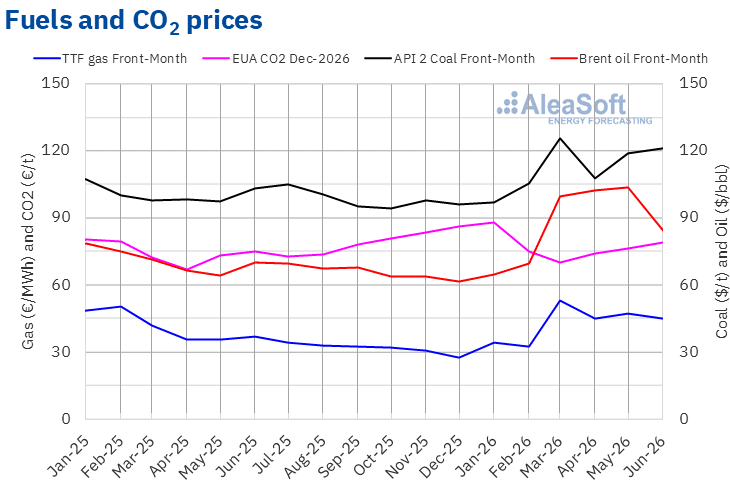
Brent oil futures for the Front‑Month in the ICE market registered a quarterly average price of $96.68/bbl in the second quarter of 2026. According to the data analysed at AleaSoft Energy Forecasting, this quarterly average was the highest since the fourth quarter of 2022. This value was 23% higher than that reached by the Front‑Month futures of the first quarter of 2026, of $78.38/bbl, and 45% higher than that of the Front‑Month futures traded in the second quarter of 2025, of $66.71/bbl.
The persistence of tensions in the Middle East and supply restrictions drove up Brent oil futures prices in the second quarter of 2026.
As for TTF gas futures in the ICE market for the Front‑Month, the average value registered during the second quarter of 2026 was €45.71/MWh, the highest since the second quarter of 2025. Compared with the average of the Front‑Month futures traded in the first quarter of 2026, of €40.13/MWh, the average of the second quarter of 2026 rose by 14%. Compared with the Front‑Month futures traded in the second quarter of 2025, when the average price was €35.78/MWh, the increase was 28%.
Concerns over the low levels of European reserves and supply restrictions drove the increase in TTF gas futures prices during the second quarter of 2026.
Regarding CO2 emission rights futures in the EEX market for the reference contract of December 2026, they reached an average price of €76.47/t in the second quarter of 2026. This quarterly price fell by 1.6% compared with the average of the first quarter of 2026, which was €77.73/t. Compared with the average of the second quarter of 2025, which was €71.76/t, the average of the second quarter of 2026 was 6.6% higher.
 Source: Prepared by AleaSoft Energy Forecasting using data from ICE and EEX.
AleaSoft Energy Forecasting’s analysis of the outlook for energy markets in Europe
On Thursday, July 9, the 68th edition of the monthly webinar series of AleaSoft Energy Forecasting will take place. This webinar will analyse the evolution and outlook of the European energy markets, the current situation and prospects of PPAs, the financing of renewable energy and storage projects, as well as the outlook for energy storage and the opportunities for hybridisation with renewable energies and self‑consumption. The analysis table of the webinar in Spanish will feature the participation of Pedro González, General Director of AEGE, and Roger Font, Managing Director Project Finance Energy at Banco Sabadell.
Source: AleaSoft Energy Forecasting.
