


AleaSoft Energy Forecasting, August 19, 2026. The European Union’s gas reserves currently stand at around 61% of their capacity, the lowest level for this time of year in recent years, even below the level recorded in 2021. In recent days, gas prices have risen and, on August 18, TTF gas futures reached their highest value since the beginning of 2023. The need to replenish inventories is already pressuring prices this summer, while the level of reserves Europe reaches October with will determine its exposure during the coming winter.
Two dates that shape the European gas year
There are two key moments in the European gas market calendar. The first comes at the end of winter, in late March, when the level of reserves determines how much gas will need to be injected during the summer. The second comes at the beginning of October, when storage facilities show the volume available to face the winter months of higher consumption.
This year, both benchmarks take on particular importance. According to data from Gas Infrastructure Europe, on April 1, 2026 European storage facilities stood at 28% of their capacity, the lowest level in the past four years. This starting point made for a particularly demanding filling season in a market already under strain on the supply side.
A filling pace slower than needed
Four and a half months later, gas reserves stand at around 61%, roughly 20% below the average of the past seven years for this time of year.
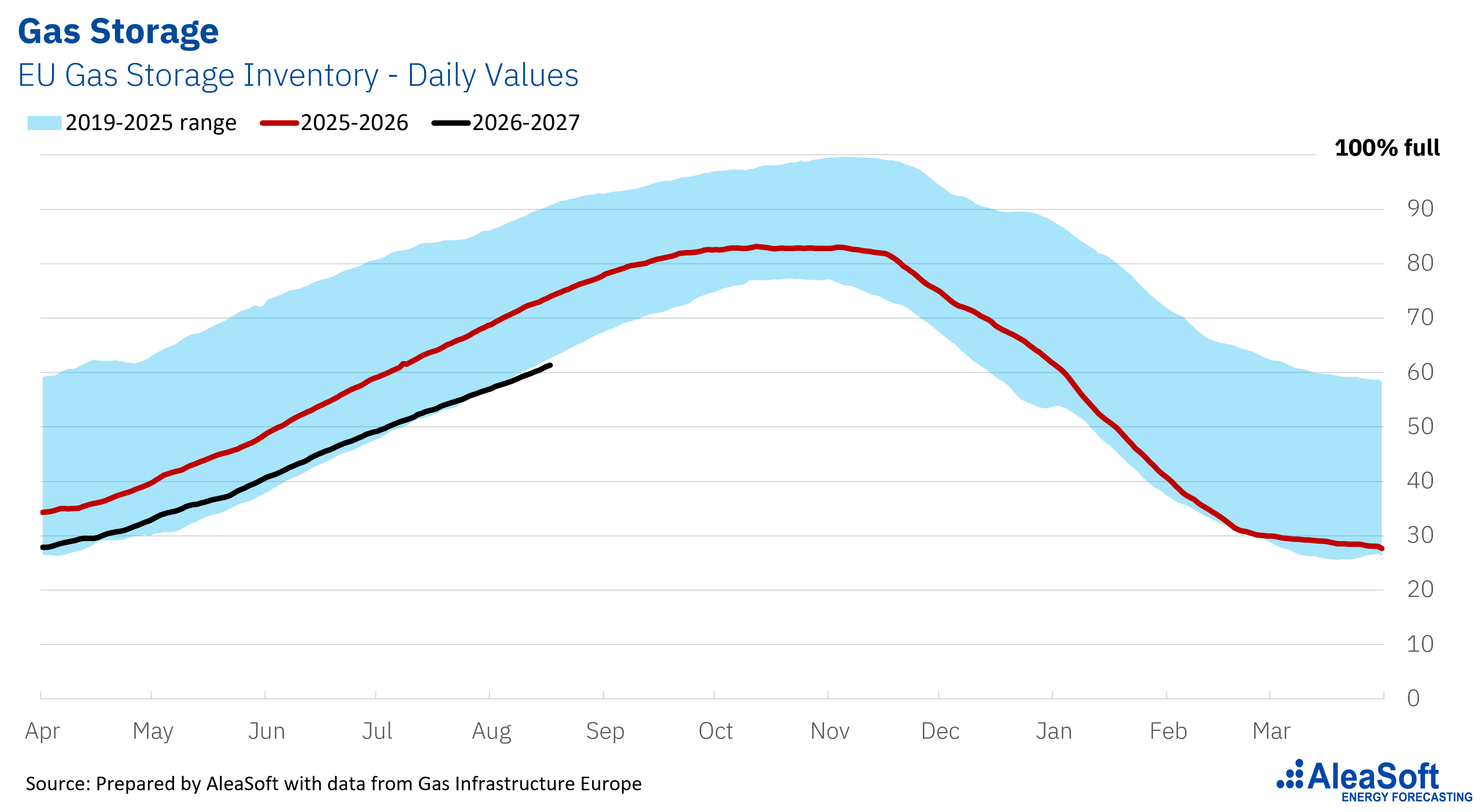
The recent pace gives a sense of the challenge. Between the beginning and the middle of August, storage levels advanced by an average of 0.27 percentage points per day. If this pace were maintained, they would reach around 73% by October 1. Europe would have to continue injections through the autumn to keep rebuilding reserves, coinciding with the gradual increase in demand associated with heating.
Closing the gap with the levels of recent years requires maintaining a high injection rate and securing sufficient volumes of gas for Europe, especially liquefied natural gas. Attracting those supplies in a competitive global market comes at a cost, and the need to keep filling storage facilities adds pressure to European demand during the summer.
A price signal that does little to favour storage
This need to fill storage facilities coincides with a rise in gas prices in recent days. On August 18, TTF gas FrontMonth futures on the ICE market reached 63.65 €/MWh, the highest level since the end of January 2023.
At the same time, the futures curve does not currently offer a clear winter premium over the nearest months. Some contracts for the winter months are trading at similar or even lower levels. This structure reduces the usual economic incentive to buy gas during the filling period, store it and sell it later at a higher price.
When the difference between current prices and winter prices does not sufficiently cover the costs associated with storage, this operation loses its commercial appeal. However, Europe still needs to refill its reserves before the winter season. This combination forces gas demand for injection to be maintained even with an unfavourable price signal and adds to the pressure on the market during the summer.
Hormuz, Russian gas and a tighter supply
Geopolitics is another major source of pressure. The conflict between the United States, Israel and Iran has drastically reduced traffic through the Strait of Hormuz and has affected the global LNG supply, particularly the supply coming from Qatar. Uncertainty over the normalisation of maritime traffic is keeping a high risk premium in the energy markets.
In parallel, the progressive elimination of European imports of Russian gas reduces the supply alternatives that still remained available. Added to this is the maintenance work at Norwegian facilities during August, which temporarily reduces flows from Europe’s main pipeline gas supplier.
The combination of these circumstances is particularly relevant during the filling season. Europe needs to attract enough gas to cover current consumption and, at the same time, continue increasing inventories that started from exceptionally low levels at the end of winter.
The European filling targets and their flexibility
The European regulatory framework maintains a filling target of 90% but, since the reform of the gas storage Regulation, in force since September 2025, this level can be reached at any point between October 1 and December 1. The rules also allow a deviation of up to ten percentage points where difficult filling conditions exist, which the European Commission can extend by a further five points if those conditions persist. The regulation will remain in force until the end of 2027.
This flexibility seeks to prevent the obligation to reach a given level of reserves from concentrating purchases and pushing prices up during the summer. Given the current conditions, the European Commission considers that a level of 80% would be sufficient to guarantee supply during the winter and technically achievable. This greater flexibility can ease buying pressure during the summer, although it means facing the winter with a smaller safety margin in storage.
Why 2026 is not 2021
The comparison with 2021 is relevant, although current conditions are different. Europe faced that winter with reduced reserves and a much greater dependence on Russian pipeline gas. That vulnerability contributed to straining the market before the invasion of Ukraine dramatically worsened the energy crisis.
Five years on, there are significant differences. Europe has greater regasification capacity, gas consumption remains below pre-crisis levels and dependence on Russian supply has been considerably reduced. In addition, the entry of new global LNG production capacity is progressively widening the supply alternatives.
The growth of renewable energies is also helping to reduce gas requirements for electricity generation during the hours of highest photovoltaic production and wind energy production.
These differences mean that low reserves do not necessarily carry the same consequences as in 2021. They do, however, increase the market’s sensitivity to any adverse event.
From stored gas to the price of electricity
The volume in storage is one of the main safety margins against unforeseen events. With less gas in storage facilities, a cold winter, a prolonged period of low renewable production or a fresh interruption to LNG supply can feed through to prices more quickly.
This strain also reaches the European electricity markets, where gas-fired plants continue to set the marginal price during many hours. A rise in the gas price directly increases the generation cost of combined cycle plants. For this reason, greater tension in the gas market can be passed through quickly to electricity prices.
This relationship explains why the evolution of European reserves is not relevant only to gas operators. Retailers, generators and large electricity consumers also need to follow the filling pace and the supply outlook closely in order to anticipate their possible impact on the electricity markets over the coming months.
Forecasts to anticipate scenarios with AleaBlue and AleaGreen
AleaBlue, the AleaSoft Energy Forecasting division specialising in short- and mid-term forecasting, provides forecasts with horizons of up to three years that make it possible to analyse the evolution of gas and electricity prices, identify hedging windows and quantify the risk associated with each purchasing strategy.
For investment and financing decisions, AleaGreen, the division specialising in long-term forecasting, provides bankable electricity market price curves, confidence bands and probabilistic scenarios based on consistent assumptions about the evolution of fuels, price volatility and the prices captured by renewable energies.
October will mark the starting point of the winter
The level of reserves Europe reaches October with will be one of the main benchmarks for the energy markets over the coming months. Storage below the levels of recent years does not necessarily imply supply problems, but it does reduce the room to absorb a cold winter, lower renewable production or fresh strains on gas imports, and it favours greater volatility in the prices of both gas and the electricity markets.
The pressure to rebuild reserves is already influencing prices during the summer. As winter approaches, the filling pace, temperatures and LNG availability will determine to what extent that tension is maintained or increases.
Source: AleaSoft Energy Forecasting.