


AleaSoft Energy Forecasting, September 22, 2026. Energy storage is entering a new growth phase at global and European level. S&P Global Energy expects Europe to install more than 30 GW of battery storage systems in 2026, almost double the 2025 figure, while the pace of new photovoltaic installations moderates. These prospects, together with the role of self-consumption, shaped the analysis at the latest webinar by AleaSoft Energy Forecasting.
Storage could grow more than photovoltaic and wind energy in 2026
On September 17 AleaSoft Energy Forecasting held its monthly webinar number 69, devoted to the evolution of European energy markets and the opportunities for energy storage and self-consumption. The session brought together Josefin Berg, Associate Director of Renewables Markets at S&P Global Energy, and Oriol Saltó i Bauzà, Associate Partner at AleaSoft. The analysis panel held in Spanish also included Francisco Valverde, an independent professional specialising in the development of renewable energy.
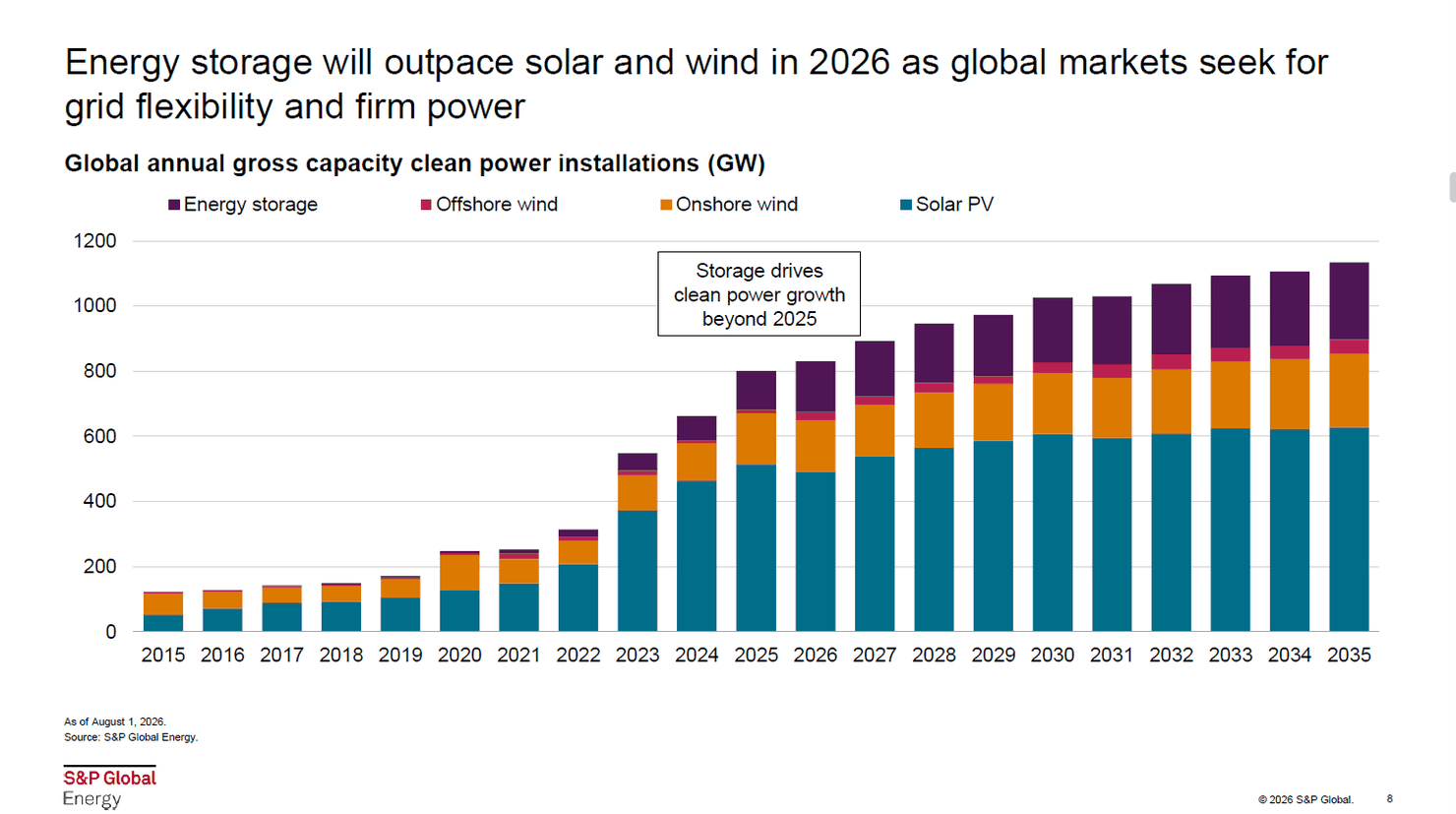
According to the forecasts presented by S&P Global Energy, the storage capacity installed annually worldwide will grow by around 67% between 2025 and 2030. Asia-Pacific, driven by China, will remain the leading region by volume, although Europe and the other markets outside Asia-Pacific and North America will record the highest percentage growth of the period.
This shift comes after several years of strong expansion of photovoltaic energy. In 2026, the expected moderation of new solar installations in China is affecting the global growth of this technology, while storage expands in a growing number of markets. According to the forecasts of S&P Global Energy, storage will outpace the growth of photovoltaic and wind energy in 2026.
Divergent development models, from auctions to the merchant market
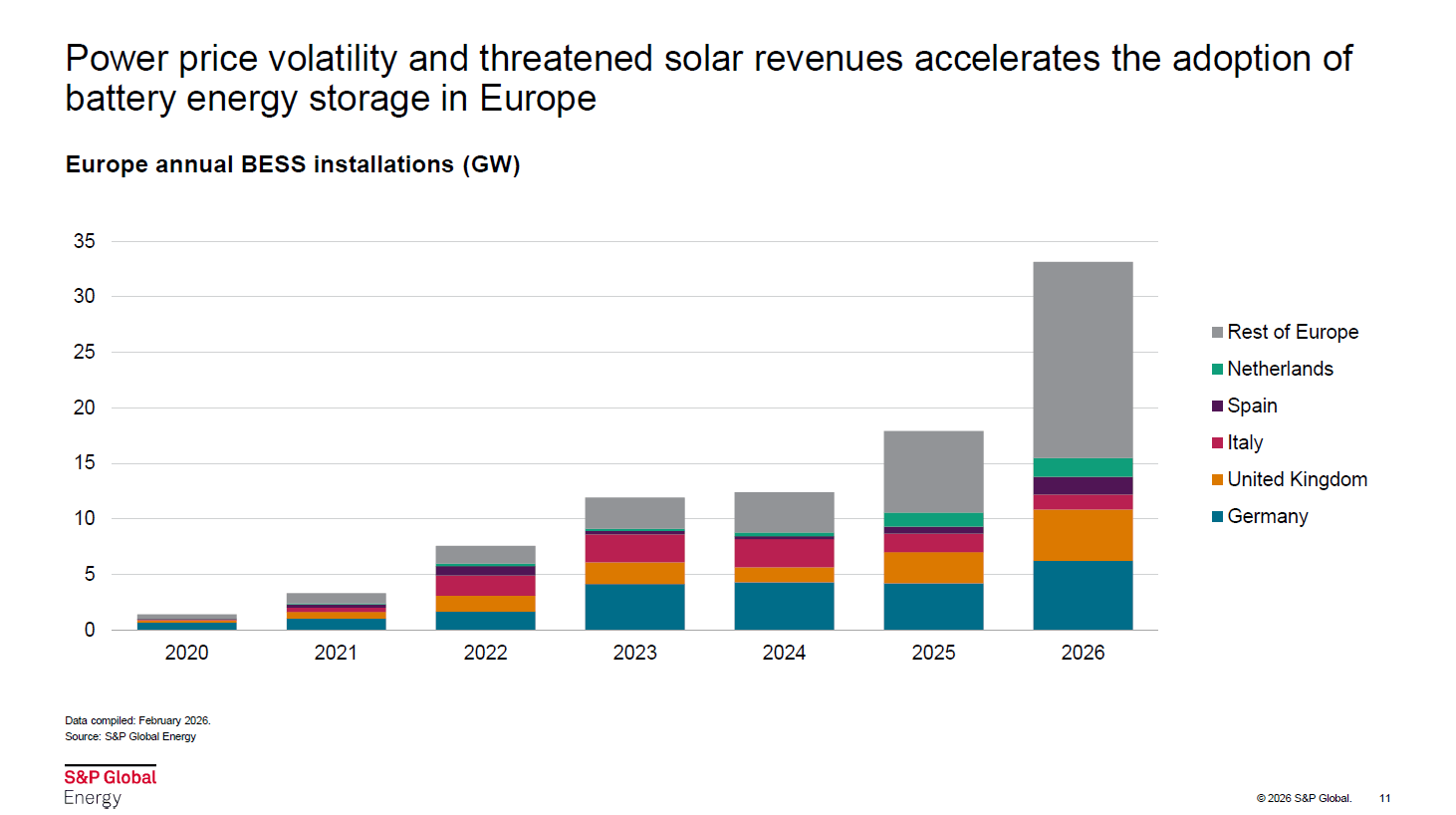
According to the data presented by S&P Global Energy, annual battery installations in Europe will exceed 30 GW in 2026, practically double the 2025 figure, driven above all by Germany, the United Kingdom, Italy, Spain and the Netherlands, which are among the leading electricity markets for battery storage. However, development models differ widely between countries. In the front-of-the-meter (FTM) segment, Bulgaria, Poland and Italy show the greatest weight of auctions, support mechanisms and contracted revenues, while Germany stands out for a largely merchant approach, with private contracts such as tolling agreements.
The growth of the battery market also continues to rely on how their costs evolve. The price of lithium carbonate has risen by 92% over the past year and faces additional pressure from supply chain disruptions, but S&P Global Energy points out that its impact on the CAPEX of a four-hour battery is limited. Innovation in cells, DC blocks and system integration is partly offsetting the price increase, so battery costs remain relatively stable.
Spain, at a decisive stage for storage
In Spain, S&P Global Energy expects an acceleration of front-of-the-meter installations, mainly through hybridisation with photovoltaic, with a peak of new installations in 2027-2028. Royal Decree-Law 7/2026 grants storage projects public utility status, simplifies administrative processing, improves the transparency of grid access, creates Renewable Acceleration Areas and extends collective electrical self-consumption, in a context in which the April 2025 blackout revealed shortcomings in inertia and voltage control on the grid that are driving interest in storage.
Subsequent developments will be shaped by factors such as grid access, where intense competition for connection points persists despite the CNMC’s new flexible access framework and the Renewable Acceleration Areas, and the development conditions for stand-alone projects, which currently do not have the priority dispatch of hybrid projects. The implementation of the capacity market, with up to €9 billion for the 2026-2036 period, will offer batteries an additional source of stable revenues that will help reduce uncertainty and support the financing of projects.
The rise of self-consumption and residential storage
Electrical self-consumption is another of the factors transforming the electricity demand curve in Spain. Behind-the-meter solar generation reduces the demand visible to the system during the central hours of the day, an effect that can already be seen in the hourly demand profile of the summer months.
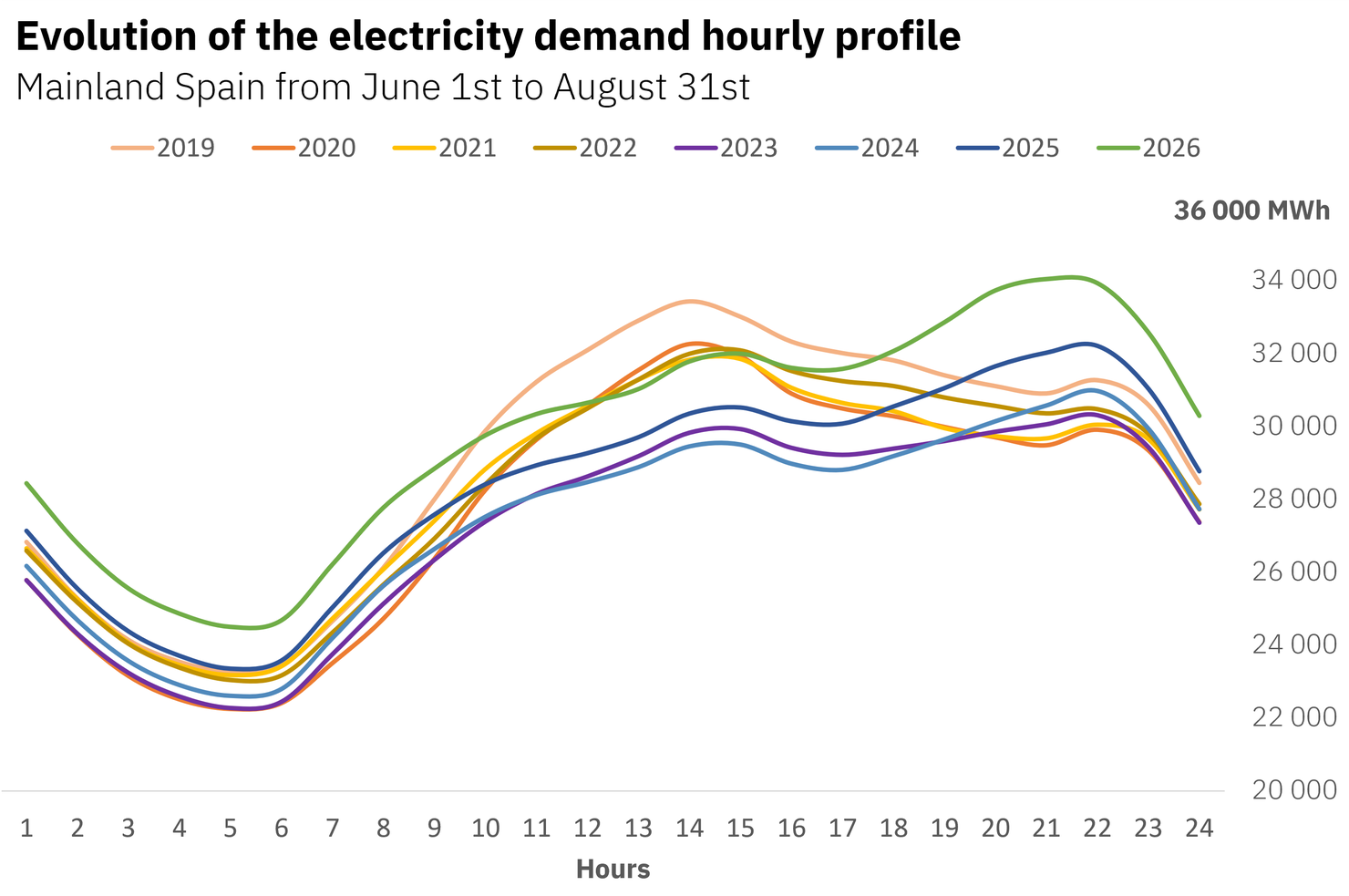 Source: Prepared by AleaSoft Energy Forecasting with data from Red Eléctrica.
More than 2 GW of behind-the-meter storage have already been installed in Spain. While new residential photovoltaic installations are moderating after the 2022 peak, residential batteries have been expanding rapidly since April 2025. At the same time, a new segment of behind-the-meter storage linked to data centers has emerged. The aggregation of distributed assets in virtual power plant (VPP) models, supported by energy communities, is emerging as the main growth opportunity still to be developed for behind-the-meter storage.
Storage, key to the next phase of the energy transition
Spain is entering a decisive stage for the development of storage. The high volume of projects currently in processing must now translate into real installations, in a context where the capacity market, grid access and hybridisation with renewables will determine which projects secure financing. At European level, the combination of more volatile prices, pressure on photovoltaic revenues and a regulatory framework increasingly oriented towards flexibility will continue to drive battery installations over the coming years.
Storage as a strategic lever, the role of AleaStorage
AleaStorage, the division of AleaSoft Energy Forecasting specialised in energy storage produces revenue estimates for batteries, both for stand-alone and hybrid projects, in energy markets and balancing services, analysis of hybridisation projects with photovoltaic and wind energy to maximise revenues and reduce risks, assessment of revenues in capacity markets and modelling of long-term price and volatility scenarios, support that is especially relevant given that revenue visibility today determines the bankability of projects.
Source: AleaSoft Energy Forecasting