


AleaSoft Energy Forecasting, September 30, 2026. AEE interview with Antonio Delgado Rigal, PhD in Artificial Intelligence, founder and CEO of AleaSoft Energy Forecasting.
1. AleaSoft was a pioneer in the use of neural networks, which were to a large extent the forerunners of today’s AI. Are you concerned about the widespread use of AI agents to produce forecasts of, for example, market prices, which might even take advantage of your results?
Not particularly. AI will make access to information enormously easier and it can also use public forecasts as one more source. But producing a reliable forecast is not a matter of asking an AI agent for a figure. Behind it there are data, models, assumptions, market knowledge, validation and quality control.
At AleaSoft Energy Forecasting we have been using artificial intelligence since 1999 and we see today’s agents as an additional tool. The competitive advantage will lie less and less in generating an answer and more and more in having good data, robust models and the judgement to know whether that answer makes sense.
2. Looking back at past forecasts, AleaSoft’s results have always been quite accurate, even in difficult periods such as the current crisis. What has been your main lesson from the periods in which there were large deviations, and how has it fed back into future forecasts?
The main lesson is to distinguish between a model error and an extraordinary change in market conditions. A pandemic, a war, a gas crisis or a regulatory change can suddenly alter variables that no model could have known in advance.
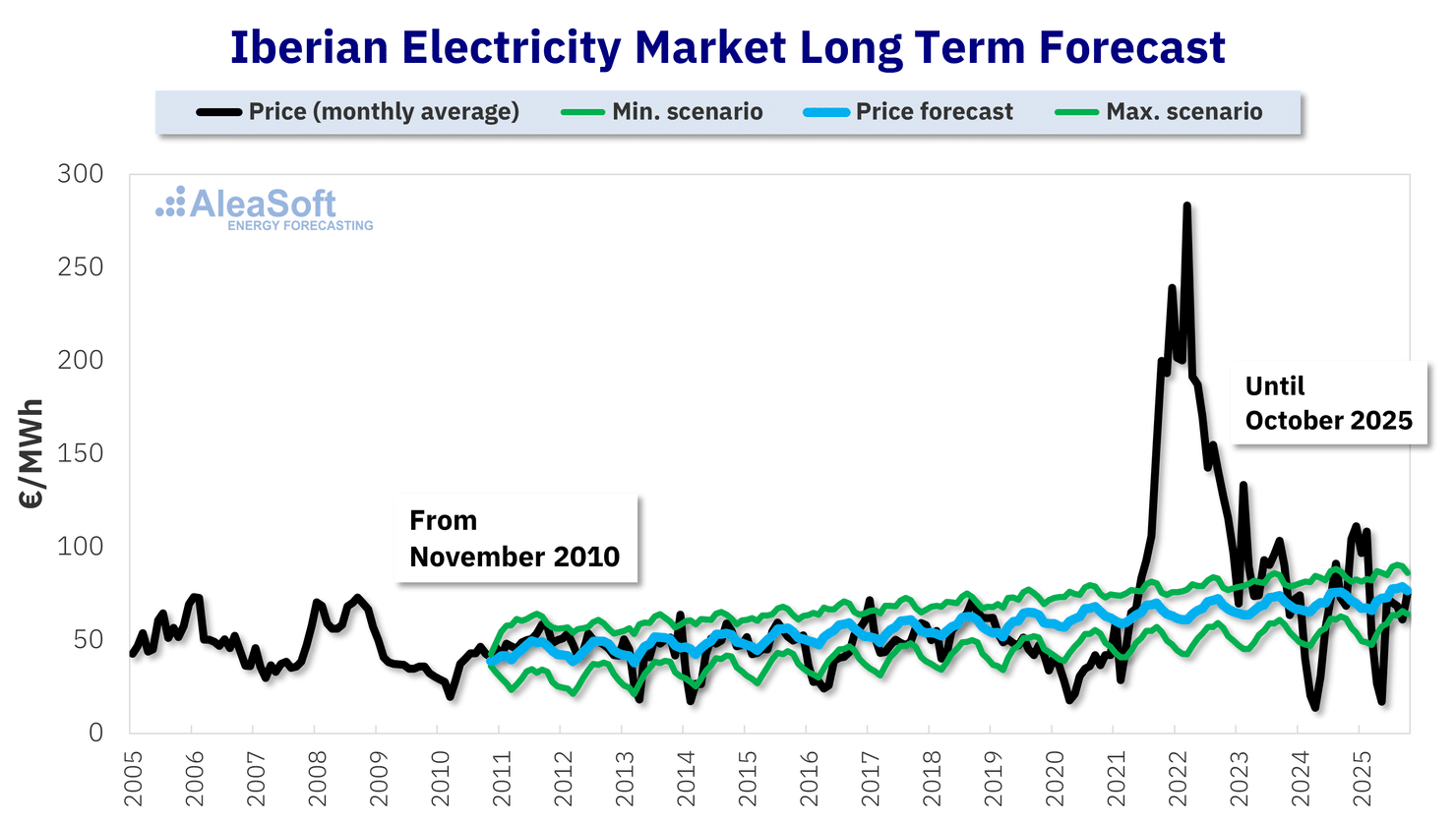
These episodes have led us to attach even more importance to scenarios and probabilistic intervals. A long-term forecast should not be understood as a single exact figure, but as a central scenario accompanied by possible deviations and by the variables that could cause them.
We have also learnt something important: models should not be overfitted to the latest major event. A crisis provides very valuable information, but that does not mean the future will repeat it.
3. How has the introduction of quarter-hourly markets influenced your forecasts for wholesale prices and for the balancing markets?
The need for granularity has clearly increased. A lot can happen within an hour: a steep solar ramp, a drop in wind energy production, a change in demand or a significant deviation. Working in fifteen-minute periods makes it possible to represent these situations, and the value of flexibility, much more accurately.
In electricity market price forecasts, this higher resolution makes it possible to capture the variations that occur within the same hour, especially at times of steep ramps in renewable production or in demand.
In the balancing markets the impact is even more significant, because system imbalances occur, and have to be corrected, over increasingly short periods. That is why it is essential to accurately anticipate the variations in the balance between generation and demand, deviations in renewable production and the system’s flexibility needs.
4. Spain has installed a significant amount of renewable capacity in recent years, but at the same time we are seeing more hours of zero or negative prices, which could jeopardise the viability of projects. AleaSoft is committed to hybridisation with batteries, but could the cannibalisation effect shift to the windiest hours, in the evening peak, when every BESS will want to discharge the energy charged during low-price solar hours?
Yes. It is important to understand that batteries reduce solar cannibalisation, without eliminating it, but they can also cannibalise peak-price hours. If we install a lot of storage capacity and many batteries buy and sell following similar signals, spreads will tend to narrow.
That is precisely why at AleaSoft we believe that a BESS cannot be valued on the assumption that current spreads will remain constant for fifteen or twenty years. The future growth of batteries, renewable generation, demand and competition between assets has to be modelled.
In addition, a battery does not depend solely on daily arbitrage. It can combine the wholesale market, balancing markets, ancillary services, capacity mechanisms and revenue contracts. The future will increasingly be about optimising a combination of revenue streams.
5. With more and more hours of zero or negative prices, should we be concerned that we keep installing new renewable capacity without enough demand able to absorb that energy, for example, from data centers or batteries/EVs?
Yes, it should concern us, but the conclusion should not be to stop installing renewables. The conclusion is that generation and demand cannot be planned independently.
We need renewables, storage, grids, interconnections and new flexible demand at the same time: electrified industry, electric vehicles, heat pumps, hydrogen and data centers, among others.
Zero and negative prices are a very clear economic signal: at certain hours we have more energy available than capacity to consume, store or export it. The next major challenge of the energy transition is to make use of those MWh.
6. In the USA there is strong controversy about data centers, their influence on prices and the changes they bring to the technical and economic operation of electricity markets. Do your forecasts for the future include the influence of these facilities and their possible location?
Yes. Data centers have become a variable that we have had to incorporate explicitly into long-term demand forecasts.
Moreover, it is not enough to estimate how many TWh they will consume. Their location, when they connect, their hourly profile, grid constraints and whether they have associated generation or storage all matter a great deal.
We are moving from a time when electricity demand was relatively predictable to one in which a single industrial investment decision or a single large data center can add hundreds of MW of demand at a specific point on the grid.
7. The spot wholesale market model is strongly criticised on the grounds that, in practice, competition and transparency may be limited. Based on what you are seeing in other markets, do you have any ideas for a possible alternative to it?
I would not replace the marginal pricing spot market. It is an efficient mechanism for deciding which facilities should produce at each moment and for providing a short-term signal.
The problem arises when we expect a market designed to optimise each hour to also be the only instrument for financing investments over twenty or thirty years.
The model we are seeing develop in Europe is more of a hybrid: the spot market for operation, PPAs and futures markets for hedging, CfDs for certain investments, and capacity and flexibility mechanisms to guarantee firm capacity.
We do not need to eliminate the market. We need to complete it.
8. Has the widespread use of hedges such as PPAs, both physical and financial, increased the use of price forecasts?
Enormously. A PPA is, at heart, an agreement on the future value of electricity, and it is difficult to negotiate that value without an independent forecast.
Moreover, today it is no longer enough to know the average market price. For a wind or solar plant, it is necessary to forecast its captured price, cannibalisation, hourly production profile, curtailments and the risks associated with the contract.
At AleaSoft we are producing PPA value forecasts for European electricity markets, with five- and ten-year horizons, for baseload as well as for wind and solar energy production. This provides an independent benchmark for negotiating contracts and analysing whether the terms offered are consistent with the market’s future outlook.
Forecasts have thus become a tool for operations and also for negotiation, financing and risk management.
9. Along the same lines, has the increase in purchases and sales of renewable projects and assets also increased the use of price forecasts? To what extent can these forecasts influence the economic valuation and the terms of a transaction?
Yes, clearly. The increase in purchases and sales of renewable plants and BESS projects has also increased the need for independent price forecasts.
When a renewable plant or a BESS project is bought or sold, a very large part of the asset’s value depends on the revenue it can generate over the next twenty or thirty years.
A small difference in the price curve can translate into a difference of millions of euros in the valuation.
That is why we are increasingly seeing independent forecasts in M&A, due diligence and financing processes. At AleaSoft we work precisely with developers, investment funds and financial institutions to provide these long-term curves. The forecast ends up in the financial model and shapes both the transaction price and the level of debt the project can support.
10. Spain has a large wind fleet that is starting to accumulate many years of operation. When we think about repowering, should we be thinking about potential revenue from the balancing markets, such as upward technical constraints, which are so important for CCGTs, rather than revenue from participating in the spot market?
We need to think about both. I believe one of the mistakes would be to repower looking only at how many additional MWh will be sold on the day-ahead market.
New wind generation has to be designed for a much more flexible system, in which participating in balancing markets and providing ancillary services will be increasingly valuable.
But it would not be prudent either to build a project whose profitability depended exclusively on the current high revenues of a particular balancing market. As more competition enters, those revenues will also tend to normalise.
The key, once again, is revenue diversification and forecasting how each market will evolve.
11. There is a lot of talk about grids being the main bottleneck of the energy transition. Are we planning grids with the actual location of future wind farms, their possible supply to data centers or the integration of BESS in mind?
We are starting to, but we need to move faster. For many years, grid planning was mainly determined by where generation was going to be installed. Now we have to forecast, at the same time, where generation, storage and new demand will be located.
A data center, a large factory, an electrolyser or a BESS can completely change the needs of a grid node.
That is why I consider it essential to also use long-term forecasts for territorial planning. The energy transition is not only about producing many renewable TWh. Those TWh have to be able to reach the place where they are needed, at the moment they are needed.
12. AleaSoft’s work is precisely about anticipating how the market will evolve. In an electricity system that is changing so quickly, how far is it really possible to make a reliable 10-, 15- or 20-year forecast for a wind farm?
It is possible, as long as we correctly understand what a long-term forecast means. We do not claim to say what the price will be in a given hour fifteen years from now. What we do is build a consistent scenario for the evolution of the electricity system.
We project demand, renewables, storage, fuels, CO2, interconnections and other fundamental variables, and we study how they interact and what equilibrium is established between them. Long-term market equilibrium is a particularly important aspect for us. Our models capture the equilibrium relationships between price and the other variables and project them into the future. This is what makes a long-term forecast consistent with the way the market works, rather than a simple extrapolation of trends.
In addition, forecasts have to be updated periodically. A bank does not need certainty about what the price will be in 2040. It needs an independent, consistent estimate with a quantified risk in order to decide whether a project can repay its debt.
At AleaSoft we have forecasts made fifteen years ago whose long-term average prices ended up extraordinarily close to actual prices. That experience of more than 25 years shows that, with a robust methodology, the long term can be much more predictable than we sometimes think.
 Source: AleaSoft Energy Forecasting.
13. If we do this interview again in ten years’ time, what would have to have happened in the Spanish electricity system for you to say: “we designed the energy transition correctly”? And what is the mistake you are most worried we are making today?
For me, success would not be measured simply by how many renewable GW are installed. I would say that we will have got the transition right if Spain has abundant, competitive and decarbonised energy, with a robust grid, sufficient storage, greater interconnections and electrified demand able to make use of it.
And, in addition, if all this has been achieved while maintaining security of supply and making investments profitable. It is an idea we repeat often at AleaSoft: for the transition to be environmentally sustainable, it also has to be economically sustainable.
The mistake that worries me most is installing generation much faster than we develop grids, storage and demand. We must not confuse installing megawatts with building an electricity system.
14. To find out more about our interviewee:
a. Favourite book: One Hundred Years of Solitude, by Gabriel García Márquez.
b. TV series: Game of Thrones.
c. Film: The Godfather.
d. Colour: Blue, the colour of AleaSoft.
15. In our daily lives, we can all contribute to the fight against climate change. What specific measure would you propose that our readers can put into practice in their daily routines starting today?
One specific measure is to adapt our electricity consumption to the times when there is more renewable generation, whenever possible: charging the electric vehicle, using certain household appliances or heating and cooling the home during the hours when more clean energy is available.
But I would add another action that I consider equally important: talking about it. Our readers can help by explaining to the people around them how important it is to fight climate change, move forward with decarbonisation and develop renewable energy.
There is still a lot of misinformation and denialism that makes necessary decisions more difficult. At AleaSoft we have spent years trying to contribute through data-based outreach, and everyone can do something similar: be well informed, share rigorous information and help create a culture that supports the energy transition.