


AleaSoft Energy Forecasting, September 18, 2026. The rapid growth of storage will progressively transform battery revenue streams in Spain. Balancing services offer highly attractive opportunities today, but their capacity is limited. In the long term, energy arbitrage is emerging as the main revenue base for these assets, now complemented by the new capacity market.
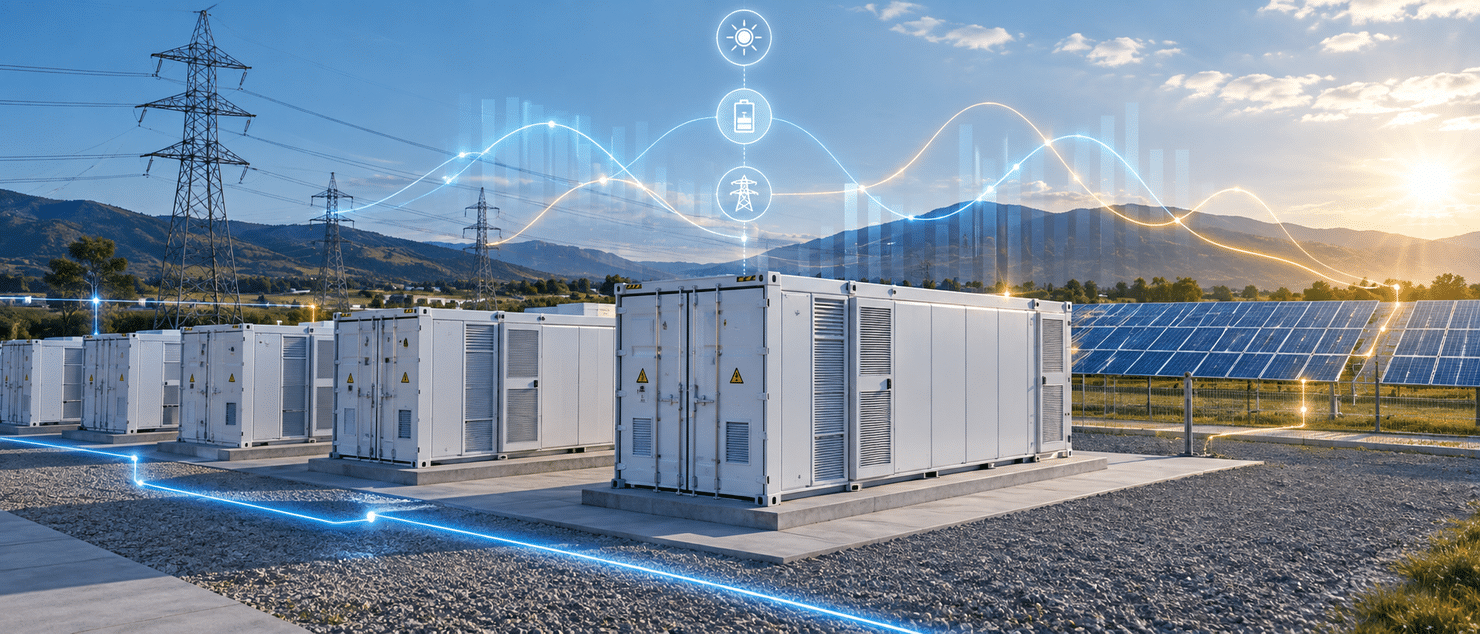
Webinar 69 by AleaSoft analysed the evolution of battery revenues
The evolution of revenue sources for batteries as energy storage capacity increases was one of the topics highlighted at webinar number 69 by AleaSoft Energy Forecasting, held on September 17. The session brought together Josefin Berg, Associate Director of Renewables Markets at S&P Global Energy, and Oriol Saltó i Bauzà, Associate Partner at AleaSoft. The analysis panel held in Spanish also included Francisco Valverde, an independent professional specialising in the development of renewable energy, and Antonio Delgado Rigal, CEO of AleaSoft, as moderator. The debate focused on how the combination of battery revenue sources will evolve as the installed fleet grows and current markets tend towards saturation.
Balancing services concentrate today’s opportunities, but with limited capacity
The current situation in the Spanish market presents especially high opportunities for the first batteries. According to the analysis presented by S&P Global Energy, revenues from ancillary services are highly concentrated. Around 10% of days can account for 60% of annual revenues, which shows both the current attractiveness of these markets and the importance of having good forecasts and operating strategies. However, these revenues can decline quickly as storage capacity increases and competes for services of limited size. In this scenario, arbitrage between low-price hours and high-price hours will play an increasingly important role. Reliable forecasts of how these services will evolve are therefore essential to correctly size a project and to avoid overestimating revenues that, by their own nature, will tend to normalise as the market matures.
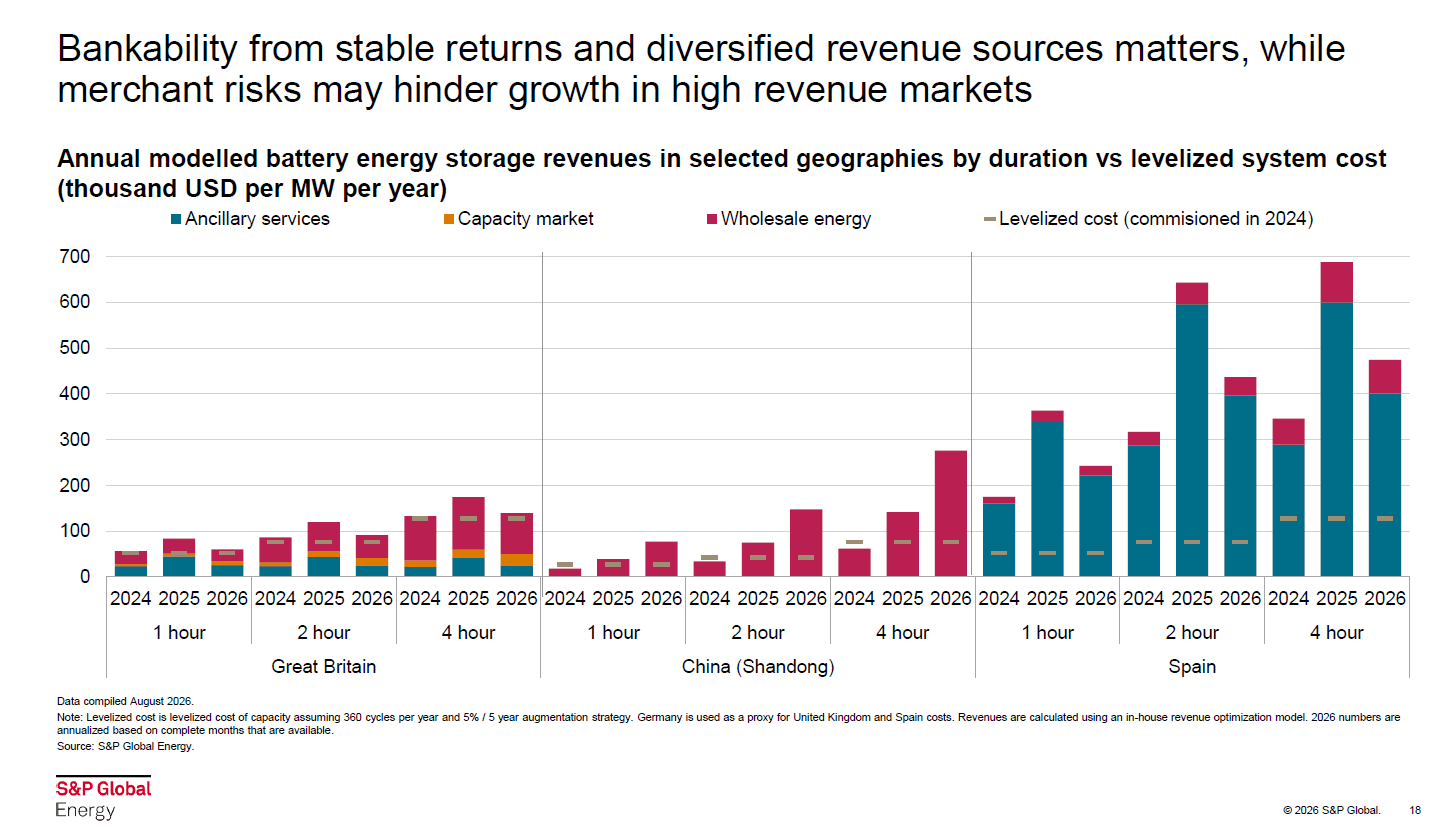 Source: S&P Global Energy.
Energy arbitrage consolidates as a long-term revenue pillar
The forecasts of AleaSoft Energy Forecasting point in the same direction. In the long term, energy arbitrage, both in the day-ahead market and in the intraday markets, will be one of the pillars of battery revenues. Hourly spreads will tend to moderate as more storage systems come online and demand flexibility increases. However, simulations carried out by AleaSoft show that arbitrage opportunities will continue to exist for a significant volume of batteries, especially in markets with greater renewable penetration and higher price volatility.
The new capacity market adds a source of contracted revenue
On September 17, Order TED/966/2026, of September 15, was published in the BOE, creating a capacity market in the Spanish peninsular electricity system. This is a centralised mechanism that will operate through competitive auctions to contract firm capacity, with participation from generation, storage and demand facilities. The scheme provides for three types of auctions: main, annual adjustment and transitional, awarded under a pay-as-bid system. In the main auctions, for new investments in generation and storage, the service period will be defined by technology and may reach a maximum of fifteen years, compared with a term of between one and ten years for new demand and one year for existing facilities.
For batteries, the capacity market adds a new potential source of contracted revenue alongside that from arbitrage and balancing services. In addition, a secondary market is envisaged that will allow the rights and obligations awarded in the auctions to be transferred or assigned, which will provide greater liquidity and flexibility to the mechanism throughout the project’s life.
The bankability of projects, the real added value
Although its economic contribution does not necessarily have to become the main revenue source for a BESS, the capacity market can be especially relevant for financing by providing greater visibility over part of future cash flows. This visibility is key to the bankability of projects. Unlike a photovoltaic plant, whose revenues can be modelled relatively directly from its production and expected prices, a battery’s revenues depend on how the asset is operated, on hourly spreads, on the markets in which it participates and on the optimisation strategy used. During the analysis panel, it was highlighted that banks have so far maintained a cautious position towards this type of project, partly because of the difficulty of quantifying their long-term cash flows. Contracted revenues through the capacity market or through private structures such as tolling agreements can help reduce that uncertainty. The higher the proportion of predictable revenues in a project’s structure, the easier it will be to close its financing on competitive terms, which in turn will accelerate the deployment of new storage capacity in Spain.
A combination of revenue sources will define battery financing
Battery financing will therefore depend on a combination of revenue sources. Arbitrage will play a central role in the long term, complemented by balancing services and the new capacity market. In this context, having robust forecasts and detailed simulations of asset operation will be essential to assess its profitability and its capacity to meet financing obligations.
The role of AleaStorage in optimising battery revenues
AleaStorage, the division of AleaSoft Energy Forecasting specialised in energy storage, focuses on the strategic analysis of batteries and hybridisation projects, providing estimates of revenues from stand-alone batteries in energy markets and balancing services, assessments of revenues in capacity markets, hybridisation analysis with renewables to maximise revenues and reduce risks, and simulations of operating strategies and energy arbitrage in the day-ahead and intraday markets. These tools allow developers, utilities and investors to quantify the expected cash flows of a BESS under different regulatory and market scenarios, an increasingly relevant requirement for the financing of renewable energy and energy storage projects.
Source: AleaSoft Energy Forecasting