


AleaSoft Energy Forecasting, September 25, 2026. Europe will install more than 30 GW of batteries in 2026, according to S&P Global Energy, but progress in each country depends on how storage is remunerated. Markets with contracted revenues attract financing more easily. In Spain, where potential revenues are high, the bankability of standalone projects is low due to merchant risk. In AleaSoft’s view, bankability in Spain will require combining contracted revenues with a well-quantified merchant component.
The revenue model sets the pace of storage in Europe
Storage revenue models by country were a central part of the presentation given by Josefin Berg, Associate Director of Renewables Markets at S&P Global Energy, at the 69th webinar organised by AleaSoft Energy Forecasting, held on September 17. According to S&P Global Energy, annual installations of battery energy storage in Europe will almost double in 2026, driven by price volatility and by the pressure on photovoltaic revenues.
According to S&P Global Energy estimates, the share of front-of-the-meter battery capacity expected to be installed between 2025 and 2030 that will come from auctions, tenders or public support programmes varies from country to country. In Bulgaria this share exceeds 90%, in Poland it is around 85% and in Italy and France it exceeds 70%. Belgium and the United Kingdom are below 50% and Germany, below 20%, is the European market with the highest merchant exposure.
Public tenders and private contracts versus merchant risk
In markets with a larger share of revenues contracted through public support mechanisms, the State takes on part of the risk through auctions, subsidies or capacity mechanisms. In September 2025, Italy held the first MACSE auction, in which it awarded 10 GWh of storage with 15-year contracts. Poland has awarded batteries contracts of up to 17 years in its capacity market. Bulgaria, with subsidies of up to 50% of the investment funded by European funds, will be the fifth largest market in the world for new battery capacity in 2026, according to S&P Global Energy.
In Germany, where the European Commission has not approved the capacity market as of September 2026, tolling agreements are spreading. Under these contracts, an optimiser pays a fixed amount for the right to operate the battery, usually for five to ten years. A project with a tolling agreement can therefore take on more debt, in exchange for giving up part of its potential revenues.
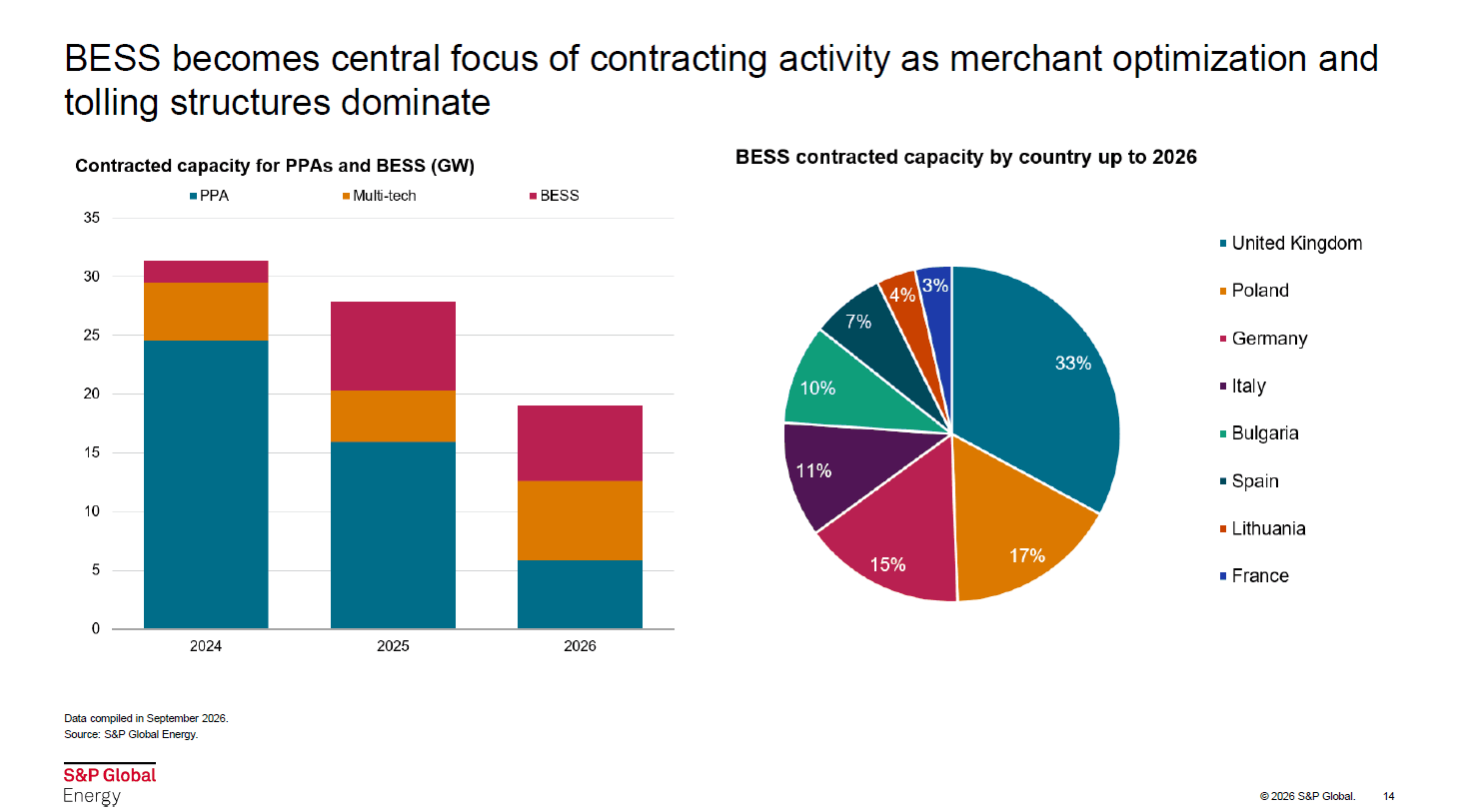
Contracting activity in Europe confirms the growth of private contracts. According to S&P Global Energy, battery capacity with signed contracts, mostly optimisation and tolling agreements, almost quadrupled in 2025 compared to 2024 and, in the first eight months of 2026, it is already at levels similar to those of PPA. The United Kingdom accounts for 33% of the contracted battery capacity in Europe, Poland for 17% and Germany for 15%. Spain represents 7%.
Spain: high revenues with little visibility
The Spanish case shows that a high level of revenues does not guarantee financing. In the S&P Global Energy simulation, which models optimal operation, a four-hour battery in Spain would have earned close to $700 000 per MW per year in 2025, compared to less than $200 000 in Great Britain. Most of this comes from ancillary services, a market of limited size in which, according to Berg, around 10% of the days account for 60% of annual revenues. The addition of new batteries will increase competition in ancillary services and could significantly reduce the revenues obtained in these markets.
For this reason, S&P Global Energy places the low bankability of standalone projects among the main challenges in Spain. Until the capacity market is operational, these projects depend on energy arbitrage and ancillary services, and they do not have the dispatch priority of hybrid projects. During the analysis table, it was noted that some Spanish banks already finance batteries in countries with contracts and capacity payments, and Berg pointed out that in Spain many utilities install batteries at their photovoltaic plants with their own funds. S&P Global Energy expects front-of-the-meter installations to peak in 2027 and 2028, and the subsequent pace will be influenced by the revenue visibility that the capacity market provides by improving project bankability.
Capacity market, tolling and hybridisation: options to reduce risk in Spain
On September 17, the BOE published Order TED/966/2026, which creates the capacity market in the Spanish peninsular electricity system, with a budget that the European Commission estimated at around €9 billion over ten years. New storage facilities will be able to obtain contracts of up to 15 years. S&P Global Energy considers the capacity market to be the factor with the greatest influence on the bankability of Spanish projects. However, pending details such as the firmness coefficients or the auction calendar will decide whether the remuneration is captured by batteries or by existing gas-fired power plants.
Tolling agreements are also starting to be signed in Spain. These contracts can provide greater revenue predictability and facilitate access to financing. According to S&P Global Energy, hybridisation with photovoltaics is the option with the clearest value in the short term, thanks to dispatch priority and reduced curtailment.
Revenue predictability as the decisive factor
The experience of different European markets highlights the importance of having predictable revenues to facilitate the financing of storage projects, whether through public auctions or through private contracts, as in Germany. In July and August, Spain registered intraday spreads close to €200/MWh on average, but it still lacks the revenue visibility that lenders require. As Josefin Berg pointed out, the decisions taken this year will shape the market over the next 10 or 20 years. The design of the capacity market, the development of contracts with optimisers and the quality of revenue forecasts will determine whether the potential of storage in Spain translates into financed projects.
Combining contracted and merchant revenues: the role of AleaStorage
In the opinion of AleaSoft Energy Forecasting, the debate is not about choosing between contracted and merchant revenues. AleaSoft’s forecasts indicate that arbitrage in the day-ahead market and in the intraday market will provide the largest volume of revenues in the long term, albeit with more competition. S&P Global Energy expects the ratio between storage capacity and peak demand to rise from less than 20% in 2025 to more than 50% in most European markets in 2035. A bankable project will combine a contracted revenue component, through the capacity market or agreements with optimisers, with a merchant component quantified with probabilistic scenarios.
This merchant component requires hourly simulation of prices, spreads, ancillary services saturation and the entry of new capacity over the entire useful life of the asset. In this context, AleaStorage, the division of AleaSoft Energy Forecasting specialised in energy storage, provides revenue estimates for batteries in the energy and ancillary services markets, both in stand-alone projects and in projects hybridised with renewables. In addition, AleaStorage assesses the revenues of energy storage projects in capacity markets, analyses hybridisation projects with renewables and models long-term price and volatility scenarios.
Source: AleaSoft Energy Forecasting