


AleaSoft Energy Forecasting, November 6, 2026. Between late October and early November, TTF gas exceeded €100/MWh and several European electricity markets registered prices not seen since 2022. Although gas has fallen back in recent days, amid expectations of an agreement with Iran after the elections in the United States, restrictions on LNG in the Strait of Hormuz and low European reserves point to a winter in which volatility and risk management will be decisive.
Gas prices drive new highs in electricity markets
The TTF gas price on the spot market, the benchmark for the European market, reached €104.60/MWh on October 31 and November 1, the highest value since December 2022. It remained above €100/MWh until November 2 and then fell to €88.52/MWh on November 5. On November 6, the price rose again to €89.74/MWh.
The rise passed through to European electricity markets. On October 29, the German market registered a daily average price of €314.85/MWh and the Dutch market one of €311.53/MWh, the highest since December 2024. On the same day, Belgium reached €296.46/MWh, while France reached €278.29/MWh on November 6. These were their highest prices since December 2022. In Italy, the price reached €282.30/MWh on November 2, also the highest since December 2022. On November 4, the MIBEL market registered €246.01/MWh in Spain and €257.55/MWh in Portugal, the highest values since April 2022.
These episodes show the weight that natural gas still carries in setting electricity prices when combined cycle gas turbine plants are needed to cover demand. Renewable production and the availability of other technologies cushion this influence, but do not eliminate exposure to tensions in the international gas market.
Hormuz and low European reserves shape the winter
The conflict in the Middle East continues to restrict LNG traffic through the Strait of Hormuz, through which around one fifth of global trade in this fuel passed before the war. The reduction in available supply has intensified competition for alternative cargoes.
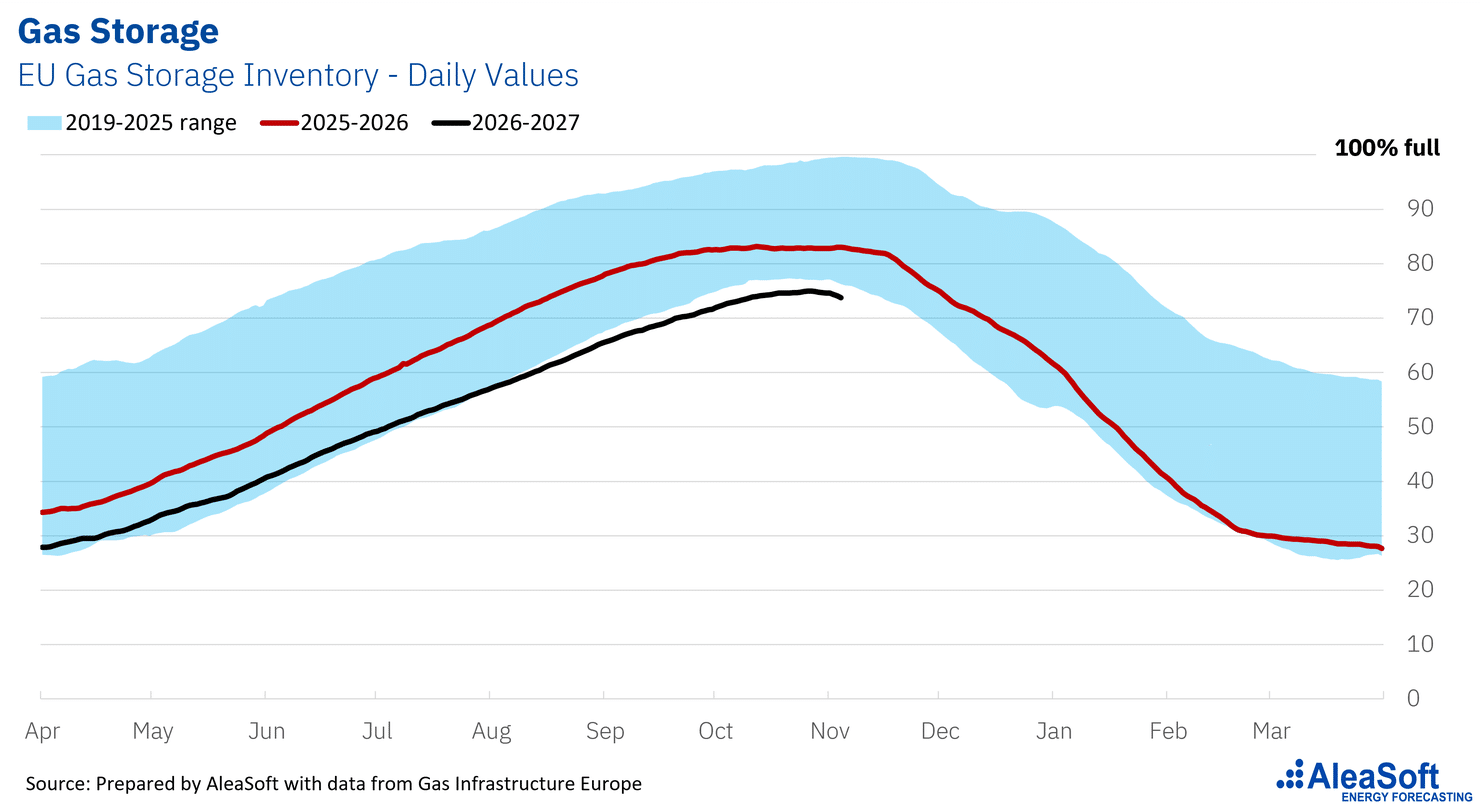
This situation coincided with the months in which Europe had to refill its reserves. The monthly average TTF gas price rose from €53.29/MWh in July to €61.54/MWh in August, €75.50/MWh in September and €85.83/MWh in October. In addition, the European Union’s gas reserves had ended the previous winter at 28% of capacity.
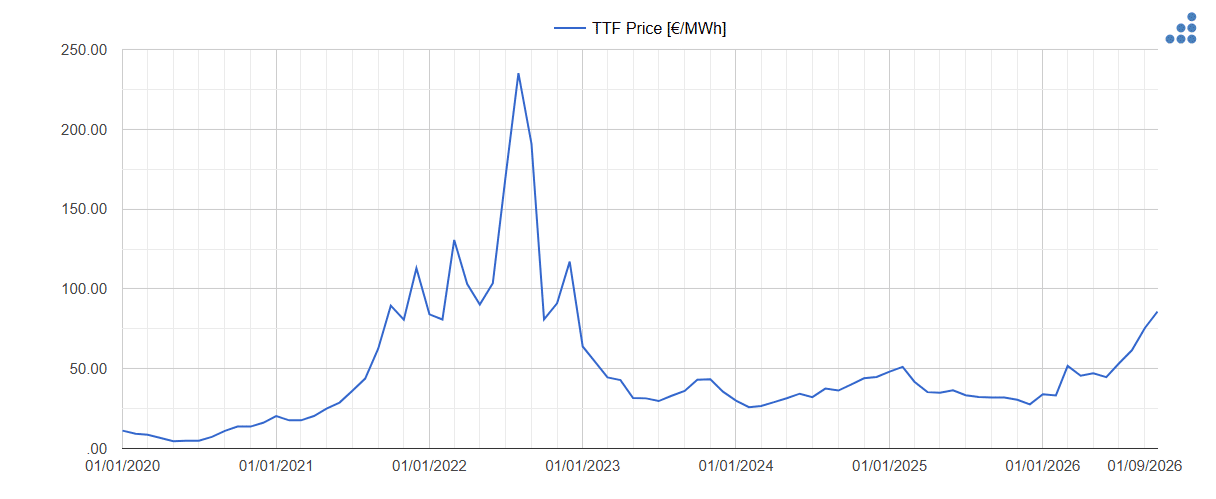 Source: Monthly TTF gas price on the EEX market available in Alea Energy DataBase.
Gas reserves currently stand at around 74%, approximately 20 percentage points below the average recorded for this time of year since 2019. Europe is therefore entering the heating season with less room for manoeuvre. If cold spells, lower renewable production and new supply restrictions coincide, gas and electricity prices could register further spikes. Other incidents cannot be ruled out either, such as availability problems in the French nuclear fleet like the episode in autumn 2016, when the French nuclear safety authority ordered inspections of the steam generators of 18 reactors and several outages had to be brought forward. However, the current situation is different from that of 2022. Europe now has greater supplier diversification, more LNG import capacity and lower gas demand, factors that strengthen security of supply, although they do not prevent sharp price reactions to unforeseen events.
Meanwhile, for now there is no quick way out of the Hormuz crisis. Negotiations between the United States and Iran, with Qatar as mediator, remain without agreement, and QatarEnergy has extended force majeure on its LNG deliveries until at least the end of December. Even if an agreement were reached, maritime traffic would take months to return to normal. The war in Ukraine also continues, and the peace talks scheduled for next week start from very distant positions. With both conflicts entrenched, a significant and sustained fall in prices in the coming months is unlikely. The fall in the first days of November reflects market expectations more than a real improvement in supply.
Hedging gains prominence in a market exposed to uncertainty
For electro-intensive industry, retailers and producers, this volatility is a risk that directly affects costs, revenues and the profitability of investments. Forward contracts, PPAs and other risk management instruments make it possible to reduce exposure to market movements and provide financial stability.
Preparing for winter cannot rely solely on a central price scenario. It is necessary to analyse stress scenarios, quantify their economic impact and have adequate hedges in place to deal with them.
Forecasts and scenarios for decision-making in a volatile winter
AleaSoft Energy Forecasting, with more than 27 years of experience, provides energy market price forecasts that are consistent across all time horizons. Through AleaBlue, it offers price forecasts for electricity and fuel markets in the short and mid-term to design purchasing, selling and hedging strategies. Meanwhile, AleaGreen prepares long-term forecasts with confidence bands for PPA negotiation, asset valuation and the financing of renewable and storage projects. With the succession of highs in gas and electricity, anticipating price trends is essential, and protecting against adverse scenarios is equally important.
Source: AleaSoft Energy Forecasting