


AleaSoft Energy Forecasting, July 20, 2026. In the third week of July, weekly prices rose across the main European electricity markets and exceeded €110/MWh in most of them. Higher gas and CO2 prices, together with lower solar energy production, drove this trend. Lower wind energy production or higher demand also pushed prices up in some markets. Portugal and France set renewable energy production records, while Brent oil and TTF gas futures rebounded amid tensions between the United States and Iran.
Solar photovoltaic and wind energy production
During the week of July 13, solar photovoltaic energy production decreased in most major European electricity markets compared with the previous week. France registered the largest decline, 14%, followed by Spain, with a 5.4% drop. Italy and Germany registered more moderate decreases of 1.6% and 1.0%, respectively. Portugal, however, bucked the trend with a 2.9% increase, marking its third consecutive week of growth.
During the week, Portugal once again broke its all‑time record for solar photovoltaic energy production for a July day, surpassing the previous record from July 7. On July 16, solar photovoltaic energy production reached a new record of 34 GWh.
For the week of July 20, AleaSoft Energy Forecasting’s solar energy forecasts point to declines across all the major European electricity markets under analysis.
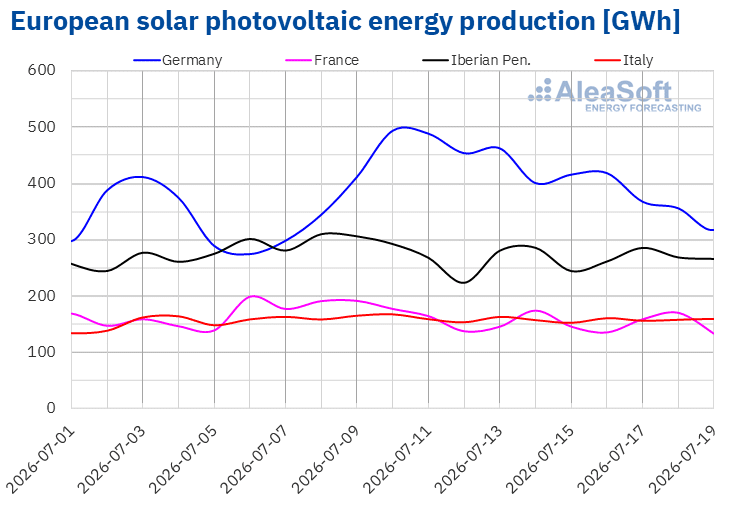
 Source: Prepared by AleaSoft Energy Forecasting using data from ENTSO-E, RTE, REN, Red Eléctrica and TERNA.
In the third week of July, wind energy production increased in most major European electricity markets compared with the previous week. Italy registered the largest increase, 22.0%, followed by Spain, with a 12% rise, and France, with a 6.5% increase. Germany, however, registered the largest decline, 28%, while Portugal registered a more moderate decrease of 5.4%.
On July 13, France set an all-time record for wind energy production for a July day, reaching 215 GWh.
For the fourth week of July, AleaSoft Energy Forecasting’s wind energy forecasts point to increases in the main European electricity markets, while the French market will register a decline.
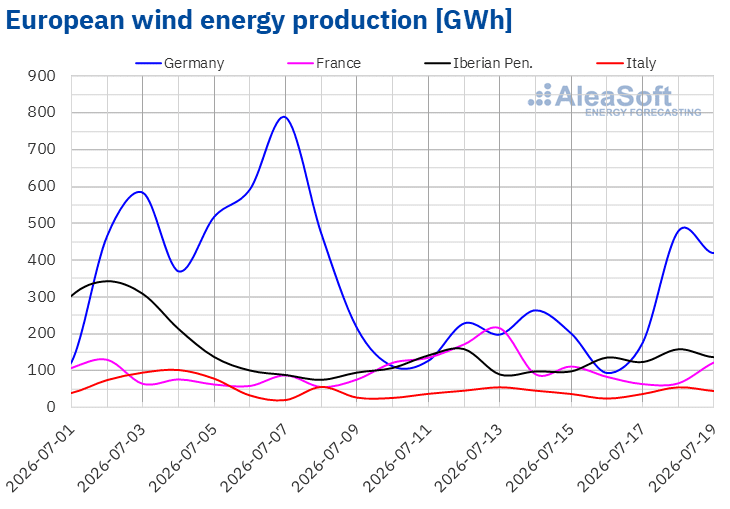 Source: Prepared by AleaSoft Energy Forecasting using data from ENTSO-E, RTE, REN, Red Eléctrica and TERNA.
Electricity demand
In the third week of July, electricity demand decreased in most major European electricity markets compared with the previous week. Italy registered the largest decline, 10%, followed by France, with a 3.8% drop, and Great Britain, with a 3.7% decrease. Belgium registered a 3.4% decline, while Portugal registered a more moderate drop of 2.4%. Germany and Spain, however, bucked the trend, with increases of 2.4% and 1.0%, respectively.
During the week, average temperatures fell in most of the markets under analysis. Great Britain registered the largest decrease, 2.7 °C, while temperatures in France and Portugal fell by 1.2 °C and 0.9 °C, respectively. Spain and Belgium registered a more moderate decline of 0.4 °C. In contrast, temperatures increased by 1.5 °C in Italy and by 0.7 °C in Germany.
For the fourth week of July, AleaSoft Energy Forecasting’s demand forecasts point to increases in the Italian and Portuguese electricity markets. Demand will decline in Germany, Spain, France, Belgium and Great Britain.
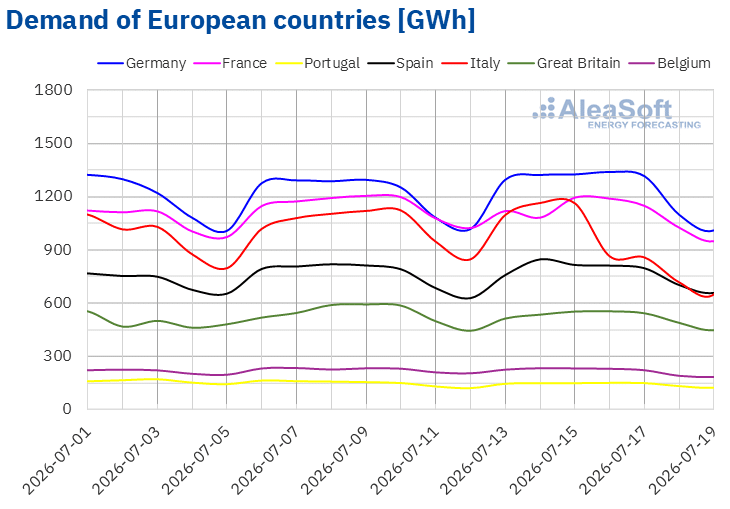 Source: Prepared by AleaSoft Energy Forecasting using data from ENTSO-E, RTE, REN, Red Eléctrica, TERNA, National Grid and ELIA.
European electricity markets
In the third week of July, weekly average prices increased across the main European electricity markets compared with the previous week. The Nordic market registered the smallest increase, 1.2%. The French market registered the largest percentage increase in prices, 25%. Prices rose by 21% in Germany and by 18% in Spain. In the other markets analyzed at AleaSoft Energy Forecasting, prices increased by between 8.9% in the Dutch market and 12% in the Italian and Portuguese markets.
In the week of July 13, weekly average prices exceeded €110/MWh in most European electricity markets. The Nordic market stood as the only exception, with an average of €57.36/MWh. The Italian market registered the highest weekly average, €161.23/MWh. In the other markets analyzed at AleaSoft Energy Forecasting, prices ranged from €112.62/MWh in the Dutch market to €131.47/MWh in the British market.
Regarding daily prices, the Nordic market remained below €85/MWh throughout the third week of July. The German, Belgian, French and Dutch markets also registered prices below €85/MWh during the weekend. On Sunday, July 19, the Nordic market registered the lowest daily average of the week among the markets under analysis, €20.69/MWh.
On the other hand, daily prices exceeded €100/MWh from Monday, July 13, through Friday, July 17, in most European electricity markets. Prices in the Italian and British markets also exceeded €100/MWh during the weekend. On Thursday, July 16, the Italian market registered the highest daily average of the week among the markets under analysis, €170.47/MWh. This marked the Italian market’s highest price since February 13, 2025. However, on Monday, July 20, the price rose even further to €172.56/MWh, its highest level since January 21, 2025. In the Spanish and Portuguese markets, prices reached €138.11/MWh on July 15, their highest level since February 18, 2025.
During the week of July 13, rising gas and CO2 emission allowance prices, together with lower solar energy production in most markets, pushed up European electricity market prices. Lower wind energy production also contributed to the increase in the German and Portuguese markets. In addition, demand increased in the German, Spanish and Italian markets.
AleaSoft Energy Forecasting’s price forecasts indicate that prices will decline during the fourth week of July in markets such as Germany, Belgium and France as demand falls. A considerable increase in wind energy production in Germany will also help lower prices. TTF gas price trends will continue to shape prices across European electricity markets.
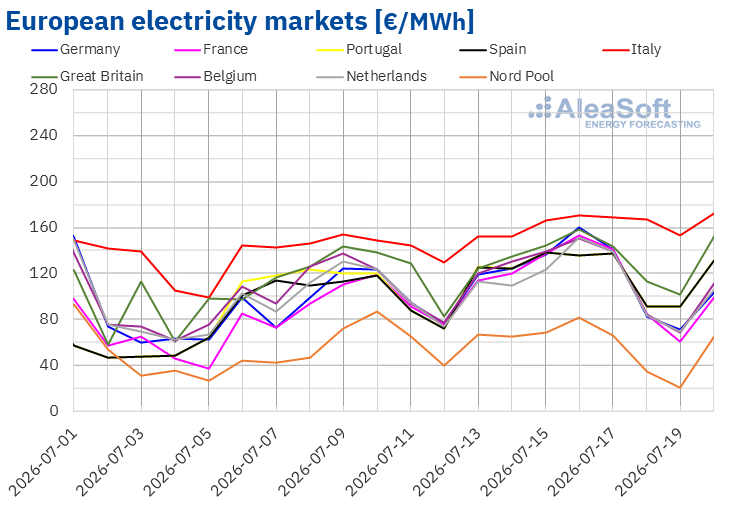 Source: Prepared by AleaSoft Energy Forecasting using data from OMIE, RTE, Nord Pool and GME.
Brent, fuels and CO2
Brent oil futures prices for the Front‑Month in the ICE market increased during the third week of July. On Monday, July 13, these futures settled at their weekly low of $83.30/bbl. Prices rose over the following sessions and reached their weekly settlement high of $88.10/bbl on Friday, July 17. According to data analyzed at AleaSoft Energy Forecasting, this price stood 16% above the previous Friday’s level and reached its highest point since June 12.
Escalating hostilities between the United States and Iran and the closure of the Strait of Hormuz pushed Brent oil futures prices higher during the third week of July.
As for TTF gas futures in the ICE market for the Front‑Month, settlement prices also increased during the third week of July. On Monday, July 13, these futures settled at their weekly low of €51.36/MWh. Prices rose in every session through Friday, July 17, when they reached their weekly settlement high of €57.44/MWh. According to data analyzed at AleaSoft Energy Forecasting, this price stood 18% above the previous Friday’s level and reached its highest point since March 21.
Threats to liquefied natural gas supplies from the Persian Gulf, amid escalating tensions between the United States and Iran, drove TTF gas prices higher during the week.
Regarding CO2 emission allowance futures in the EEX market for the reference contract of December 2026, prices reached their weekly settlement high of €81.39/t on Tuesday, July 14. Settlement prices declined during the final sessions of the week and reached their weekly low of €79.12/t on Friday, July 17. However, according to data analyzed at AleaSoft Energy Forecasting, this price stood only 0.1% below the previous Friday’s level.
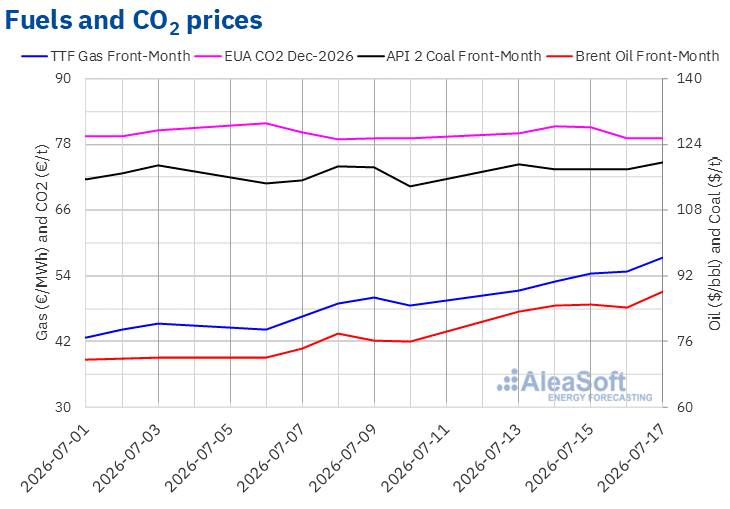 Source: Prepared by AleaSoft Energy Forecasting using data from ICE and EEX.
AleaSoft Energy Forecasting’s analysis on the prospects for energy markets in Europe
On Thursday, July 9, AleaSoft Energy Forecasting held the 68th edition of its monthly webinar series. During this edition, participants analyzed evolution and prospects of European energy markets, as well as the current situation and prospects for PPA, the financing of renewable energy and storage projects, and hybridization opportunities involving renewable energy and self‑consumption. Pedro González, Director‑General of AEGE, and Roger Font, Managing Director Project Finance Energy at Banco Sabadell, participated in the discussion panel during the Spanish‑language webinar. They shared perspectives from the electro‑intensive industry and the project financing sector, respectively.
Source: AleaSoft Energy Forecasting.