


AleaSoft Energy Forecasting, September 16, 2026. European natural gas is trading at highs not seen since late 2022, and European Union reserves stand well below the average of recent years for this time of year. However, the generation mix, the reliance on gas for heating and industry and the interconnection capacity of each country determine a very different level of exposure heading into winter among the main European electricity markets.

Gas prices reach three-year highs while European reserves fall short
The price of natural gas on the European reference market, the TTF, was trading on September 16, 2026 at €81.07/MWh in the spot market, after marking an annual high of €83.97/MWh a day earlier. These are levels not recorded since the close of 2022, when the market still reflected the energy crisis following the invasion of Ukraine, and represent a rise of 187% compared to the start of the year. The front-quarter TTF future is moving in the same direction, standing at €79.95/MWh on September 15, up 191% on the start of the year. Alongside this price rise comes a tight reserves picture, with European Union storage filling at 68.49% on September 15, 2026, well below the 80.83% recorded on the same date in 2025 and levels above 93% in 2023 and 2024, a combination that constitutes a risk for European electricity markets.
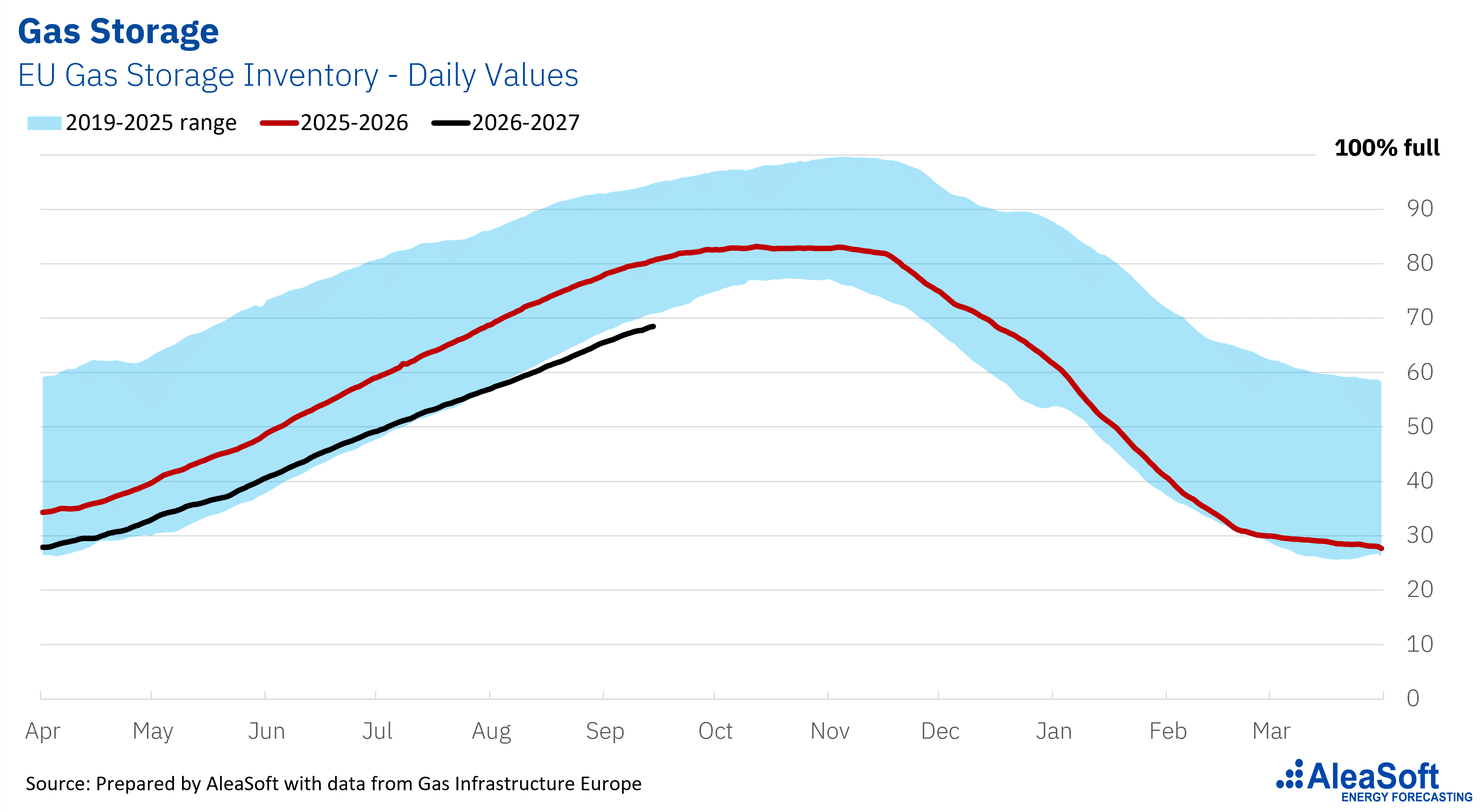
Germany and France face winter with less margin than a year ago
Germany concentrates much of the risk this winter. Without nuclear generation since 2023, with a high reliance on natural gas in electricity generation, heating and industry, and with its floating LNG terminals covering the gap left by Russian gas, the country enters winter with storage filling at 55.93%, almost 20 percentage points below the 76% recorded a year ago, the largest year-on-year drop among the major European markets. This combination explains why the EEX market’s electricity future for the fourth quarter of 2026 traded in Germany at €173.61/MWh on September 15, one of the highest absolute levels among the major continental markets.
France is often cited as the best-protected market thanks to its nuclear fleet, and EDF’s forecast for 2026 and 2027 stands in the range of 350 to 370 TWh, according to the guidance issued at the end of 2025. However, that nuclear cushion is tighter than usual this winter. The Flamanville-3 EPR reactor, of around 1.6 GW, enters an outage in September 2026 for its first major overhaul, with an estimated duration of one year, meaning it will be out of service throughout the winter. Even so, France’s gas reserve level, at 77.16% versus 90% in 2025, and the electricity future for Q4‑2026 on the EEX market at €159.70/MWh as of September 15, still reflect a more comfortable position than Germany’s, albeit with less margin than is usually attributed to this market.
Italy, Spain and Portugal: different gas reliance, different exposure
Italy maintains a strong reliance on natural gas in its generation mix, making it one of the markets most sensitive to any TTF movement. Its storage filling stands at 84.80%, only around 5 percentage points below the 90% recorded in 2025, the smallest drop among the major markets analysed, but this relative strength in reserves does not stop it from being the market with the highest electricity prices in the group, with the Q4‑2026 future at €214.77/MWh and the Q1‑2027 future at €198.45/MWh on the EEX market on September 15.
Spain and Portugal start from a different position, with a much lower weight of gas than in Italy in electricity generation thanks to their renewable fleet and to nuclear generation in Spain, and with storage filling levels of 73.44% and 93.95% respectively, versus 86.34% and 99.54% in 2025. Despite this, gas continues to act as the marginal fuel in the hours that set the Iberian market price, and interconnection capacity with France remains limited for exporting the renewable surplus or importing electricity at times of stress. The Q4‑2026 future on the Spanish EEX market traded at €150.14/MWh on September 15, up 126% on the start of the year.
United Kingdom and Poland: different risks
The United Kingdom combines high reliance on natural gas, both for generation and heating, with structurally reduced storage capacity since the closure of the Rough facility, which puts its filling level at just 31.31%. Being outside the single European market, its exposure depends more heavily on interconnections with the continent and on its own LNG imports. On the EEX market, the British Q1‑2027 future reached €162.36/MWh on September 15, up 112% on the settlement price of January 2.
Poland presents a different profile. Its storage filling as of September 15, at 98.25%, is even higher than the 96.23% recorded a year ago, thanks to an active supply diversification policy following the end of Russian gas imports. Poland’s risk lies less in reserves than in the transition of its generation mix, still heavily reliant on coal, towards a greater share of gas and renewables, a process that shapes its future exposure to the gas market in a different way from the other markets analysed.
Mitigation mechanisms for a tighter winter
Faced with this scenario, the different markets have tools available to cushion the impact. Long-term supply contracts and hedging strategies allow retailers and large consumers to lock in part of their exposure before volatility passes through to the bill. The European Union’s strategic reserves and solidarity mechanisms, activated in previous periods of stress, offer an additional safety net against a severe supply disruption.
Strengthening interconnections, both electricity and gas, between the Iberian Peninsula and the rest of the continent, and between northern and southern European markets, remains the most important structural measure for reducing the differences in exposure between the different European markets, but its development lies beyond the horizon of this winter.
Risks that could put further pressure on the market
Several factors could put further pressure on prices in the coming months. A prolonged cold spell in the depths of winter would require a faster pace of storage withdrawal. Competition with Asia for available LNG cargoes, in a global market where any change in demand in China or Japan quickly passes through to the price, is another risk factor, as is the persistence of geopolitical tension in the LNG transit zones.
On the weather front, the US agency NOAA puts the ENSO Niño 3.4 index at 1.8 °C in August 2026 and assigns over 90% probability to a very strong El Niño episode during autumn and winter, with a 75% probability that the October-to-December quarter will exceed 2.5 °C, an exceptional level since 1950. An episode of this magnitude is typically associated with milder, wetter winters in western and southern Europe, a pattern that AEMET itself reflects in its seasonal forecast for Spain, with temperatures in the upper tercile for the September-to-November quarter. However, there is a greater risk of isolated cold snaps if the polar vortex weakens.
Effects on electricity markets: marginal price and volatility
Natural gas continues to be, in most markets, the marginal fuel setting the price of electricity for many hours across Europe, so any TTF movement passes through relatively quickly to electricity market prices. This pass-through is not, however, uniform throughout the day, and the volatility expected this winter represents a significant opportunity for reading price differentials between hours and for the operation of batteries and other energy storage assets, capable of capturing value precisely at moments of greatest strain between supply and demand. A winter with tight reserves and high gas prices is, in that sense, a scenario in which active position management, rather than simple market exposure, makes the difference in the final outcome.
A winter marked by uncertainty in energy markets
Winter 2026-2027 is shaping up with a gas market showing higher prices and tighter reserves than in recent years, in a context where each European electricity market’s real exposure depends on very different factors, from the generation mix to the availability of the nuclear fleet itself. Amid the uncertainty in energy markets, the ability to anticipate the evolution of gas and electricity prices, market by market, becomes an essential factor for decision-making. AleaSoft Energy Forecasting closely tracks the evolution of these markets through AleaBlue, its division for short- and mid-term forecasting.
Source: AleaSoft Energy Forecasting