


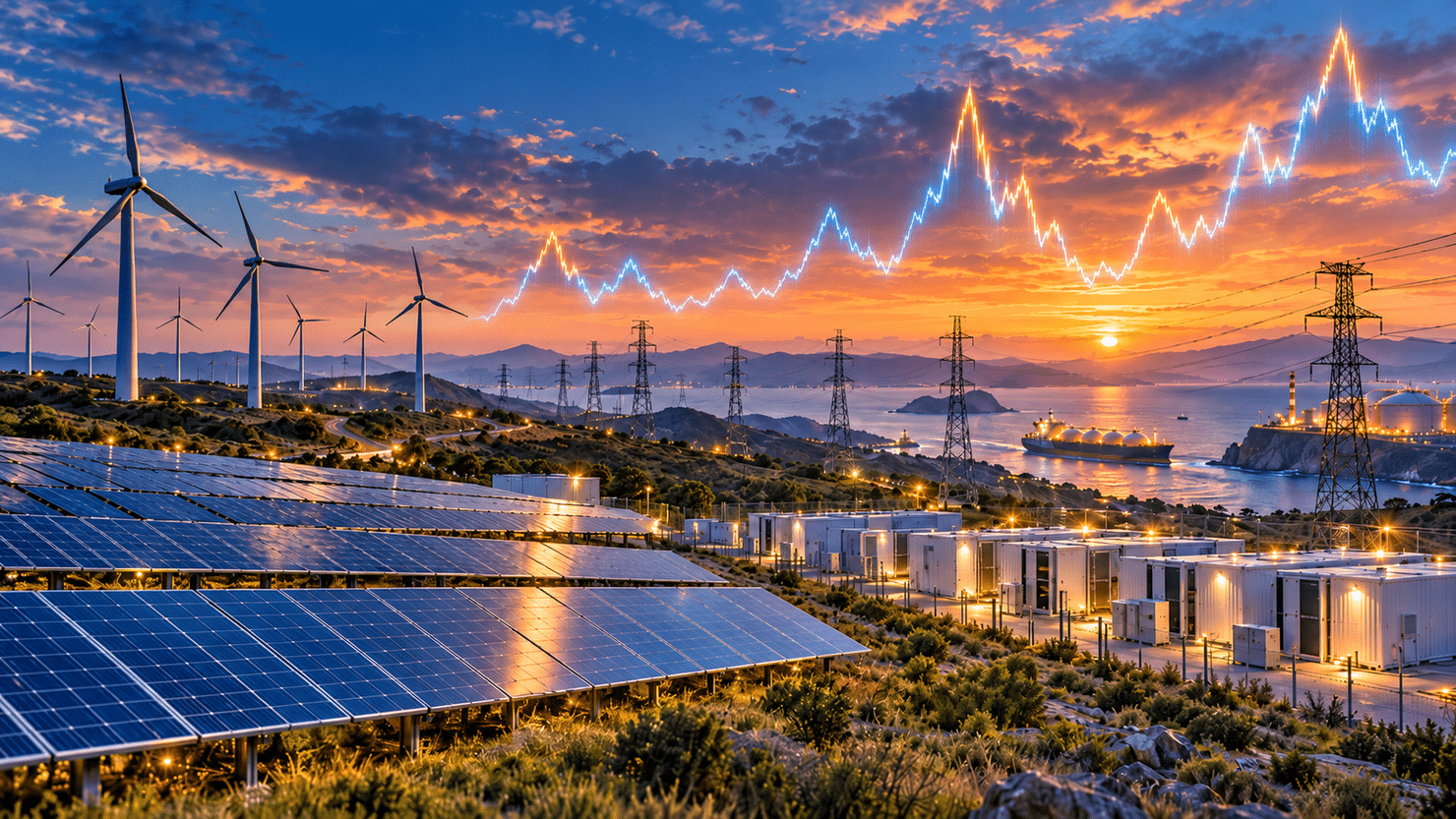
AleaSoft Energy Forecasting, October 7, 2026. The global energy system may have enough energy in 2027 and, at the same time, go through episodes of high prices. With lower inventories, strategic reserves drawn down during the crisis and an uncertain geopolitical outlook, the margin to react to a new unexpected event has narrowed. Volatility, rather than the average price, will therefore probably be the key to understanding next year.
Less margin to absorb a new unexpected event
The current situation of the international markets for oil and natural gas is shaped not only by the tensions already affecting supply, but also by a reduced capacity to respond to new unexpected events. What matters is not only how much oil or natural gas the world can produce, but how much margin exists to react to a new disruption. Lower inventories, strategic reserves used in recent months, problems at certain infrastructures, higher logistics costs and a geopolitical outlook that remains highly uncertain have reduced the capacity that traditionally made it possible to absorb a temporary supply disruption.
The Strait of Hormuz is the clearest example. Its importance for global flows of oil and liquefied natural gas turns any prolonged tension into a global problem. However, the strait does not need to remain completely closed to have economic consequences. More difficult transit means higher transport costs, more expensive insurance, diverted cargoes and less efficient use of energy infrastructure. Energy may keep arriving. The question is at what price.
The bearish scenario also exists
It is advisable not to fall into an exclusively bullish analysis. The latest Short-Term Energy Outlook from the US Energy Information Administration (EIA), published on October 6, places the average Brent price at around $84 per barrel in 2027, compared with the $96 forecast for 2026. The same forecast expects US oil production to reach approximately 14.3 million barrels per day in 2027, up from 13.9 million in 2026. There is also room for production to increase in other countries and for part of the exports affected by the current conflicts to gradually recover. A scenario of easing in the oil market during 2027 is therefore entirely possible.
But the relevant question is not only what the annual average price will be, but what happens around that average. A market with fewer available inventories and less capacity to react can experience much sharper price movements when a new disruption appears. That change in the risk profile is probably more important than trying to anticipate whether Brent will average $80, $90 or $100 per barrel.
Reserves determine the system’s capacity to respond
During a crisis, inventories make it possible to temporarily decouple consumption from production. If a supply problem appears, economies can continue consuming while drawing on stored oil. But that capacity gradually runs out. Strategic and commercial reserves have been used intensively to contain the supply problems of recent months, and on October 2 the G7 leaders agreed on a new release of up to 100 million barrels of oil and diesel, coordinated through the International Energy Agency over four months.
These decisions make it possible to contain the current problem, but they also reduce the capacity to respond to the next one. Rebuilding inventories will also be another source of future demand. This means that the market could remain tight even with moderate global economic growth, because the need to refill storage tanks will be added to usual consumption.
China could shift the balance again
China remains one of the biggest unknowns for 2027. A stronger recovery of its economy would increase its demand for oil, gas and other commodities. There is also a second dimension, energy security. In a more uncertain geopolitical environment, China has incentives to maintain high inventories and diversify its sources of supply. A Chinese recovery could therefore have a double impact, with more consumption and more storage. This effect would be particularly relevant if it coincided with the need for the United States, Europe and other countries to rebuild their own reserves, and it could lead to competition for supply greater than economic growth figures alone would suggest.
For Europe, the real risk lies in gas
From a European perspective, the most important element for 2027 is probably not oil directly, but gas. In recent years, Europe has drastically reduced its dependence on Russian gas and has replaced a large part of those volumes with LNG. The European energy system is now more diversified, but it is also more connected to the global LNG market and competes directly with Asia for available cargoes. In September, Europe received 54% of US LNG exports, according to preliminary data from LSEG (London Stock Exchange Group), a sign of how important the United States has become for European energy security.
The winter of 2026‑2027 will therefore be decisive. A mild winter would allow Europe to reach spring with relatively comfortable storage levels. A cold winter would have the opposite effect, and Europe would have to carry out a strong purchasing campaign during spring and summer to rebuild its gas reserves before the following winter. If Asian demand also increases at that time, gas prices could once again come under strong pressure.
From gas to electricity prices
The transmission of gas prices to the European electricity markets is direct. Hormuz and the international LNG markets affect the price of gas, gas affects the cost of combined cycle plants and combined cycle plants continue to set the marginal price of electricity for many hours. However, the consequence does not have to be a uniform increase in electricity prices.
The growing penetration of photovoltaic energy and wind energy is transforming the profile of hourly prices. In Spain there will be more and more hours with high renewable production and low prices, especially during solar hours. But there will still be other hours in which dispatchable technologies, including combined cycle plants, are needed to cover demand, and if gas prices are high, those hours may register considerably higher prices. Two apparently contradictory phenomena can thus coexist, more hours of electricity with very low prices and an electricity market with high price volatility.
The spread will become increasingly important
This trend has important consequences for producers, consumers and investors. For a photovoltaic plant it is no longer enough to know how the average market price evolves, what matters most is its captured price. For a large consumer it is not enough to forecast the average annual cost of electricity, what matters is when it consumes and what the price is during those hours. And for a battery, the fundamental element is precisely the difference between the value of electricity at different times. The higher the renewable penetration, the greater the need to shift energy from hours of abundance to hours of scarcity.
Even so, oversimplification must be avoided. A battery is not valued with a spread, it is valued by simulating how it will operate throughout its useful life. Future revenues will depend on the evolution of hourly prices, demand, renewable generation, balancing services, curtailment, grid constraints, battery degradation and growing competition between storage systems. For this reason, revenue forecasting must progressively become risk forecasting.
Renewables and storage as protection against volatility
Fossil fuel crises tend to be interpreted initially as a problem for the energy transition. In the medium and long term, precisely the opposite happens. The greater the uncertainty about the cost and availability of imported oil and gas, the greater the strategic value of having domestic energy resources. Europe imports a large part of the fossil fuels it consumes, while the sun and the wind are local resources.
Variable renewables produce when the resource is available and not necessarily when there is demand. Energy storage makes it possible to start changing that relationship. Photovoltaic and wind energy produce power without the need for fuel, and batteries make it possible to shift part of that production over time. The combination of renewable energies, storage, electricity grids, interconnections, demand management and flexible generation will make it possible to progressively reduce Europe’s exposure to international fuel markets.
2027: fewer certainties and a greater need for scenarios
It is very difficult today to anticipate what the average price of oil, gas or electricity will be throughout 2027. There are relevant forces in both directions. On the bearish side are the potential increase in global production, the recovery of the affected infrastructure, the growth of renewables and an eventual geopolitical normalisation. On the bullish side are low inventories, the need to rebuild reserves, the uncertainties in the Middle East, a possible recovery in Asian demand and growing global competition for LNG. That is why the most important concept for 2027 will probably not be price, but volatility.
In this context, working exclusively with a central scenario is becoming less and less useful. Producers, large consumers, developers, funds and financial institutions need to know the expected scenario and, in addition, what may happen if gas prices, demand, renewable production or geopolitical conditions change. For many years, the main objective of the energy transition was to produce renewable electricity at ever lower prices. Now the challenge is also to have that electricity available when it is needed, and the value will increasingly lie in being able to store it, manage it and deliver it at the right time.
Forecasts and scenarios for decision making in a volatile market
In this scenario, buying, selling, hedging and investment decisions require consistent forecasts across all time horizons and scenario-based risk analysis. AleaSoft Energy Forecasting, through AleaBlue, provides electricity market price forecasts and fuel price forecasts in the short‑ and mid‑term for managing risks and opportunities. AleaGreen offers long-term forecasts with confidence bands for asset valuation, PPAs and the financing of renewable energy projects. Meanwhile, AleaStorage analyses the revenues and risks of storage projects with batteries throughout their useful life.
Source: AleaSoft Energy Forecasting