


AleaSoft Energy Forecasting, June 12, 2026. Decarbonising industry requires more than replacing fossil fuels with electricity. Process electrification, battery and thermal storage, hedging strategies and price forecasts will be key to reducing emissions without compromising competitiveness. In this new landscape, risk management and flexibility are becoming decisive factors in industrial decision‑making.
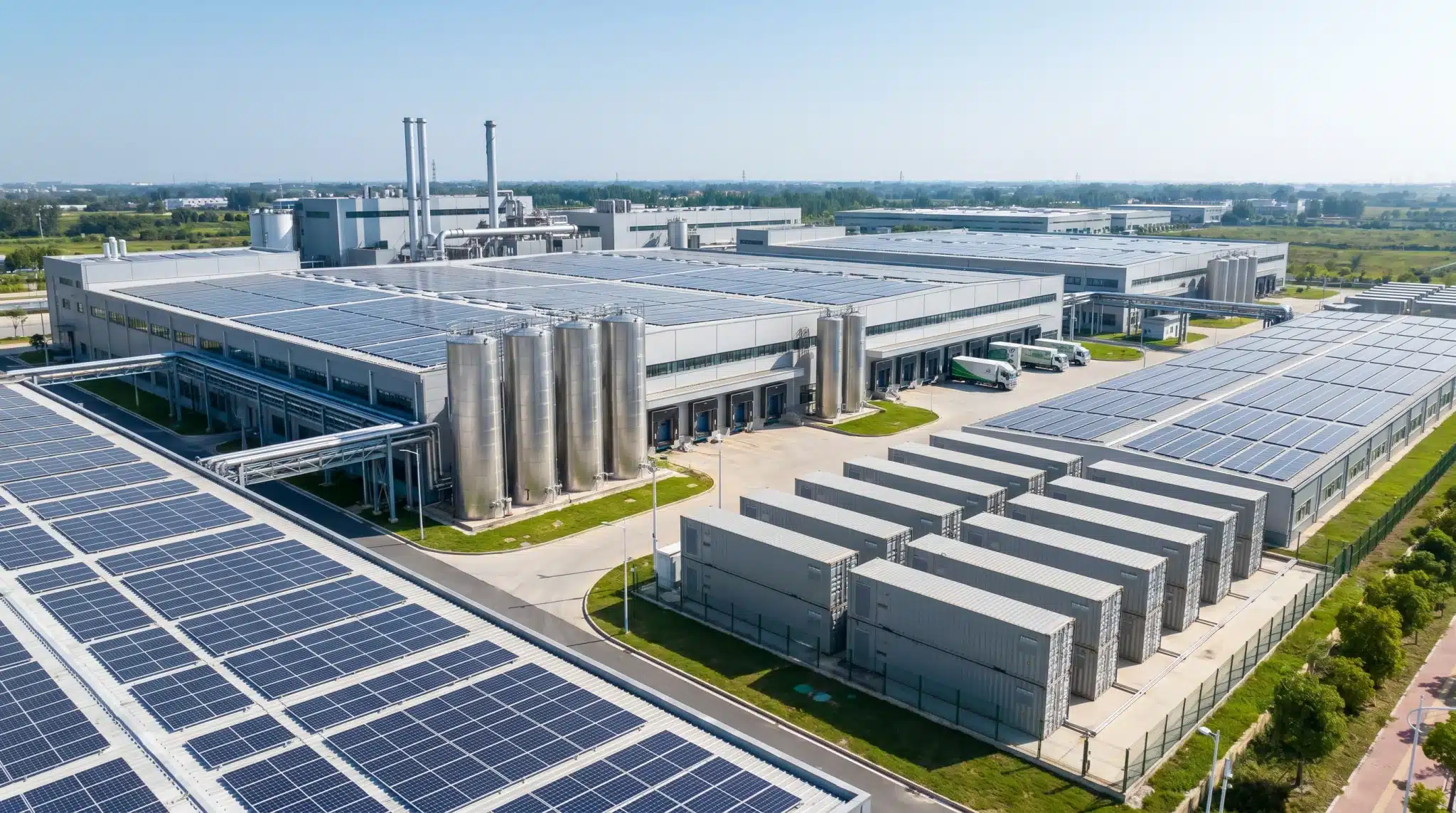
Industry faces one of the greatest challenges of the coming decades: significantly reducing its CO₂ emissions while maintaining security of supply, cost competitiveness and the stability of production processes. For many industrial sectors, particularly those that are electricity‑intensive or gas‑intensive, this process is no longer driven solely by environmental or reputational considerations, but also by economic, regulatory, financial and strategic factors.
For years, industrial processes have relied on natural gas for thermal applications such as furnaces, steam generation, drying and heat treatment. However, the need to reduce emissions, market volatility, regulatory pressure and advances in electrical technologies are accelerating the transition towards solutions based on renewable electricity.
This transition will not be uniform. In low- and mid‑temperature processes, electrification opportunities are emerging through technologies such as industrial heat pumps, electric boilers, induction systems and heat recovery. In high‑temperature processes, the transition will be more complex and will require combinations of direct electrification, green hydrogen, biomethane, renewable fuels and CO₂ capture. All these resources will need to be integrated without compromising industrial competitiveness.
Electricity at the heart of decarbonisation
Electrification is the catalyst of the decarbonisation strategy. This transition makes it possible to reduce emissions when the electricity comes from renewable sources, but it also increases exposure to electricity market volatility, hourly prices, renewable cannibalisation, grid constraints and developments in futures markets.
For this reason, the transition is not simply a matter of replacing equipment. It involves redefining a company’s energy strategy and adopting an active approach to energy management.
An industrial company incorporating photovoltaic self‑consumption, storage systems or new electrical technologies must decide when to consume electricity, when to shift demand, when to store energy and how to manage its exposure to the markets. In this context, industry is moving from being a passive consumer to becoming an active manager of flexibility.
Electrical and thermal storage as complementary tools
Energy storage will play a fundamental role in industrial transformation. Batteries make it possible to store electricity and use it when it delivers the greatest economic value, reducing demand peaks, increasing the use of self‑generated electricity and facilitating participation in future flexibility, balancing and ancillary services markets.
Thermal storage, meanwhile, offers factories with high heat requirements the advantage of producing heat when electricity prices are at their lowest and storing that energy to supply subsequent production processes. Technologies based on hot water, steam, molten salts, ceramic materials, thermal oils, sand and rocks provide solutions suited to different consumption profiles.
Selecting the most appropriate technology requires a combined analysis of electricity and heat consumption profiles, the temperatures required, operational flexibility, load‑shifting capacity, equipment service life and expected market developments.
The importance of forecasts for investment
Electrification and storage will require significant investment, often involving long payback periods and depending on market variables subject to uncertainty.
Price forecasts are therefore essential for assessing the profitability of new facilities, storage systems and self‑consumption projects. These assessments should not be based solely on historical data. They should also draw on long‑term forecasts that consider scenarios for renewable energy penetration, changes in electricity demand, the development of storage and hydrogen, regulation, fuel prices and CO₂ emission allowance prices.
Forecasting should go beyond a single central projection. The use of stochastic forecasts with probabilistic scenarios makes it possible to assess price ranges and confidence bands, quantify risks, evaluate the sensitivity of investments and improve decision‑making.
Hedging and contracts to manage volatility
Growing dependence on electricity will increase the need for hedging strategies to address market volatility. Futures market hedges, bilateral contracts and power purchase agreements, or PPA, can provide price stability and facilitate investment financing. Their design should be supported by rigorous modelling of consumption profiles, available flexibility and market forecasts.
Futures markets make it possible to fix or limit prices over specific time horizons. Bilateral contracts negotiated directly with generators, retailers or other market participants can offer structures that are more closely tailored to an industrial company’s consumption profile. Renewable PPA can provide long‑term price stability, although they also introduce profile risk, cannibalisation risk and potential mismatches between renewable energy generation and industrial consumption.
A properly structured hedging strategy can help facilitate financing, stabilise margins, reduce market risk and improve industrial competitiveness in an increasingly complex environment.
Active energy management
Industrial transformation will have a day‑to‑day operational dimension, with energy managed on an hourly basis. Energy management will integrate forecasts of spot prices, intraday markets, temperatures, renewable energy generation and demand, together with battery states of charge, thermal storage levels, operational constraints and hedging strategies.
The most advanced companies will combine monitoring tools, forecasting models and optimisation systems to maximise the value of their energy resources and strengthen their competitiveness. In this context, short-, mid- and long‑term forecasts are becoming strategic infrastructure. Short‑term forecasts support the operation of batteries, flexible demand and thermal storage. Mid‑term forecasts allow companies to plan purchases, shutdowns, hedging and risk management. Long‑term forecasts are essential for evaluating investments, PPA, process electrification and deep decarbonisation.
Decarbonising without losing competitiveness
Decarbonisation will require a combination of efficiency, electrification, renewable self‑consumption, storage, PPA, hedging, stochastic forecasting and active risk management. It will represent a new way of interacting with energy markets and integrating energy management into corporate strategy.
Companies that are able to anticipate developments, invest on the basis of robust criteria and manage uncertainty effectively will be better positioned to compete in an environment characterised by high renewable energy penetration and growing market complexity. Throughout this process, market price forecasts, probabilistic modelling, scenario analysis and risk management will be just as important as the technology itself.
Industrial decarbonisation goes beyond the mere availability of electrical equipment, batteries and thermal storage systems. Success will depend on the strategic ability to determine the optimal time to invest, manage day‑to‑day operations and protect against volatility in energy markets.
AleaSoft Energy Forecasting’s analysis and forecasts of energy markets and storage in Europe
On June 18, 2026, AleaSoft Energy Forecasting will hold its 67th webinar. With the participation of experts from ENGIE Spain, the webinar will analyse recent developments in European energy markets and the prospects for the second half of 2026. The session will examine how the consolidation of renewable energy generation and greater price volatility in Europe are redefining the role of energy storage and hybrid projects as key assets for providing flexibility to the electricity system. The session will also provide a detailed review of the current situation and trends in Spain’s PPA market, assessing its role as an essential instrument for stability, financing and hedging in changing price environments.
In this context, AleaSoft Energy Forecasting stands out for its ability to analyse, model and optimise renewable, storage and hybrid projects through price forecasts, scenario analysis and market simulations. This helps maximise their value and supports more robust decision‑making in an increasingly complex and dynamic environment.
Source: AleaSoft Energy Forecasting.