


AleaSoft Energy Forecasting, June 23, 2026. The rapid growth of renewable energy production has positioned Spain among the most competitive wholesale electricity markets in Europe. However, for this advantage to translate into more investment, greater industrial competitiveness and increased stability for renewable energy projects, it will be necessary to accelerate the electrification of demand, strengthen grids and transfer the wholesale price signal more efficiently to end consumers.

The decoupling between renewable energy production and demand
In recent years, Spain has seen a very significant expansion of its renewable energy capacity, particularly photovoltaic energy. This growth has helped reduce dependence on fossil fuel technologies in price setting and has contributed to positioning the Spanish electricity market among the most competitive in Europe in wholesale terms. However, electricity demand has not advanced at the same pace as installed capacity.
This decoupling between production and demand is causing increasing pressure during certain hours of the day. High solar energy production during the central hours of the day, combined with demand that is still insufficient to absorb all this energy, has increased the frequency of low, zero or negative prices. This situation directly affects the revenues of renewable energy projects and may reduce the attractiveness of new investments if system imbalances are not corrected.
Demand as a balancing factor for the electricity system
During the webinar organised by AleaSoft Energy Forecasting on June 18, it was highlighted that small increases in demand can have a significant impact on prices. Rising temperatures and the associated increase in electricity consumption for cooling have already helped, in recent days, to break the run of zero prices that had been recorded in the Iberian market since May. This behaviour shows the importance of demand as a balancing factor in a system with high renewable energy penetration.
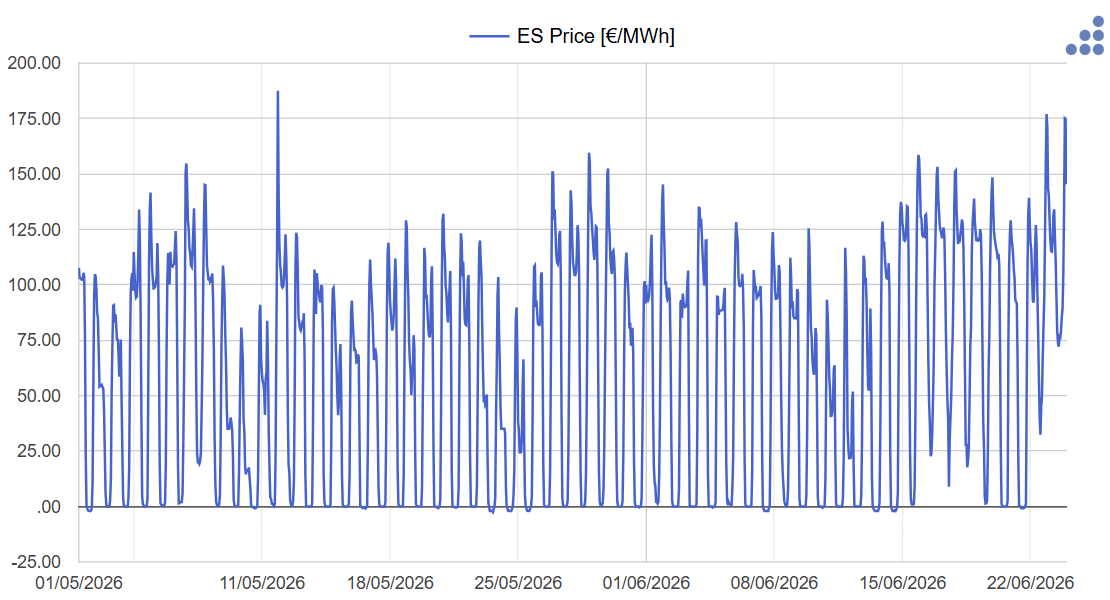 Hourly prices in the wholesale electricity market in Spain. Source: Alea Energy DataBase.
Electrification of new final energy uses
The electrification of industry, transport, data centers, thermal consumption and other final energy uses will therefore be a decisive factor in harnessing Spain’s full renewable energy potential. The greater the volume of flexible and electrified demand, the greater the system’s capacity to integrate renewable energy production, reduce curtailment and sustain prices that make it possible to maintain asset profitability.
However, for electrification to move forward, competitive wholesale prices alone are not enough. This advantage must reach end consumers. The structure of network tariffs, charges, regulated costs and tax components can dilute the low price signal from the wholesale market and reduce the incentive to replace fossil fuel consumption with electricity.
Another key challenge is grid access. Part of the demand that wants to electrify is facing difficulties in connecting to the grid or securing the necessary capacity. It will therefore be essential to make progress in grid development, the availability of connection points and regulation that facilitates the incorporation of new industrial and flexible demand.
The next phase of the energy transition
In this context, the next major challenge for the energy transition in Spain will not only be to continue installing more renewable energy capacity, but also to ensure that demand grows in step with it. After an initial stage focused on the success of renewable energy supply, the next phase will need to focus on demand, flexibility and the final competitiveness of electricity.
The importance of long‑term forecasts
Long‑term forecasts of prices, demand and renewable energy production will be essential for analysing these scenarios. For consumers, retailers, developers, banks and investment funds, having a robust view of the evolution of demand and its impact on prices will be key for making investment, contracting and hedging decisions in the coming years.
AleaGreen analysis to assess electrification and flexibility scenarios
As the electrification of demand gains prominence, the need to assess how new electricity consumption, storage systems, self‑consumption, PPA contracts and demand management strategies can change market exposure and asset profitability will increase. AleaGreen applies its analyses to these specific cases through studies adapted to each project, incorporating assumptions on renewable energy penetration, captured prices, consumption profiles, flexibility and the evolution of the electricity system. In this way, its clients can compare alternatives, quantify risks and define strategies aligned with a market in which demand will play an increasingly active role.
Source: AleaSoft Energy Forecasting.