


AleaSoft Energy Forecasting, June 25, 2026. The growing volatility of European electricity markets is reinforcing the role of batteries as a tool to capture value, optimise revenues and facilitate the integration of renewable energy. In a context of low prices during solar hours and higher peaks at other times of the day, storage makes it possible to shift energy from lower‑price hours to higher‑value periods.
Hourly volatility and opportunities for storage
European electricity markets are showing an increasingly marked hourly structure. High photovoltaic energy production lowers prices during the middle of the day, while lower solar production in the late afternoon and at night creates arbitrage opportunities. This difference between low and high prices within the same day is one of the main economic drivers of energy storage.
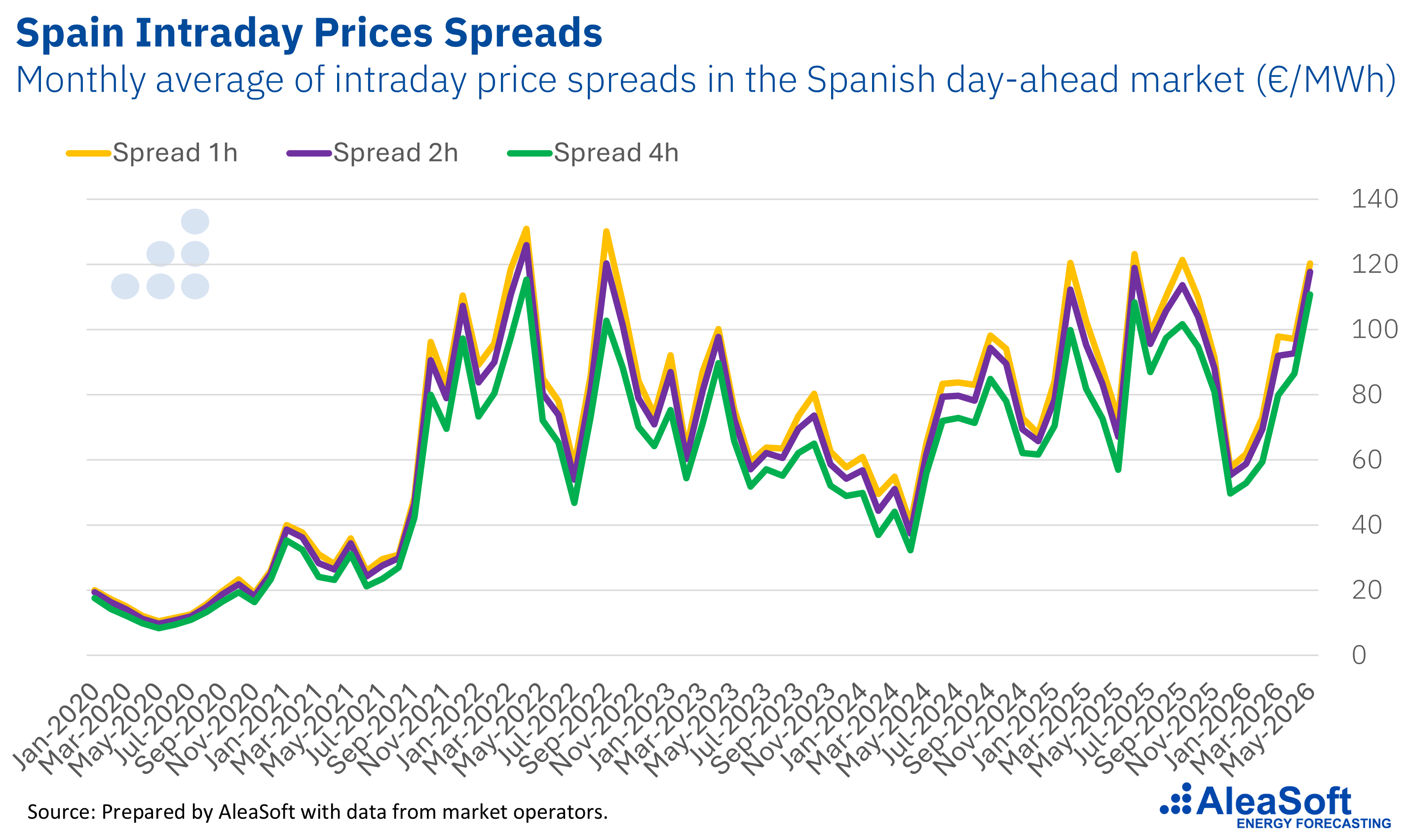
Daily spreads and potential revenues in Spain
In the Spanish electricity market, daily spreads reached very high levels in May. As analysed in the AleaSoft Energy Forecasting webinar held on June 18, average daily spreads stood at around €120/MWh for one hour and above €110/MWh for four hours. Translated into potential revenues, a two‑hour battery with one daily cycle would have obtained around €68 000/MW over the last twelve months, while a four-hour battery would have approached €123 000/MW.
These values show the appeal of storage, but it is also necessary to emphasise the importance of analysing each project individually. The value of a battery depends on multiple factors: the location of the asset, grid access capacity, the possibility of charging from the grid or only from a renewable energy plant, the technology, duration, operating strategy and exposure to different markets.
Hybridisation with batteries in photovoltaic power plants
Hybridisation with batteries is particularly relevant for photovoltaics. In a context in which the prices captured by this technology have fallen due to the concentration of production during solar hours, adding storage can improve the project’s revenue profile. The battery makes it possible to store part of the energy generated during low-price hours and sell it at times of higher value.
During the webinar, it was noted that adding a two‑hour battery to a photovoltaic power plant, even when charging only from the plant itself, could significantly increase the asset’s revenues. If the battery has a longer duration or can also charge from the grid, the optimisation potential increases.
However, hybridisation is not a standard solution that can be applied equally to all assets. Each plant requires a specific analysis to determine the optimal battery size, operating strategy and expected revenue mix. An oversized battery may not maximise profitability, while an insufficient battery may fail to take advantage of market opportunities.
Hybridisation versus stand‑alone projects
In Spain, hybridisation may gain prominence over stand‑alone projects due to the availability of connection points. Many access points are already associated with existing or developing renewable energy plants, favouring the incorporation of batteries into photovoltaic or wind energy projects. Stand‑alone projects can offer more flexible operation, but they face greater barriers in terms of access and permitting.
The role of storage in the electricity system
The development of storage will be key to reducing curtailments, improving the prices captured by renewable energy and providing flexibility to the electricity system. However, for projects to be viable, long‑term hourly forecasts, revenue simulations, sensitivity analyses and scenarios will be needed to assess profitability under different market conditions.
In an increasingly volatile market, batteries do not only make it possible to manage risks. They also turn that volatility into a revenue opportunity. Therefore, modelling storage and hybrid projects will be an essential tool for developers, investors, banks and renewable asset managers.
AleaSoft Energy Forecasting’s analysis for storage and hybridisation projects
To take advantage of the opportunities generated by electricity market volatility, AleaStorage, the division of AleaSoft Energy Forecasting specialised in energy storage, helps its clients transform market uncertainty into well‑founded investment decisions. Its services make it possible to assess stand‑alone and hybrid projects through long‑term hourly forecasts, operation simulations, sensitivity analyses and bankability studies. This approach makes it possible to define the optimal battery size, estimate expected profitability and compare different charging and discharging strategies. In this way, utilities, developers, funds, financial institutions and large consumers have rigorous information to reduce uncertainty and move forward with competitive projects.
Source: AleaSoft Energy Forecasting.