


AleaSoft Energy Forecasting, March 3, 2026. In February, monthly prices declined in most major European electricity markets, with the exception of the Nordic market. Several markets registered their lowest monthly average in recent months, notably the Portuguese market, which reached the lowest price in its history within the Iberian MIBEL market. The fall in gas and CO₂ prices, the latter registering their lowest monthly average since September, together with lower demand compared to January in most markets, supported this trend. In some cases, increased renewable energy production also contributed to the price drops. France, Italy and Portugal registered their highest‑ever wind energy production for a month of February, as did Italy for photovoltaic energy production. Brent futures reached their highest monthly average since August.
Solar photovoltaic and wind energy production
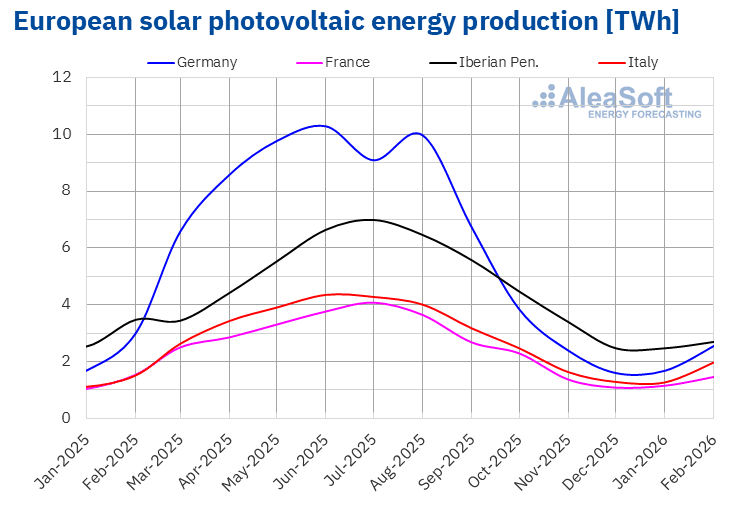
In February 2026, solar photovoltaic energy production rose by 30% in the Italian market compared with the same month of the previous year. In the rest of the analysed markets, production from this technology declined. The Spanish market registered the largest drop, 23%, while the French market registered the smallest decrease, 4.9%. Germany and Portugal registered declines of 16% and 18%, respectively.
Compared with January 2026, solar photovoltaic energy production increased across the main European electricity markets analysed. The Italian market registered the largest rise, 72%, followed by a 68% increase in Germany. Spain, Portugal and France registered increases of 20%, 25% and 40%, respectively.
The Italian market reached a historic record for solar photovoltaic energy production for a month of February, with 1981 GWh.
Between February 2025 and February 2026, the Spanish market added 8198 MW of solar photovoltaic energy capacity, excluding self consumption, according to data from Red Eléctrica. Over the same period, the Portuguese market added 915 MW to the system, according to REN.
 Source: Prepared by AleaSoft Energy Forecasting using data from ENTSO-E, RTE, REN, REE and TERNA.
 Source: Prepared by AleaSoft Energy Forecasting using data from ENTSO-E, RTE, REN, REE and TERNA.
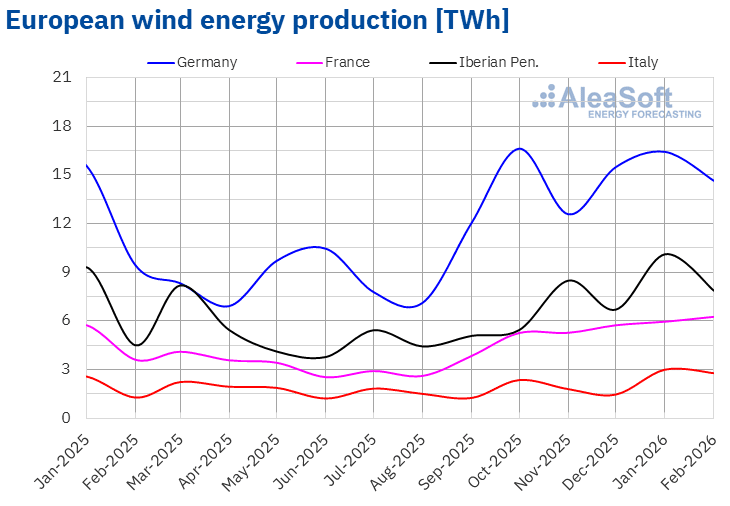
In February 2026, wind energy production increased year on year in the main European electricity markets. Italy registered the largest increase, 117%, followed by Portugal and France, with rises of 91% and 73%, respectively. Germany registered the smallest increase, 55%, while Spain registered growth of 71%.
Compared with the previous month, wind energy production increased in France and Italy. France registered the largest rise, 16%, while Italy registered a more moderate increase, 2.6%. By contrast, wind energy production fell in the Iberian Peninsula and Germany in February compared with January. Spain registered the largest drop, 16%, while Germany and Portugal registered declines of 1.4% and 6.4%, respectively.
In February 2026, the French, Italian and Portuguese markets registered their highest ever wind energy production for a month of February, with 6247 GWh, 2770 GWh and 1636 GWh, respectively.
According to Red Eléctrica, between February 2025 and February 2026 the Spanish market added 1020 MW of new wind energy capacity, excluding self consumption. Over the same period, the Portuguese market added 36 MW to the system, according to REN.
 Source: Prepared by AleaSoft Energy Forecasting using data from ENTSO-E, RTE, REN, REE and TERNA.
Electricity demand
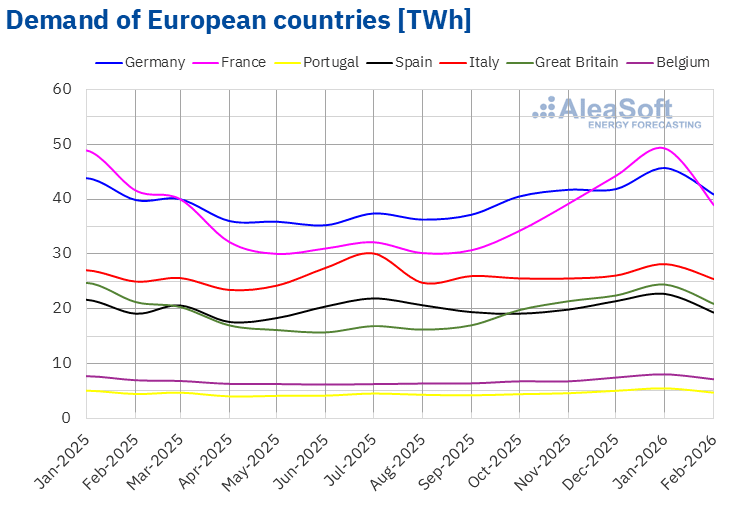
In February 2026, electricity demand increased year on year in most major European markets. The Portuguese market registered the largest increase, 5.3%, while the Spanish market registered the smallest rise, 1.0%. The Italian market registered an increase of 1.8%, and the German and Belgian markets registered demand rises of 2.5% in both cases. By contrast, the British and French markets registered year on year declines of 1.7% and 6.4%, respectively.
Compared with January 2026, demand fell in February in most major European markets, considering figures adjusted for the number of days in each month. France registered the largest drop, 12%, while Germany registered the smallest, 1.0%. Belgium, Portugal, Great Britain and Spain registered decreases ranging from 2.0% in Belgium to 6.0% in Spain. In the Italian market, demand remained similar to January once adjusted for the number of days in each month. However, without this adjustment, the decrease was 9.7%.
Average temperatures were milder than in the same month of 2025 across all analysed European markets. Belgium and France registered the largest increases, 2.8 °C and 2.6 °C respectively, while Portugal registered the smallest rise, 0.9 °C. In Spain, Italy, Germany and Great Britain, increases ranged from 1.1 °C in Spain to 1.7 °C in Great Britain.
Compared to January 2026, average temperatures in February were higher than in the previous month in all analysed markets. France registered the largest increase, 4.2 °C, while Great Britain registered the smallest rise, 2.5 °C. In the other markets, average temperatures increased between 2.6 °C in Portugal and 3.8 °C in Germany.
 Source: Prepared by AleaSoft Energy Forecasting using data from ENTSO-E, RTE, REN, REE, TERNA, National Grid and ELIA.
European electricity markets
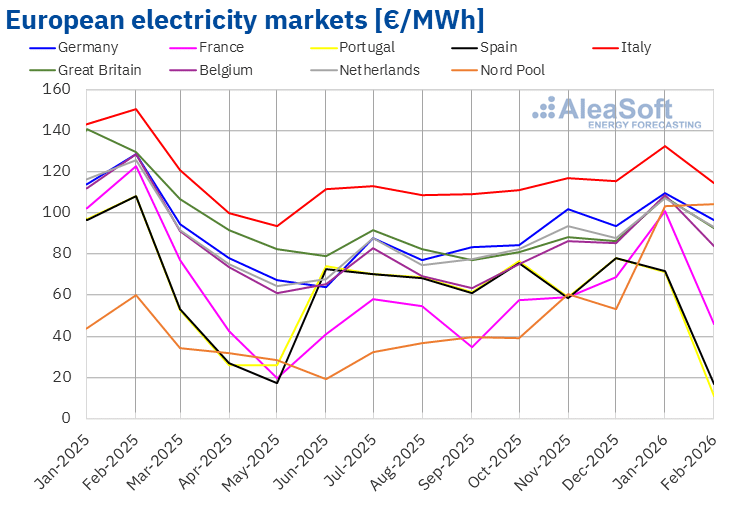
In February 2026, the monthly average price was below €100/MWh in most major European electricity markets. The exceptions were the Nordic and Italian markets, with averages of €104.38/MWh and €114.41/MWh, respectively. In contrast, the Portuguese, Spanish and French markets registered the lowest monthly prices, €10.64/MWh, €16.41/MWh and €46.02/MWh, respectively. In the remaining European electricity markets analysed at AleaSoft Energy Forecasting, averages ranged between €83.61/MWh in the Belgian market and €96.58/MWh in the German market.
Compared to January, average prices fell in most European electricity markets analysed at AleaSoft Energy Forecasting. The Nordic market was the exception, with an increase of 1.0%. On the other hand, the Spanish and Portuguese markets registered the largest percentage price drops, 77% and 85%, respectively. In the other markets, prices fell between 12% in the German market and 54% in the French market.
Comparing February average prices with those registered in the same month of 2025, prices also declined in most markets. The Nordic market was again the exception, with an increase of 74%. The Spanish and Portuguese markets registered the largest percentage price falls, 85% and 90%, respectively. In the remaining markets, price decreases ranged from 24% in the Italian market to 62% in the French market.
As a result of these price declines, in February the Portuguese market registered the lowest monthly price in its history within the Iberian MIBEL market, since its launch in July 2007. The Spanish market reached its lowest price since May 2024. The French market registered its lowest monthly average since October 2025, while the Italian and Belgian markets registered their lowest prices since November 2025. By contrast, the Nordic market, where prices increased, reached its highest average since January 2023.
In February 2026, the decline in gas and CO₂ emission allowance prices, the increase in solar energy production and the fall in demand compared to January supported the decrease in European electricity market prices. The increase in wind energy production in the French and Italian markets also contributed to lower prices in those markets.
Year on year, the fall in gas and CO₂ emission allowance prices compared to February 2025, together with the notable increase in wind energy production, drove the year on year decline in European electricity market prices. In addition, solar energy production increased in Italy, while demand fell in the French and British markets.
 Source: Prepared by AleaSoft Energy Forecasting using data from OMIE, RTE, Nord Pool and GME.
Brent, fuels and CO2
Brent oil futures for the Front Month in the ICE market registered a monthly average price of $69.37/bbl in February 2026. According to data analysed at AleaSoft Energy Forecasting, this was the highest monthly average since August 2025. This value was 7.2% higher than the January 2026 Front Month futures average, $64.73/bbl. In contrast, it was 7.4% lower than the February 2025 Front Month futures average, $74.95/bbl.
During February, developments in the conflict between the United States and Iran influenced Brent oil futures prices. Fears of supply disruptions arising from this conflict exerted upward pressure on prices, whose average exceeded that of the previous month. However, concerns over demand limited the increases. The possibility of higher OPEC+ production in April and the International Energy Agency’s monthly report lowering its demand forecasts contributed to these concerns. New US tariffs also exerted downward pressure in the second half of February.
As for TTF gas futures in the ICE market for the Front Month, the average value registered in February 2026 was €32.42/MWh. Compared with the average of Front Month futures traded in January 2026, €34.13/MWh, the February average fell by 5.0%. Compared with the average of Front Month futures traded in February 2025, €50.27/MWh, this represented a decrease of 36%.
In February, greater availability of liquefied natural gas from the United States and forecasts of milder temperatures exerted downward pressure on TTF gas futures prices. As a result, the monthly average declined despite low European storage levels and fears of supply disruptions due to instability in the Middle East.
Regarding CO₂ emission allowance futures in the EEX market for the reference contract of December 2026, the average price in February was €75.00/t. According to data analysed at AleaSoft Energy Forecasting, this was the lowest monthly average since September 2025. This monthly price was 15% lower than the January 2026 average, €88.13/t. Compared with the February 2025 average, €79.40/t, the February 2026 average was 5.5% lower.
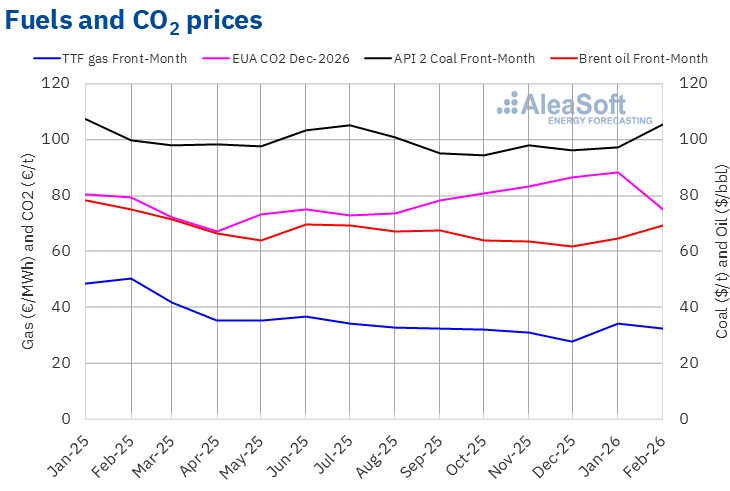 Source: Prepared by AleaSoft Energy Forecasting using data from ICE and EEX.
AleaSoft Energy Forecasting’s analysis on the prospects for energy markets and storage in Europe
The AleaStorage division of AleaSoft Energy Forecasting prepares forecasting reports for energy storage projects. These reports are essential to ensure storage is a profitable and manageable investment. AleaStorage services include revenue and profitability calculations for both stand alone batteries and hybrid systems, as well as optimal storage sizing in hybrid systems.
Source: AleaSoft Energy Forecasting.