


AleaSoft Energy Forecasting, October 15, 2026. Captured prices for solar PV have fallen because renewable generation has grown faster than demand. Data centers, electrification and storage are beginning to change that relationship. Integrating them requires adequate grids, regulation and planning, but it opens a stage in which new demand will give value to renewable energy and storage, although the early election adds uncertainty over the timing.
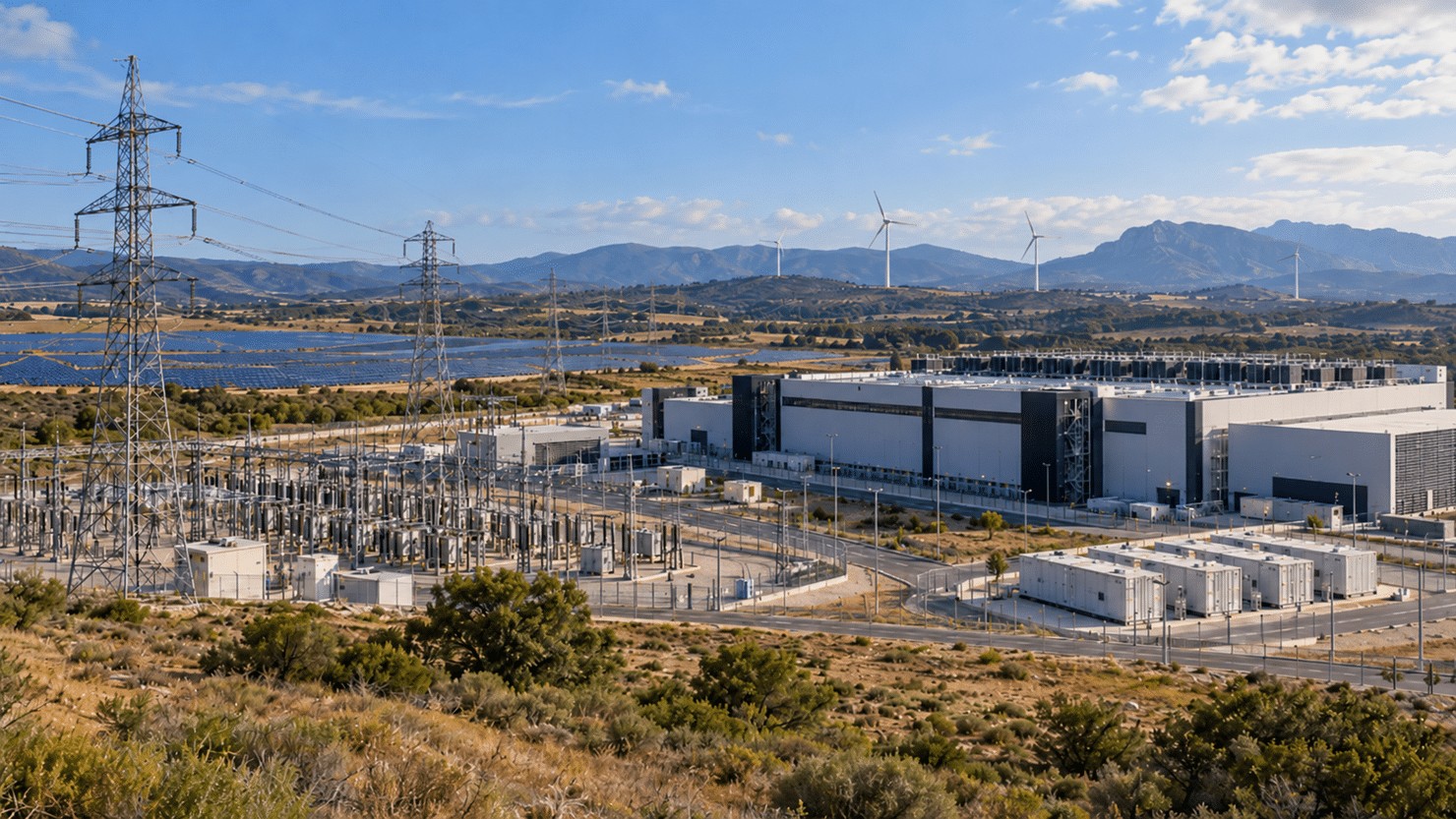
Data centers are becoming one of the main drivers of growth in electricity demand in Spain. The development of artificial intelligence, cloud services and digitalisation is driving projects of a scale that was hard to imagine a few years ago and that may have a significant impact on the evolution of the electricity system over the next decade.
Spain has especially favourable conditions to attract these investments: abundant renewable resources, a strategic geographical position, good telecommunications infrastructure and an increasingly integrated electricity market, with a high penetration of renewable energy. But turning this opportunity into economic development requires more than having renewable electricity. It will be necessary to guarantee grid access capacity, a competitive and reliable supply during all hours of the year and efficient integration of this new demand.
Captured prices: demand changes the equation
Over the last decade solar PV and wind capacity has grown very quickly and, during solar hours, generation frequently exceeds demand. In 2025 alone, Spain added 8.8 GW of solar PV and 1.2 GW of wind capacity, while demand grew by 2.8%, to 256 086 GWh, according to Red Eléctrica. In the first half of 2026 there were 557 hours of negative prices in the day-ahead market. The captured price of solar PV went from €42.53/MWh in 2024 to €35.47/MWh in 2025 and to €38.87/MWh between January 1 and October 14, 2026.
This situation reflects a temporary mismatch between supply and demand, not a permanent feature of the system. The equation is beginning to change on the demand side. Data centers need clean, reliable electricity 24 hours a day and can pass their cost on to the digital services they sell, so they are willing to compete for long-term renewable PPAs. The electrification of industry and transport, heat pumps, electric vehicles, renewable hydrogen and the data centers themselves will compete for renewable generation that will have to grow rapidly. Spain’s National Energy and Climate Plan (NECP) forecasts that electricity demand will grow by 34% relative to 2019 by 2030 and that the electrification of the economy will reach 35%.
Storage also adds demand in the hours when there is currently excess energy. Batteries store electricity when renewable generation is abundant and prices are low, and release it when it is scarce. The NECP forecasts 22.5 GW of storage in 2030, compared with the 3427 MW installed at the end of 2025 according to Red Eléctrica. Globally, the IEA estimates that data center electricity consumption will rise from 415 TWh in 2024 to around 945 TWh in 2030. More renewables, much more storage and growing demand do not point to a structurally low-price scenario. The future will be renewable, but not necessarily low-priced, and in that scenario captured prices for solar PV have room to recover.
More than 6 GW of access granted on the transmission grid
According to the demand access capacity map published by Red Eléctrica on October 1, data processing centers had accumulated 6329 MW of access capacity granted on the transmission grid, or 34.2% of the 18.52 GW awarded to demand facilities. It is the category with the most capacity granted, and none of those 6329 MW was in service yet.
The volume is even larger when the distribution grids are included. The explanatory report accompanying the draft Royal Decree on data centers, from the Ministry for the Ecological Transition and the Demographic Challenge (MITECO), states that more than 6 GW have been granted on the transmission grid and around another 6 GW on distribution. These figures far exceed the deployment estimates in the 2024 Artificial Intelligence Strategy, which envisages some 2.5 GW of computing capacity in 2030, equivalent to between 3.5 and 4 GW of electricity demand.
There is therefore a considerable gap between the capacity requested or granted and the power that is likely to end up materialising. This situation highlights the importance of distinguishing firm projects from those that may never be built, and of preventing scarce grid capacity from remaining reserved for long periods without materialising.
Specific regulation for data centers
The rapid growth of these facilities has led the Government to prepare a specific regulatory framework. The draft Royal Decree on the energy and environmental sustainability, resilience and digital sovereignty of data centers was put out for public consultation between August 27 and September 10, and the CNMC, Spain’s markets and competition regulator, issued its report on it on September 22.
The draft would generally apply to data centers with an access capacity equal to or greater than 1 MW and sets requirements relating to energy efficiency, water consumption, resilience, digital sovereignty and supply from new renewable generation. One of the elements that has generated most debate is the proposal that, under certain conditions, at least 80% of the electricity consumed in each hour be backed by renewable generation produced in that same hour, together with additionality requirements for renewable generation.
The CNMC shares the general sustainability objectives but has recommended introducing greater flexibility in their application. Among other considerations, it notes that requiring additional new generation even during hours with renewable surpluses, curtailment or very low or negative prices could produce inefficient signals. In precisely those hours, new demand can make it easier to integrate the available renewable generation.
This issue is especially relevant in a system such as Spain’s, with growing penetration of solar PV and wind energy. Rather than imposing a uniform pattern across all hours, regulation can favour signals that encourage consumption when renewables are abundant and the use of storage and other sources of flexibility when availability is lower.
New requirements for connecting to the grids
In parallel with the specific regulation for data centers, the Government is processing another rule with direct implications for these facilities. On October 13, the Council of Ministers authorised the urgent administrative processing of the draft Royal Decree that will establish new minimum design, equipment, operating and safety requirements for facilities connecting to the transmission and distribution electricity grids. The rule is not aimed exclusively at data centers, but they will be one of the types of new demand most affected by its application.
The aim is to adapt connection requirements to an electricity system very different from the one that existed when the current rules were designed. Among other measures, the proposal requires demand facilities to be able to withstand certain voltage dips. According to MITECO, this capability would reduce the constraints arising from the interaction between different nodes and bring to light access capacity that cannot currently be granted, as well as strengthening the security of system operation.
This regulatory development is relevant because it shows that physically expanding the grids is not the only way to increase their capacity. Improving the technical behaviour of new facilities, managing demand properly and using existing infrastructure more efficiently can also make it possible to connect new projects.
Renewables, storage and flexibility
The growth of data centers may also become a major boost for investment in new renewable generation. High and relatively stable demand offers long-term visibility to generators and can facilitate contractual structures such as PPAs. But renewable generation alone does not guarantee a supply that matches a data center’s consumption profile over 24 hours a day.
Solar PV produces mainly during solar hours and wind energy production depends on weather conditions. At the same time, data centers have much more stable consumption profiles. Combining different renewable technologies, battery storage, demand management and market participation can help reduce this mismatch. The CNMC itself considers that the regulatory design should incentivise storage, diversification of renewable technologies and hybrid configurations able to shift energy from periods of higher renewable output to hours of lower availability.
This trend may also open up new opportunities for BESS projects. Batteries can complement renewable PPAs, optimise the electricity purchasing profile, reduce exposure to the highest-price hours and, depending on their configuration and the applicable regulation, take part simultaneously in different markets and system services.
The grid will be one of the determining factors
The growth of data centers also coincides with a much broader transformation of electricity demand. The electrification of industry and transport, the production of renewable hydrogen, new housing and other uses will also need connection capacity.
The proposed transmission grid planning to 2030 reflects this transformation. In its initial version, put out for public consultation in autumn 2025, it planned to serve 3.8 GW associated with data processing centers, within a much broader growth of new demand connected to the grid. After the comments received during the consultation, the investment foreseen in the electricity planning already exceeds 17 000 million euros, according to MITECO.
The location of new data centers will depend on the availability of land, digital connectivity and water resources, but actual grid capacity and the time needed to obtain access and connection will be increasingly decisive factors for investment decisions.
The early election introduces regulatory uncertainty
A further element of uncertainty is now added to this process. Royal Decree 806/2026 of October 5 dissolved the Congress and the Senate and called general elections for November 29, 2026.
The draft specific regulation for data centers is a Royal Decree and therefore its final approval does not require a vote in Parliament. However, the early election reduces the time available and adds uncertainty over when the pending procedures will be completed and what the final content of the rule will be. This uncertainty is especially relevant for investments with horizons of several decades, for which regulatory stability is essential.
At the same time, the decision of the Council of Ministers on October 13 to speed up the processing of the new technical connection requirements shows a willingness to move forward on some of the regulatory changes before the elections.
An opportunity for the Spanish electricity system
The growth of data centers poses significant challenges, but it is not solely a matter of rising electricity consumption. New structural demand can help absorb a growing share of renewable generation, favour new investment and offer long-term signals for technologies such as wind, solar PV and storage. It can also drive new flexibility solutions and more efficient use of the grids.
For this to happen, growth in demand will need to be coordinated with the development of generation, storage and grids. Its contribution to the system will depend on whether regulation, planning and market signals allow that growth to be turned into new renewable and storage investment, rather than resulting in greater pressure on the grids. That balance between digitalisation, electrification and renewable development will be one of the great challenges of the Spanish electricity system over the next decade.
Long-term forecasts for new demand: the role of AleaGreen and AleaStorage
Deciding where to locate a data center, what PPA structure to sign, what mix of solar PV and wind to contract or what battery size to include are decisions with horizons of twenty or thirty years. To make them with confidence, it is essential to have robust demand forecasts and electricity market price forecasts, able to analyse long-term scenarios and determine how hourly profiles, captured prices, spreads and flexibility needs will evolve as demand, renewable generation and storage grow.
In this context, AleaGreen, the AleaSoft Energy Forecasting division specialising in long-term forecasts, provides price, demand and renewable production forecasts with confidence bands for asset valuation, PPA structuring and financing of renewable energy projects. For its part, AleaStorage analyses the revenues and risks of battery storage projects over their entire useful life, including their hybridisation with renewable generation and with large consumers such as data centers.
Source: AleaSoft Energy Forecasting