


AleaSoft Energy Forecasting, September 9, 2026. TTF gas and Brent oil futures prices continue their climb amid heightened geopolitical tension in the Middle East. The Front‑Month TTF gas futures contract closed on September 8 at €75.84/MWh and during the September 9 session it reached €79.00/MWh, its highest level since early 2023. Meanwhile, the Front‑Month Brent futures contract closed on Tuesday at $97.92/bbl and during the following session climbed back above the $100/bbl barrier for the first time since July 24.
TTF gas hits new highs
Upward pressure on the European gas market intensified over the past few days. According to closing data analysed by AleaSoft Energy Forecasting, the Front‑Month TTF contract rose from €73.31/MWh on September 7 to €75.84/MWh on the 8th, a rise of 3.5%. Compared with the August 31 close of €69.81/MWh, the increase already exceeds 8%.
The trend accelerated during the September 9 session. The contract traded as high as €79.00/MWh, around 4% above the previous close and at levels not seen since early 2023.
Geopolitical tensions in the Middle East, restrictions on international LNG flows and competition between Europe and Asia for supply continue to add a significant risk premium to prices. Europe is also approaching the heating season with gas reserves lower than usual for this time of year, which increases the market’s sensitivity to any new supply disruption.
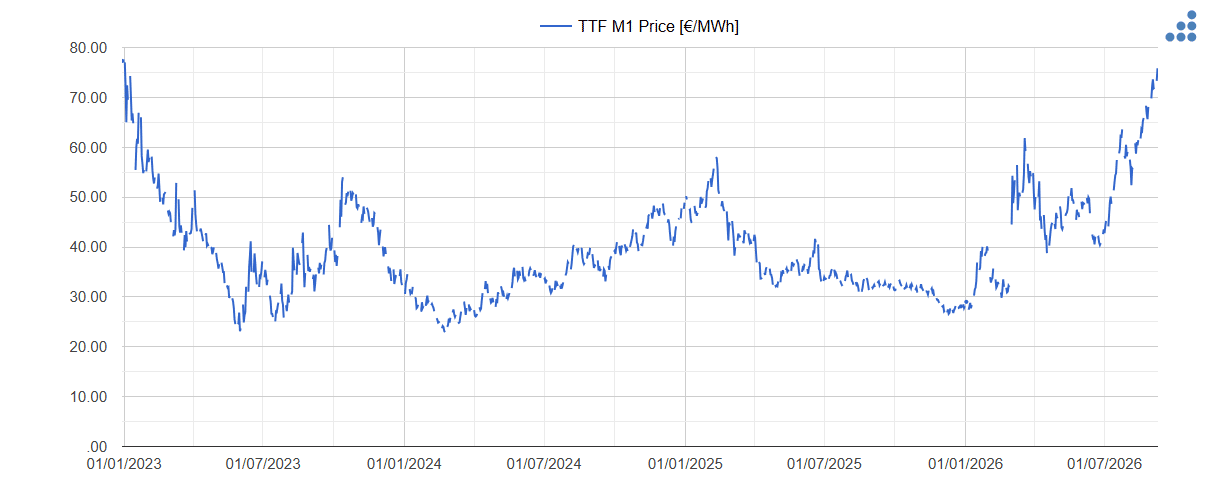 Source: TTF gas futures for the Front‑Month on the ICE Market available in Alea Energy DataBase.
Brent oil climbs back above $100/bbl
The rise is also taking place in the oil market. The Front‑Month Brent contract closed on September 8 at $97.92/bbl, compared with $97.00/bbl the previous day. During the September 9 session it topped $100/bbl and reached $101.49/bbl, around 3.6% above the previous close. This is the first time since July 24 that Brent has surpassed this level.
The escalation of the conflict in the Middle East is again placing supply-route risks at the centre of attention. Difficulties in transit through the Strait of Hormuz and rising tensions in the Red Sea are increasing the perceived risk to international oil and gas flows.
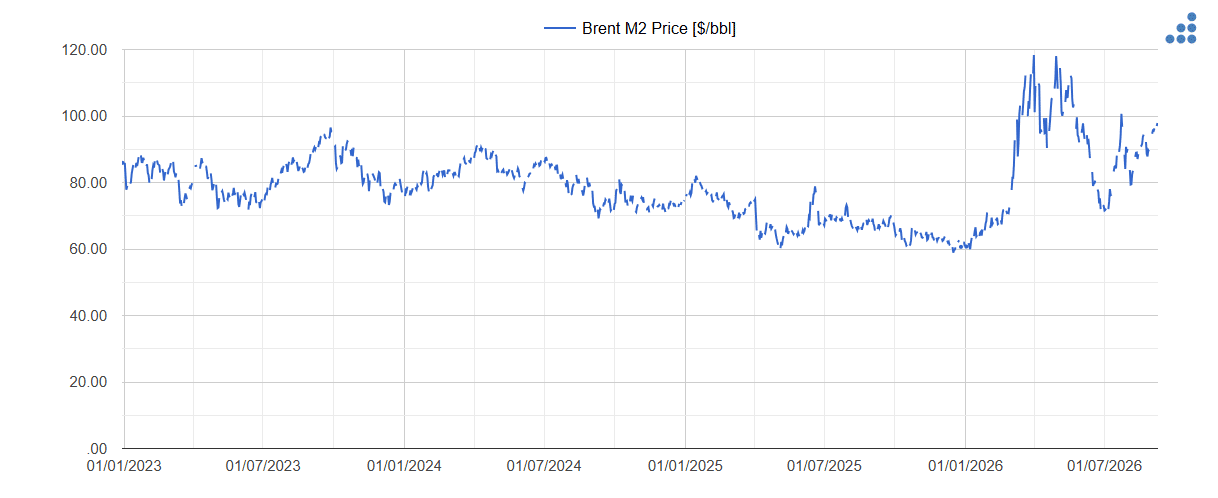 Source: Brent oil futures for the Front‑Month on the ICE Market available in Alea Energy DataBase.
Futures maintain the risk of a winter with high prices
The trend of recent days reinforces the scenario of high energy prices heading into next winter. Futures currently incorporate a significant risk premium linked to geopolitics, storage levels and the availability of LNG.
However, current futures prices should not be interpreted as a forecast that these levels will necessarily hold throughout the winter. A reduction in geopolitical tensions, a recovery in LNG flows or mild temperatures could quickly ease part of the risk premium. Conversely, new supply disruptions or a cold winter would keep pressure on gas and, by extension, on electricity prices in Europe.
This context again highlights the importance of combining the information provided by the futures curve with market forecasts and scenario analysis. For large consumers, retailers and electro-intensive companies, trying to wait for the lowest-price moment involves taking on market risk. A hedging strategy must define in advance what percentage of consumption to cover, over what horizon and what level of risk the company can take on.
The role of PPAs in a highly volatile environment
The rise in futures prices also has implications for PPAs. For renewable projects, higher price expectations can improve the reference levels used in negotiations, increase projected revenues and support bankability and the financing of renewable projects.
For consumers, PPAs are also a tool for reducing exposure to episodes of high volatility in energy markets and to provide visibility into part of long-term electricity costs. However, decisions on a contract that may run for ten or fifteen years should not be based solely on the exceptional situation of futures at a given moment.
Long-term forecasts to sustain bankability: the role of AleaGreen
The rebound in TTF gas and Brent confirms that geopolitics will remain a key driver of energy prices over the coming months. However, neither large consumers nor renewable developers should make hedging or financing decisions based solely on a snapshot of the markets at a given moment.
Current levels reinforce the importance of using long-term forecasts and different scenarios to correctly value a PPA. The geopolitical risk premium may ease, while other structural factors, such as growth in renewable generation, energy storage, interconnections and the evolution of electricity demand, will determine prices over the life of the contract.
AleaGreen, the division of AleaSoft Energy Forecasting specialising in energy forecasts for the long term, produces price curves for the electricity and gas markets with horizons of up to 40 years, together with sensitivity analysis incorporating different assumptions on geopolitics, LNG availability and renewable growth. This information allows developers, investors, banks and funds to support the bankability of projects without depending on the short-term, point-in-time situation of futures.
Source: AleaSoft Energy Forecasting